Creality WiFi Takes On Octoprint

A very common hack to a 3D printer is to connect a Raspberry Pi to your printer and then load Octoprint or a similar program and send your files to the printer via the network. [Teaching Tech] noticed that Creality now has an inexpensive WiFi interface that promises to replace Octoprint and decided to give it a quick review.

You might wonder why you’d want this system when Octoprint exists? Mainly, the value proposition is the price. You can buy the Creality box for about $20. A Raspberry Pi with a similar case would be at least twice that price. In addition, the box integrates with a Thingiverse-like library and does cloud slicing, which is attractive when you have a very small computer connected to your printer.

However, [Teaching Tech] found some issues. The box was pretty picky about connecting to printers and there were many other problems. The 3D model library wasn’t very comprehensive, although that could change if the thing got very popular. Worse, the slicer didn’t really produce stellar results.

We have to admit, an attractive network interface for $20 would be of interest. But it is hard to see how this would be a better value than Octoprint unless you were very short on cash and had no Raspberry Pi surplus laying around. You still need an SD card and a power supply, so those extras are a wash.

On the other hand, if Creality fixes the problems and expands the 3D model library, we’d buy one. But it remains to be seen if either of those things will happen, much less both of them. We do wish [Teaching Tech] had opened the thing up for us. Maybe next time.
Continue reading “Creality WiFi Takes On Octoprint”

Can You Use An Easy-Bake Oven For Reflow Soldering?

The answer is yes, yes you can. As long as you have one made after about 2011, at least. In the video after the break, [Blitz City DIY] takes us briefly through the history of the venerable Easy-Bake Oven and into the future by reflow soldering a handful of small blinky boards with it.

You’re right, these things once used special light bulbs to cook pint-sized foods, but now they are legit ovens with heating elements that reach 350°F and a little above. The only trouble is that there’s no temperature controller, so you have to use low-temperature solder paste and an oven thermometer to know when to pull the little tray out. Other than that, it looked like smooth sailing.

If you’re only doing a board every once in a while, $40 for a reflow oven isn’t too shabby. And yeah, as with all ovens, once you’ve reflowed a board in it, don’t use it for food.

If you’d rather build an oven, high-powered light bulbs will still do the trick.

Continue reading “Can You Use An Easy-Bake Oven For Reflow Soldering?”

IRC Over LoRa, For When Things Really Go South

As a society, we’ve become accustomed to always-on high-speed data connections, whether we’re at home on the computer or out and about with a mobile device. But what happens if a natural disaster knocks out the local infrastructure? Sure some people will be able to fire up their radio if they need to reach out and touch someone, but even among hackers, hams are a minority. What we really need is a backup Internet.

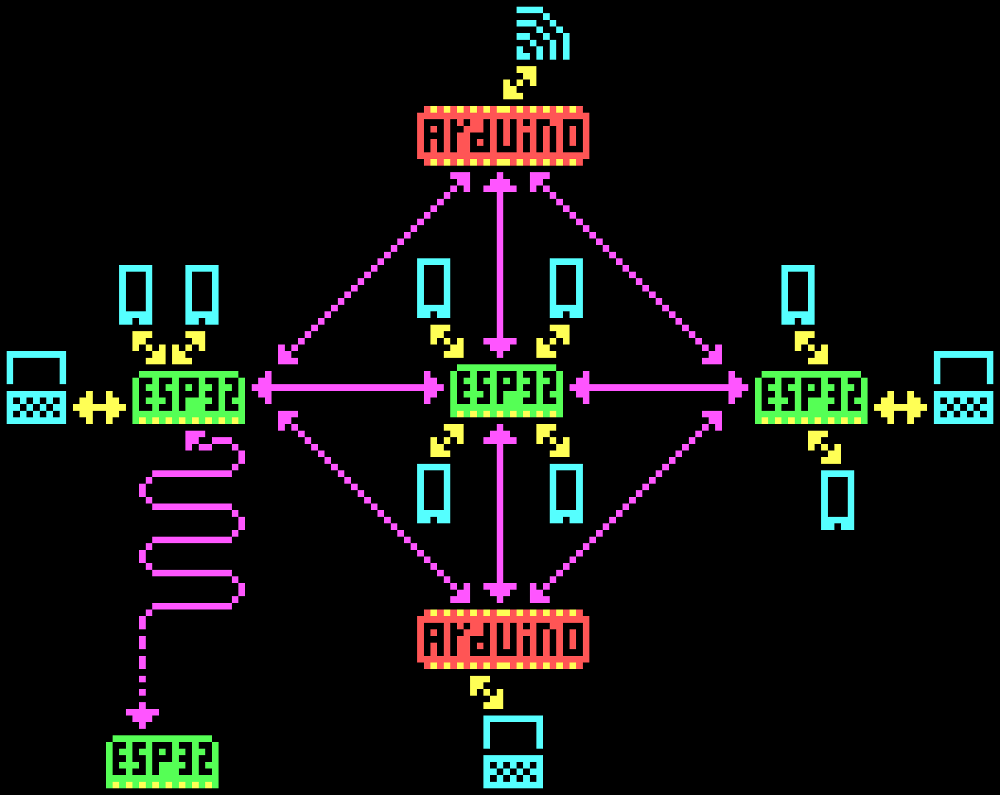
The team behind the CellSol project hopes to show that building a volunteer-operated distributed communications network is not only within the capabilities of the hacker community but probably much easier and cheaper to do than you might think. Each node in the network, known as a Pylon in CellSol parlance, can shuttle data between the LoRa backbone and WiFi-enabled devices like smartphones and computers. Once the network is up and running, users don’t need any special hardware or software to use it.

Now to be clear, nobody is talking about surfing the web here. When a user connects to one of the ESP32 Pylons, they’ll be able to access a simplistic chat system through their browser. If the Pylon has an active Internet connection the chat can be bridged to an IRC channel. Without Internet connectivity, the pylon will simply give users on the CellSol network a means to communicate among each other. To keep things simple there’s no user names, private messages, or encryption. This is bare-bones, end-of-the-world style communication.

Want to join the CellSol revolution? All you really need is an ESP32, a LoRa radio, and the open-source firmware. If you get something like the Heltec LoRa 32 development board, you don’t even need to solder anything together. Just flash the board and go. Once you have a few Pylons going, you can also put together a cheap repeater node using a LoRa equipped Arduino. Both devices are small and energy efficient enough that they could easily be battery or solar powered. As you can see in the video after the break, the team even envisions a future where they could be dropped off in public areas via drone.

This isn’t the first time we’ve seen the ESP32 used to establish an off-grid LoRa communications network, and like those previous attempts, it’s usefulness will largely depend on how many people you can convince to set up their own nodes and repeaters. But if you’ve got some open minded friends who live relatively close by, this could be a great way to have a little chat.

Continue reading “IRC Over LoRa, For When Things Really Go South”

A Beeping Toy Helps A Blind Dog Play Fetch

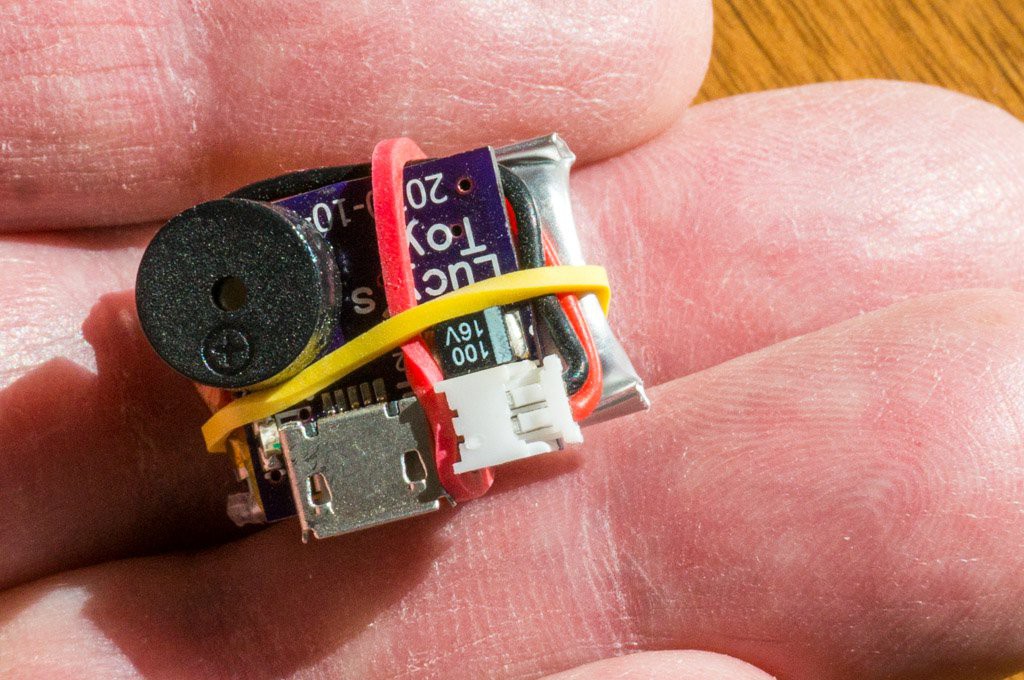
When a beloved pet goes blind, it doesn’t mean they can’t or don’t want to play fetch anymore, only that the game must change a bit. [Bud Bennett]’s dog Lucy has slowly lost her sight to progressive renal atrophy but is still up for playing with toys, so [Bud] decided to make a beeper that can go inside various stuffed toys to help Lucy locate them. Lucy doesn’t care for commercial toys that chime constantly, especially once she’s got it in her mouth.

This tiny package is centered around an LIS3DH accelerometer and programmed with a PIC16F18313. When the toy is thrown up in the air, the accelerometer determines that it’s in free fall and triggers an interrupt on the PIC. The piezo buzzer starts beeping so Lucy can find it, then stops a short while later and waits for the next free fall. The power dissipation is so low that [Bud] expects to charge the 120 mAh LiPo battery about once a year.

We bet that communication between [Bud] and Lucy is already pretty good, but maybe she could be more expressive with a doggy soundboard.

Homebuilt Racing Sim Does Almost Everything From Scratch

If you desire a sim gaming rig, there are off-the-shelf options up and down the market that stretch as high as your budget can afford. Some choose to eschew this route, however and build their own from scratch. Few people go quite so far as [Popicasa POPStuDio], however.

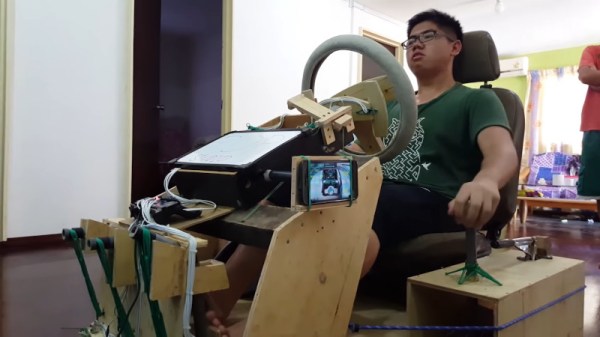
The first version of the rig is about as hacked as you can possibly get, and it’s a joy to see it built from scrap. The wheel itself and the pedals are all built out of old PVC pipe, with a bunch of old wood screwed together for the frame. A cheap USB gamepad serves to handle input to the PC for the pedals and H-shifter. The H-shifter uses simple power switches, repurposed in an ingenious way to sense gear position. The knob itself is cast out of what appears to be hot glue. Steering is done by connecting the wheel to a flexible shaft that tips a smartphone back and forth, using its internal accelerometers and gyros to sense rotation. It’s not clear how this is tied into the PC running Project CARS, but it’s impressive nonetheless.

Version 2 of the build takes things up a notch, using an Arduino Leonardo to handle steering and pedal functions as a Human Interface Device. There’s also force feedback, via a hefty motor attached to the steering shaft via a belt drive. This version implements an H-shifter as well as paddle shifters too for a more modern experience.

Both builds are unique in the modern era for eschewing CNC or 3D printed parts. It’s all done by hand, taking days of effort, and using only basic tools. It’s refreshing to see such a complex build done with nothing but simple materials and sheer commitment. We’re sure [Popicasa POPStuDio] enjoys the rig, and we can’t wait to see where it goes next. Perhaps the next iteration will even feature a motion platform, perhaps built out of old forklift parts? Only time will tell. Video after the break.

Continue reading “Homebuilt Racing Sim Does Almost Everything From Scratch”

Hacker’s Discovery Changes Understanding Of The Antikythera Mechanism

With all the trained academics who have pored over the Antikythera mechanism in the 120 years since it was pulled from the Mediterranean Sea, you’d think all of the features of the ancient analog computer would have been discovered by now. But the mechanism still holds secrets, some of which can only be appreciated by someone in tune with the original maker of the device. At least that what appears to have happened with the recent discovery of a hitherto unknown lunar calendar in the Antikythera mechanism. (Video, embedded below.)

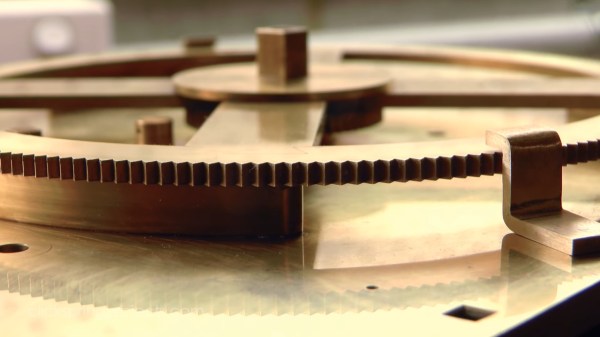
The Antikythera mechanism is fascinating in its own right, but the real treat here is that this discovery comes from one of our own community — [Chris] at Clickspring, maker of amazing clocks and other mechanical works of art. When he undertook a reproduction of the Antikythera mechanism using nothing but period-correct materials and tools four years ago, he had no idea that the effort would take the direction it has. The video below — also on Vimeo — sums up the serendipitous discovery, which is based on the unusual number of divisions etched into one of the rings of the mechanisms. Scholars had dismissed this as a mistake, but having walked a mile in the shoes of the mechanism’s creator, [Chris] knew better.

The craftsmanship and ingenuity evidenced in the original led [Chris] and his collaborators to the conclusion that the calendar ring is actually a 354-day calendar that reflects a lunar cycle rather than a solar cycle. The findings are summarized in a scholarly paper in the Horological Journal. Getting a paper accepted in a peer-reviewed journal is no mean feat, so hats off to the authors for not only finding this long-lost feature of the Antikythera mechanism and figuring out its significance, but also for persisting through the writing and publication process while putting other projects on hold. Clickspring fans have extra reason to rejoice, too — more videos are now on the way!

Continue reading “Hacker’s Discovery Changes Understanding Of The Antikythera Mechanism”

Giving Blind Runners Independence With AI

Being able to see, move, and exercise independently is something most of us take for granted. [Thomas Panek] was an avid runner before losing his sight due to a genetic condition, and had to rely on other humans and guide dogs to run again. After challenging attendants at a Google hackathon, Project Guideline was established to give blind runners (or walkers) independence from a cane, dog or another human, while exercising outdoors. Using a smartphone with line following AI software, and bone conduction headphones, users can be guided along a path with a line painted on it. You need to watch the video below to get a taste of just how incredible it is for the users.

Getting a wheeled robot to follow a line is relatively simple, but a running human is by no means a stable sensor platform. At the previously mentioned hackathon, developers put together a rough proof of concept with a smartphone, using its camera to recognize a painted line on the ground and provide left/right audio cues.  As the project developed, the smartphone was attached to a waist belt and bone conduction headphones were used,  which don’t affect audio situational awareness as much as normal headphones.

The shaking and side to side movement of running, and varying light conditions and visual obstructions in the outdoors made the problem more difficult to solve, but within a year the developers had completed successful running tests with [Thomas] on a well-lit indoor track and an outdoor pedestrian path with a temporary line. For the first time in 25 years, [Thomas] was able to run independently.

While guide dogs have proven effective for both daily life and running, they cost approximately $60000 over an average working life of 8 years, putting them out of reach of many sight-impaired people around the world. Project Guideline is still in the early stages, and real-world problems like obstacles and traffic still need to be addressed, but there is massive potential.

Continue reading “Giving Blind Runners Independence With AI”