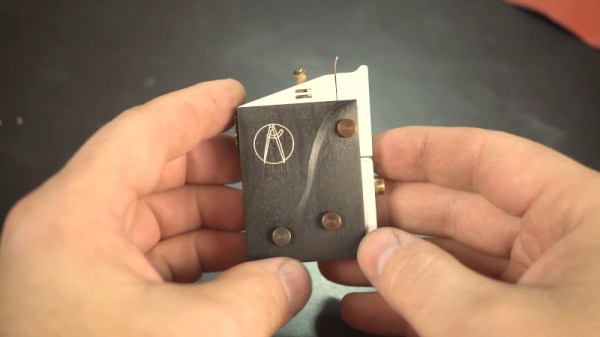
Hackaday Podcast 082: DJ CNC, NFC Black Box, Sound Of Keys, And Payin’ For 3D Prints

Hackaday editors Elliot Williams and Mike Szczys check in on the best hacks from the past week. All the buzz is the algorithm that can reverse engineer your house keys from the way they sound going into the lock. Cardboard construction goes extreme with an RC car build that’s beyond wizard-level. Speaking of junk builds, there’s a CNC mill tipped on its side grinding out results worlds better than you expect from something made with salvaged CD-ROM drives. And a starburst character display is a clever combination of laser cutting and alternative using UV-cured resin as a diffuser.

Take a look at the links below if you want to follow along, and as always, tell us what you think about this episode in the comments!

Take a look at the links below if you want to follow along, and as always, tell us what you think about this episode in the comments!

Direct download (60 MB or so.)

Continue reading “Hackaday Podcast 082: DJ CNC, NFC Black Box, Sound Of Keys, And Payin’ For 3D Prints”

Creating Kelvin Test Leads For Four-Wire Measurments

[VoltLog] has a cheap Hantek LCR meter, but it only has two probes. The best resistance and impedance measurements, though, use four wires to improve accuracy. The first order of business was a custom PCB to fit into the connector of the meter, along with a 3D-printed case.

Using a four-wire scheme requires unusual alligator clips that don’t electrical short the jaws together. The clips were hard to solder and even harder to strain relief. but [VoltLog] seemed to handle it with little problem.

Continue reading “Creating Kelvin Test Leads For Four-Wire Measurments”

This Week In Security: XCode Infections, Freepik, And Crypto Fails

There is a scenario that keep security gurus up at night: Malware that can detect software compilation and insert itself into the resulting binary. A new Mac malware, XCSSET (PDF), does just that, running whenever Xcode is used to build an application. Not only is there the danger of compiled apps being malicious, the malware also collects data from the developer’s machine. It seems that the malware spreads through infected Xcode projects.

WordPress Plugins

WordPress has a complicated security track record. The core project has had very few serious vulnerabilities over the years. On the other hand, WordPress sites are routinely compromised. How? Generally through vulnerable plugins. Case in point? Advanced Access Manager. It’s a third party WordPress plugin with an estimate 100,000 installations. The problem is that this plugin requires user levels, a deprecated and removed WordPress feature. The missing feature had some unexpected results, like allowing any user to request administrator privileges.

The issue has been fixed in 6.6.2 of the plugin, so if you happen to run the Advanced Access Manager plugin, make sure to get it updated. Beyond that, maybe it’s time to do an audit on your WordPress site. Uninstall unused plugins, and make sure the rest are up to date, along with the WordPress installation itself. Continue reading “This Week In Security: XCode Infections, Freepik, And Crypto Fails”

Open Hardware Laptop Built On Power PC ISA

Since Apple switched to Intel chips in the mid-00s, the PowerPC chips from Motorola and the PowerPC Instruction Set Architecture (ISA) that they had been using largely fell by the wayside. While true that niche applications like supercomputing still use the Power ISA on other non-Apple hardware, the days of personal computing with PowerPC are largely gone unless you’re still desperately trying to keep your Power Mac G5 out of the landfill or replaying Twilight Princess. Luckily for enthusiasts, though, the Power ISA is now open source and this group has been working on an open-source laptop based on this architecture.

While development is ongoing and there are no end-user products available yet, the progress that this group has made shows promise. They have completed their PCB designs and schematics and have a working bill of materials, including a chassis from Slimbook. There are also prototypes with a T2080RDB development kit and a NXP T2080 processor, although they aren’t running on their intended hardware yet. While still in the infancy, there are promising videos (linked below) which show the prototypes operating smoothly under the auspices of the Debian distribution that is tailored specifically for the Power ISA.

We are excited to see work continue on this project, as the Power ISA has a number of advantages over x86 in performance, ARM when considering that it’s non-proprietary, and even RISC-V since it is older and better understood. If you want a deeper comparison between all of these ISAs, our own [Maya Posch] covered that topic in detail as well as covered the original move that IBM made to open-source the Power ISA.

Continue reading “Open Hardware Laptop Built On Power PC ISA”

Over-Engineered Single Button Timer

Feature creep is typically something to be avoided, since watching a relatively simple project balloon into a rat’s nest of complexity often leads to ineffective, or even abandoned, projects. On the other hand, if you can maintain a tight focus, it’s not always a bad thing. [cbm80Amiga] shows us how to drill down and add specific features in this single-button timer without losing focus on what the original project was all about.

The timer is based on an Arduino Pro Mini and an HX1230 LCD with a simple piezo speaker for audible alerts. A single button controls operation of the timer, with short presses incrementing each digit and long presses moving on to the next digit. Controlling button presses this finely is a project in its own, but then [cbm80Amiga] moves on to other features such as backlight control, low power modes which allow it to operate for around two years on a single battery charge, preset times for various kitchen uses, and different appearance settings.

Honestly we aren’t sure how you could cram any more features on this timer without fundamentally altering the designed simplicity. It doesn’t fall into the abyss of feature creep while being packed with features, and it’s another example of how keeping things simple is often a recipe for success.

Thanks to [Hari] for the tip!

Continue reading “Over-Engineered Single Button Timer”

38 Years Later, The Atari 2600 Learns To Speak

Back in the early 1980s, there was a certain fad in making your computer produce something resembling human speech. There were several hardware solutions to this, adding voices to everything from automated telephone systems to video game consoles, all the way to Steve Jobs using the gimmick to introduce Macintosh to the world in 1984. In 1982, a software-based version of this synthesis was released for the Atari 8-bit line of computers, and ever since them [rossumur] has wondered whether or not it could run on the very constrained 2600.

Fast-forward 38 years and he found out that the answer was that yes, it was indeed possible to port a semblance of the original 1982 Software Automatic Mouth (or SAM) to run entirely on the Atari 2600, without any additional hardware. To be able to fit such a seemingly complicated piece of software into the paltry 128 bytes (yes, bytes) of RAM, [rossumur] actually uses an authoring tool in order to pre-calculate the allophones, and store only those in the ROM. This way, the 2600 alone can’t convert text to phonemes, but there’s enough space left for the allophones, which are converted into sound, that about two minutes of speech can fit into one cartridge. As for why he went through the trouble, we quote the author himself: “Because creating digital swears with 1982 speech synthesis technology on a 1977 game console is exactly what we need right now.”

For this project, [rossumur] has written an incredibly interesting article on speech synthesis in order to explain the SAM engine used here. And this isn’t his first time on the website either, always cramming software where it shouldn’t fit, such as a “Netflix”-like streaming service, or 8-bit console emulators, both on nothing but an ESP32 microcontroller. Check this one out in action after the break.

Continue reading “38 Years Later, The Atari 2600 Learns To Speak”

Cold Tube Draws The Heat

If you live anywhere near the tropics, air conditioning isn’t a luxury but a necessity. The problem however is that humid climates can cause conventional air conditioners to draw more power to dehumidify the air than it requires to just cool it, which increases the power needed to run the unit. Back in 1963, there was a proposal to create a cooling system that didn’t foster condensation and couple it with different methods of removing humidity. Researchers in Singapore have now created such a system. It uses a membrane that is permeable to infrared radiation but prevents condensation around the cooling unit.

You can see a video of the apparatus in a pavilion in the Singapore heat in the video below. Chilled water runs through tubes behind a membrane that passes thermal radiation. Since the tubes are not exposed to the ambient atmosphere, condensation is minimal. But heat radiates from the warmer area to the much colder area of the tubes.

Continue reading “Cold Tube Draws The Heat”