Listening To An IPhone With AM Radio

Electronic devices can be surprisingly leaky, often spraying out information for anyone close by to receive. [Docter Cube] has found another such leak, this time with the speakers in iPhones. While repairing an old AM radio and listening to a podcast on his iPhone, he discovered that the radio was receiving audio the from his iPhone when tuned to 950-970kHz.

[Docter Cube] states that he was able to receive the audio signal up to 20 feet away. A number of people responded to the tweet with video and test results from different phones. It appears that iPhones 7 to 10 are affected, and there is at least one report for a Motorola Android phone. The amplifier circuit of the speaker appears to be the most likely culprit, with some reports saying that the volume setting had a big impact. With the short range the security risk should be minor, although we would be interested to see the results of testing with higher gain antennas. It is also likely that the emission levels still fall within FCC Part 15 limits.
Continue reading “Listening To An IPhone With AM Radio”

Radon Monitor Recreates Steam Gauge With E-Ink

While the full steampunk aesthetic might be a bit much for most people, those antique gauges do have a certain charm about them. Unfortunately, implementing them on a modern project can be somewhat tricky. Even if you’ve got a stock of old gauges laying around, you’ve still got to modify the scale markings and figure out how to drive them with digital electronics. While we’ve seen plenty of people do it over the years, there’s no debating it’s a lot harder than just wiring up an I2C display.

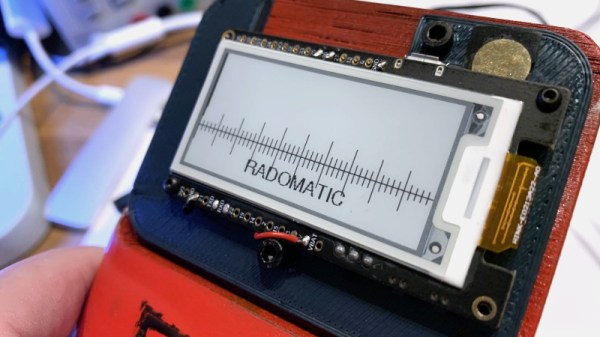
But maybe it doesn’t have to be. With his Rad-O-Matic, [Hans Jørgen Grimstad] created a pretty convincing “analog” gauge using a small e-ink panel. Of course it won’t fool anyone who gives it a close look, but at a glance, you could certainly be forgiven for thinking it was some kind of vintage indicator. Especially with the cracked and stained Fresnel lens he put in front of it.

For this project [Hans] used a LilyGo T5, which combines an ESP32 with a 2.13 inch electronic paper display. These are presumably meant to be development boards for digital signage applications, but they occasionally show up in hacker projects since they’re so easy to work with. The board pulls data from a RD200M radon sensor over a simple UART connection, and the current reading is indicated by a “needle” that moves across a horizontal scale on the display.

On its own, it wouldn’t look very vintage. In fact, quite the opposite. But [Hans] really helped sell the look on this project by designing and 3D printing a chunky enclosure and then weathering it to make it look like it’s been kicking around since the Cold War.

If you don’t feel like faking it, we’ve seen some very impressive projects based on authentic vintage gauges. As long as you don’t mind tearing up hardware that’s likely older than you are, putting in the extra effort necessary for a convincing modification can really pay off.

[Thanks to Tarjei for the tip.]

Closely Examining How A PG&E Transmission Line Claimed 85 Lives In The 2018 Camp Fire

In 2018, the Camp Fire devastated a huge swathe of California, claiming 85 lives and costing 16.65 billion dollars. Measured in terms of insured losses, it was the most expensive natural disaster of the year, and the 13th deadliest wildfire in recorded history.

The cause of the fire was determined to be a single failed component on an electrical transmission tower, causing a short circuit and throwing sparks into the dry brush below – with predictable results. The story behind the failure was the focus of a Twitter thread by [Tube Time] this week, who did an incredible job of illuminating the material evidence that shows how the disaster came to be, and how it could have been avoided.

Mismanagement and Money

The blame for the incident has been laid at the feet of Pacific Gas and Electric, or PG&E, who acquired the existing Caribou-Palermo transmission line when it purchased Great Western Power Company back in 1930. The line was originally built in 1921, making the transmission line 97 years old at the time of the disaster. Despite owning the line for almost a full century, much of the original hardware was not replaced in the entire period of PG&Es ownership. Virtually no records were created or kept, and hardware from the early 20th century was still in service on the line in 2018.

Continue reading “Closely Examining How A PG&E Transmission Line Claimed 85 Lives In The 2018 Camp Fire”

Figuro Draws 3D In Browser

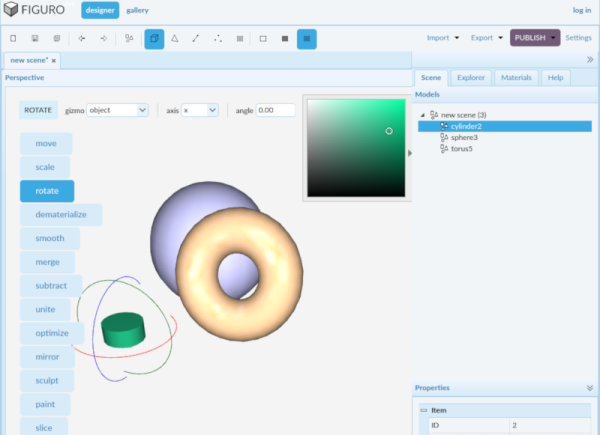
We would have never guessed there would be so many browser-based CAD packages. While TinkerCAD is great for simple things, there are also packages such as OnShape that rival commercial CAD programs. A site calle Figuro claims to occupy the space between TinkerCAD and Blender. We aren’t so sure, but it is an interesting entry into the field. Apparently, Figuro has been around for some time, but has recently had a major face lift. The new interface looks good, but it has invalidated a number of video tutorials on their YouTube channel.

One of the things we like about TinkerCAD is it is highly discoverable. That is, you can fire it up, play with it a bit, and probably do quite a few things. Maybe it is just us, but Figuro didn’t give us the same experience. It is easy enough to draw simple shapes. But trying to multiselect was unreliable. Panning and rotating the view was very sensitive too, so we found we were occasionally lost in the work view with no easy way to reset the view. Even something as simple as subtracting one shape from another was painful.

Continue reading “Figuro Draws 3D In Browser”

Vacuum Dragster Uses Syringes For Propulsion

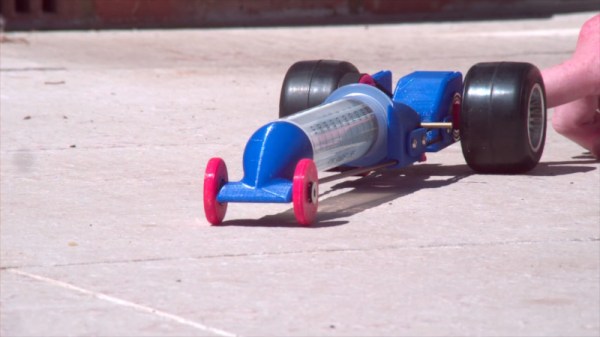
Atmospheric pressure is all around us, and capable of providing a great deal of force when used properly. As Otto Von Guericke demonstrated with his Magdeburg hemispheres over 350 years ago, simply removing air from a chamber to create a vacuum can have astounding results. More recently, [Tom Stanton] has used vacuum to power a small 3D-printed dragster.

In the dragster build, a typical plunger syringe is plugged at the end, and the plunger pulled back. Atmospheric pressure acts against the vacuum, wanting to push the plunger back towards its original position. To make use of this, a string is attached to the plunger, causing it to turn a gear as it moves forward, driving the rear wheels through a belt drive. With the correct gear ratio on the belt drive, the dragster is capable of spinning its tires and shooting forwards at a quick pace.

The work is a great follow on from [Tom]’s earlier vacuum experiments, using syringes as small rockets.  It reminds us of the classic CO2 dragsters from high school competitions, and would be a great project for any science class. Video after the break.

Continue reading “Vacuum Dragster Uses Syringes For Propulsion”

Mirror Turns Webcam Into Document Camera

This is one of those so-simple-I-wish-I-invented-it hacks. Professor [Michael Peshkin] is teaching his engineering students remotely. While he has a nice second camera that he can use to transmit whatever he doodles on paper, most of his students just have the single webcam built into their laptops.

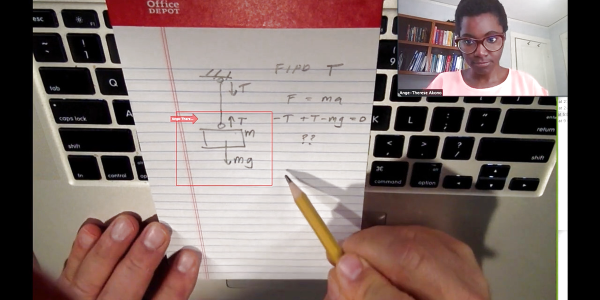
The solution is to put a mirror in front of the laptop cam, and flip the image left-to-right in software. They use Zoom, which has a mirror mode. Done.

The trick is making a nice frame. [Michael] has bent one out of wire, but suggests that a mirror compact works about as well in a pinch. It’s super important that his students can ask him questions backed up by drawings, and this reduces the startup cost to nearly nothing, making it universally useful.

[Prof. Peshkin] is not a stranger to mirror-based pedagogical hacks. Seven years ago, he showed us how to make a transparent whiteboard for video lectures, and it blew up on Hackaday. Since then, there are hundreds or thousands of Lightboards in the wild. We hope this idea catches on as well!

Into The Belly Of The Beast With Placemon

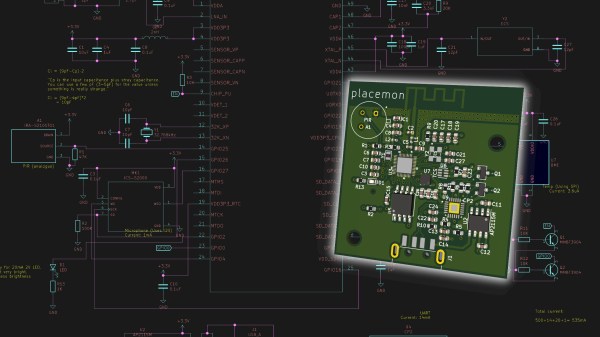
No, no, at first we thought it was a Pokemon too, but Placemon monitors your place, your home, your domicile. Instead of a purpose-built device, like a CO detector or a burglar alarm, this is a generalized monitor that streams data to a central processor where machine learning algorithms notify you if something is awry. In a way, it is like a guard dog who texts you if your place is unusually cold, on fire, unlawfully occupied, or underwater.

[anfractuosity] is trying to make a hacker-friendly version based on inspiration from a scientific paper about general-purpose sensing, which will have less expensive components but will lose accuracy. For example, the article suggests thermopile arrays, like low-resolution heat-vision, but Placemon will have a thermometer, which seems like a prudent starting place.

The PCB is ready to start collecting sound, temperature, humidity, barometric pressure, illumination, and passive IR then report that telemetry via an onboard ESP32 using Wifi. A box utilizing Tensorflow receives the data from any number of locations and is training to recognize a few everyday household events’ sensor signatures. Training starts with events that are easy to repeat, like kitchen sounds and appliance operations. From there, [anfractuosity] hopes that he will be versed enough to teach it new sounds, so if a pet gets added to the mix, it doesn’t assume there is an avalanche every time Fluffy needs to go to the bathroom.

We have another outstanding example of sensing household events without directly interfacing with an appliance, and bringing a sensor suite to your car might be up your alley.