Books You Should Read: The Boy Who Harnessed The Wind

For many of us, our passion for electronics and science originated with curiosity about some device, a computer, radio, or even a car. The subject of this book has just such an origin. However, how many of us made this discovery and pursued this path during times of hunger or outright famine?

That’s the remarkable story of William Kamkwamba that’s told in the book, The Boy Who Harnessed the Wind. Remarkable because it culminates with his building a windmill (more correctly called a wind turbine) that powered lights in his family’s house all by the young age of fifteen. As you’ll see, it’s also the story of an unyielding thirst for knowledge in the face of famine and doubt by others.

Continue reading “Books You Should Read: The Boy Who Harnessed The Wind”

How Much Is That Plotter In The Window?

We live in a strange time indeed. People who once eschewed direct interactions with fellow humans now crave it, but to limited avail. Almost every cashier at the few stores deigned essential enough to maintain operations are sealed away behind plastic shields, with the implication that the less time one spends lingering, the better. It’s enough to turn an introvert into an extrovert, at least until the barriers are gone.

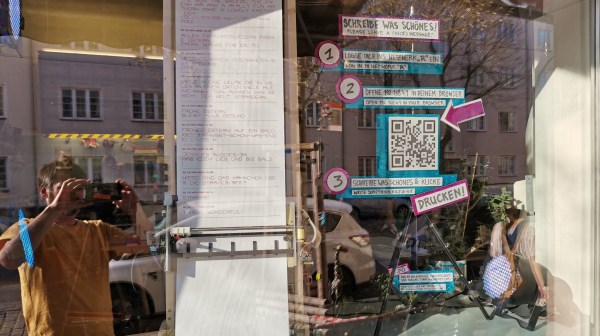
We get the idea that the need to reach out and touch someone is behind [Niklas Roy]’s “Please Leave a Message”, an interactive art installation he set up in the front window of his Berlin shop. Conveniently located on a downtown street, his shop is perfectly positioned to attract foot traffic, and his display is designed to catch the eye and perhaps crack a smile. The device consists of a large wooden easel holding the guts from an old X-Y pen plotter, an Arduino and an ESP-8266, and a couple of drivers for the plotter’s steppers. Passers-by are encouraged to scan a QR code that accesses a web page served up by the ESP-8266, where they can type in a brief message. The plotter dutifully spells it out on a scroll of paper for all to see, using a very nice font that [Niklas] designed to be both readable and easily plotted. The video below shows it in action with real people; it seems to be a crowd-pleaser.

[Niklas] has been incredibly prolific, and we’ve covered many of his interactive art installations. Just search for his name and you’ll find everything from a pressure-washer dancing waters display to a plus-sized pinball machine.

Continue reading “How Much Is That Plotter In The Window?”

Crunching Giant Data From The Large Hadron Collider

Modern physics experiments are often complex, ambitious, and costly. The times where scientific progress could be made by conducting a small tabletop experiment in your lab are mostly over. Especially, in fields like astrophysics or particle physics, you need huge telescopes, expensive satellite missions, or giant colliders run by international collaborations with hundreds or thousands of participants. To drive this point home: the largest machine ever built by humankind is the Large Hadron Collider (LHC). You won’t be surprised to hear that even just managing the data it produces is a super-sized task.

Since its start in 2008, the LHC at CERN has received several upgrades to stay at the cutting edge of technology. Currently, the machine is in its second long shutdown and being prepared to restart in May 2021. One of the improvements of Run 3 will be to deliver particle collisions at a higher rate, quantified by the so-called luminosity. This enables experiments to gather more statistics and to better study rare processes. At the end of 2024, the LHC will be upgraded to the High-Luminosity LHC which will deliver an increased luminosity by up to a factor of 10 beyond the LHC’s original design value.

Currently, the major experiments ALICE, ATLAS, CMS, and LHCb are preparing themselves to cope with the expected data rates in the range of Terabytes per second. It is a perfect time to look into more detail at the data acquisition, storage, and analysis of modern high-energy physics experiments. Continue reading “Crunching Giant Data From The Large Hadron Collider”

Fusing Plastic Sheets With A 3D Printer (Sort Of)

If you want to experiment with pneumatic devices, you’ll likely find yourself in need of custom inflatable bladders eventually. These can be made in arbitrary 2D shapes by using a soldering iron to fuse the edges of two plastic sheets together, but it’s obviously a pretty tedious and finicky process. Now, if only there was some widely available machine that had the ability to accurately apply heat and pressure over a large surface…

Realizing his 3D printer had all the makings of an ideal bladder fusing machine, [Koppany Horvath] recently performed some fascinating experiments to test this concept out in the real-world. Ultimately he considers the attempt to be a failure, but we think he might be being a bit too hard on himself. While he didn’t get the sheets to fuse hard enough to resist being pulled apart by hand, we think he’s definitely on the right track and would love to see more research into this approach.
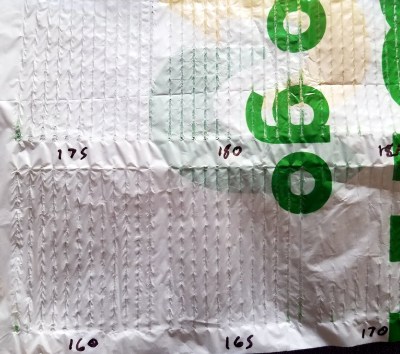
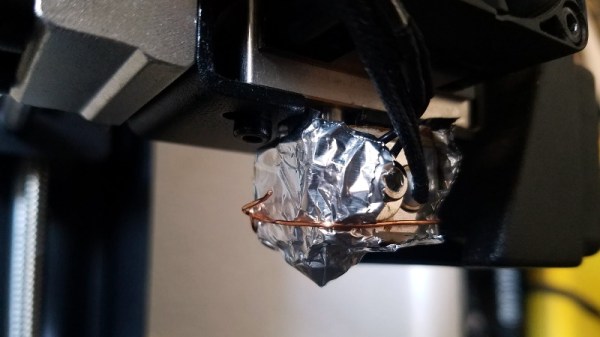
For these early tests, [Koppany] wrapped the hotend of his Monoprice Maker Select Plus with some aluminum foil, and covered the bed with a piece of cardboard. Stretched over this were two sheets of plastic, approximately 0.5 mil in thickness. Specifically, he used pieces cut from the bags that his favorite sandwiches come in; but we imagine you could swap it out for whatever bag your takeout of choice is conveyed in, assuming it’s of a similar thickness anyway.

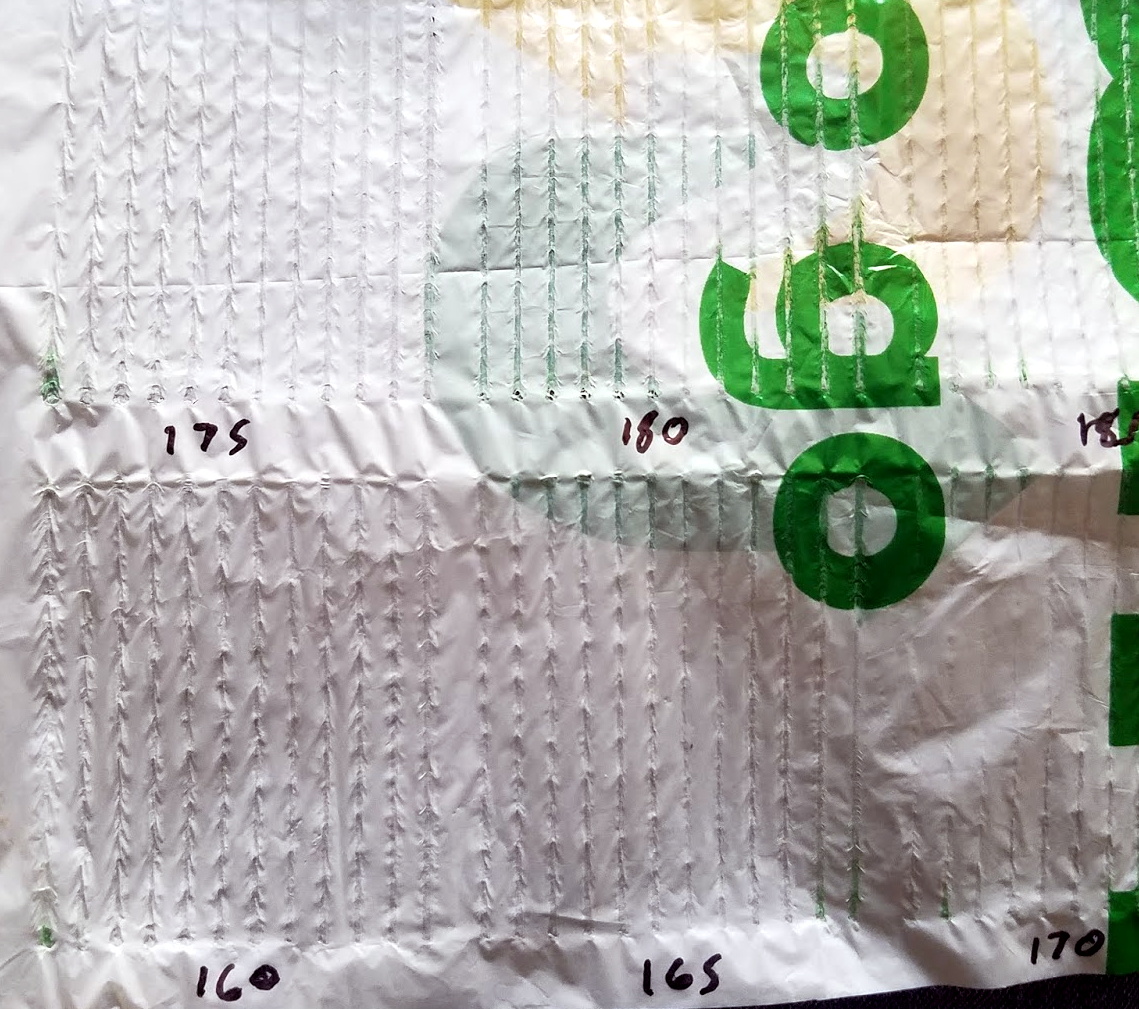
There were problems getting the plastic pulled tight enough, but that was mostly solved with the strategic placement of binder clips and a cardboard frame. Once everything was in place, [Koppany] wrote a Python script that commanded the printer to drag the hotend over the plastic at various speeds while simultaneously adjusting the temperature. The goal was to identify the precise combination of these variables that would fuse the sheets of plastic together without damaging them.

In the end, his biggest takeaway (no pun intended) was that the plastic he was using probably isn’t the ideal material for this kind of process. While he got some decent seams at around 180 °C , the thin plastic had a strong tendency towards bunching up. Though he also thinks that a convex brass probe inserted into the hotend could help, as it would smooth the plastic while applying heat.

We’ve already seen some very promising results when using LDPE film in a CO2 laser cutter, but if a entry-level 3D printer could be modified to produce similar results, it could be a real game changer for folks experimenting with soft robotics.


TEMPEST Comes To GNU Radio

As we use our computers, to watch YouTube videos of trucks hitting bridges, to have a Zoom call with our mothers, or even for some of us to write Hackaday articles, we’re unknowingly sharing a lot of what we are doing with the world. The RF emissions from our monitors, keyboards, and other peripherals can be harvested and reconstructed to give a third party a view into your work, and potentially have access to all your darkest secrets.  It’s a technique with origins in Government agencies that would no doubt prefer to remain anonymous, but for a while now it has been available to all through the magic of software defined radio. Now it has reached the popular GNU Radio platform, with [Federico La Rocca]’s gr-tempest package.

He describes it as a re-implementation of [Martin Marinov]’s TempestSDR, which has a reputation as not being for the faint-hearted. The current version requires GNU Radio 3.7, but he promises a 3.8-compatible version in the works. A YouTube video that we’ve placed below the break has a range of examples running, though there seems to be little information on the type of antenna employed. Perhaps a log-periodic design would be most appropriate.

Continue reading “TEMPEST Comes To GNU Radio”

Quality Upgrades Give Old Synth New Lease On Life

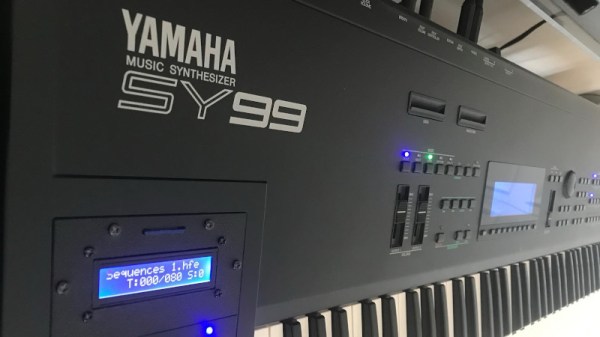
Technology marches on at a rapid pace, but in many fields much love remains for older hardware. While still highly capable, there’s often room for improvement thanks to components made available in the intervening years. After longing for his SY-77 synthesiser of the 90s, [Mark] sourced a tired SY-99, the next model up in the line – and set to work on some upgrades.

The SY-99 relied on floppy disks for storage, but the mechanical drives are now difficult to maintain, to say nothing of the unreliability of floppy media. [Mark] installed a SD Card HXC floppy emulator instead, using a Sparkfun SD breakout to neatly install the card slot in the synth’s case. The tired LCD was replaced with a newer model using the same controller, with an LED backlight proving a nice upgrade over the original EL unit.

Additionally, [Mark] realised that there was scope to create his own upgrade modules with off-the-shelf SRAM chips. This proves far cheaper than sourcing second-hand Yamaha stock off eBay, and is readily achievable by anyone with a basic understanding of digital logic. The ICs can be had for a few dollars, versus well over $50 for the original cards – if you can even find them. Some labor is involved, but it’s a lot less painful to the wallet.

[Mark]’s work is a great example of how hardware that was once prohibitively expensive can be given greater functionality at a lower cost thanks to new technology. We’ve seen other synths modded too, like this Korg Monotron. If you’ve been tinkering away in a keyboard yourself, be sure to let us know!

[Thanks to CRJEEA] for the tip]

Writing Android Apps In C, No Java Required

Older Android devices can be had for a song, and in many cases are still packing considerable computational power. With built in networking, a battery, and a big touch screen, they could easily take the place of a Raspberry Pi and external display in many applications. As it so happens, Google has made it very easy to develop your own Android software. There’s only one problem: you’ve got to do it in Java.

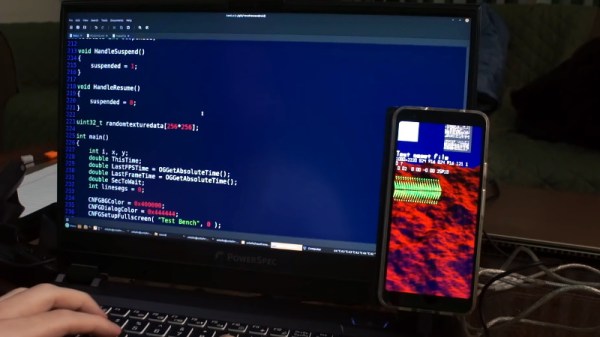
Looking to get away from all that bloat and overhead, [CNLohr] set out to see what it would take to get 100% C code running on an Android device. After collecting information and resources from the deepest and darkest corners of the Internet, he found out that the process actually wasn’t that bad. He’s crafted a makefile which can be used to get your own C program up and running in seconds.

We mean that literally. As demonstrated in the video after the break, [CNLohr] is able to compile, upload, and run a C Android program in less than two seconds with a single command. This rapid development cycle allows you to spend more time on actually getting work done, as you can iterate through versions of your code almost as quickly as if you were running them on your local machine.

[CNLohr] says you’ll still need to have Google’s Android Studio installed, so it’s not as if this is some clean room implementation. But once it’s installed, you can just call everything from his makefile and never have to interact with it directly. Even if you don’t have any problem with the official Android development tools, there’s certainly something to be said for being able to write a “Hello World” that doesn’t clock in at multiple-megabytes.

Continue reading “Writing Android Apps In C, No Java Required”