The Game That Launched 1,000 Hackers

John Conway passed away this week. Even if you don’t know much about mathematics, you will probably know nearly everyone’s favorite cellular automata ruleset: Conway’s “Game of Life”. It’s so much a part of our cultural history, that proto-hacker Eric Scott Raymond suggested using the glider as the hacker emblem.

The idea that a very simple set of rules, applied equally and everywhere, could result in “life” was influential in my growth as a young hacker, and judging from the comments on our article about Conway, I’m not alone. But I won’t lie: I was a kid and thought that it could do much more than make pretty patterns on the screen. I was both right and wrong.

Although amazingly complex machines can be built in Conway’s Life, just check out this video for proof, in the end no grand unifying theory of cellular automata has emerged. As a research topic Conway’s chosen field of mathematics, cellular automata is a backwater. It didn’t really go anywhere. Or did it?

Implementing Conway’s Life in BASIC on a Tandy Color Computer was one of the first things that launched me on my geeky path. It ranks with MENACE: the matchbox-based machine learning algorithm from the 1960’s and an introduction to Markov Chains in the form of a random text generator in my young algorithmic life, all of which I incidentally read about in Martin Gardner’s column in “Scientific American”. Conway’s Life, along with some dumb horse-race game, also taught me about bad random-number generators: the screen would populate the same “randomly” every time on the old CoCo.

So maybe Conway didn’t want to be remembered just for his “Life” because it was a bit of a mathematical dead-end. But in terms of its impact on the world, an entire generation of hackers, and my own personal life, it was able to fill up significantly more than a screen full of pixels. Here’s to Conway, his “Life”, and everyone else who is inspiring the next. You’re not just gliders, you’re glider guns!

This article is part of the Hackaday.com newsletter, delivered every seven days for each of the last 200+ weeks. It also includes our favorite articles from the last seven days that you can see on the web version of the newsletter.

Want this type of article to hit your inbox every Friday morning? You should sign up!

[Game of Life example shown in this article is John Conway’s Game of Life – 1.0 written in Python by Nick Jarvis and Nick Wayne]

Get Back Out There, Robotically

When interacting with reality at a distance is the best course of action, we turn to robots. Whether that’s exploring the surface of Venus, the depths of the ocean, or (for the time being) society at large, it’s often better to put a robot out there than an actual human being. We can’t all send robots to other planets, but we can easily get them in various other places with telepresence robots.

This tiny telepresence robot comes to us from [Ross] at [Crafty Robot] who is using their small Smartibot platform as a basis for this tiny robot. The smartibot drives an easily-created cardboard platform, complete with wheels, and trucks around a smartphone of some sort which handles the video and network capabilities. The robot can be viewed and controlled from any other computer using a suite of web applications that can be found on the project page.

The Smartibot platform is an inexpensive platform that we’ve seen do other things like drive an airship, and the creators are hoping that as many people as possible can get some use out of this quick-and-easy telepresence robot if they really need something like this right now. The kit seems like it would be useful for a lot of other fun projects as well.

Continue reading “Get Back Out There, Robotically”

Mathematical Proof The Eagle In The USPS Logo Is FAST!

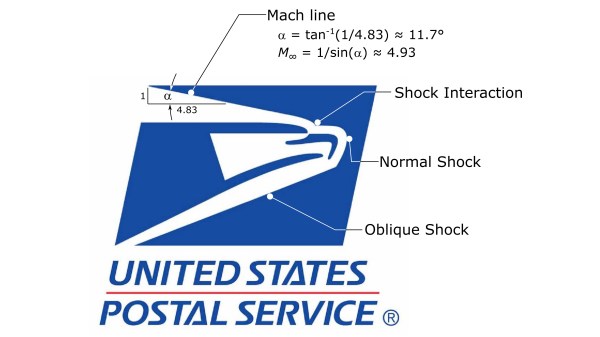
The logo for the United States Postal Service is a mean-looking eagle. But a true fluid dynamics geek might look at it and realize that eagle is moving so fast it’s causing a shock wave. But just how fast is it moving? [Andrew Higgins] asked and answered this question, posting his analysis of the logo’s supersonic travel. He claims it’s Mach 4.9, but, how do we know? Science!

It turns out if something is going fast enough, you can tell just how fast with a simple picture! We’ve all seen pictures of jets breaking the sound barrier, this gives us information about the jet’s speed.

Mach Lines

How does it work?

Think about it like this: sound moves at roughly 330 m/s on Earth at sea level. If an object moves through air at that velocity, the air disturbances are transmitted as sound waves. If it’s moving faster than sound, those waves get distributed downstream, behind the moving object. The distance of these waves behind the moving object is dependent on the object’s speed.

This creates a line of these interactions known as a “Mach line.” Find the angle difference of the Mach line and the direction of travel and you have the “Mach angle” (denoted by α or µ).

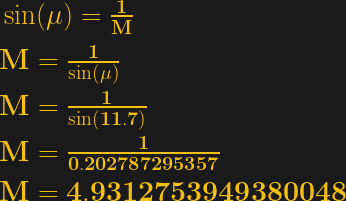
There is a simple formula for determining the speed of an object using the Mach angle, the speed of sound (a), and an object’s velocity (v): sin(µ) = a / v.  The ratio of to a is known as the Mach number, (M). If an object is going exactly the speed of sound, it’s going Mach 1 (because v = a).

Since Mach number (M) is v / a, we can plug it into the formula from above as 1 / M and use [Andrew]’s calculation shown in the image at the top of the article for a Mach angle (µ) of ~11.7°:

\bf \sin ( \mu ) = \frac{1}{M} \\ \\ M = \frac{1}{\sin(\mu)} \\ \\ M = \frac{1}{\sin(11.7)} \\ \\ M = \frac{1}{0.202787295357} \\ \\ M = 4.9312753949380048

The real question is, did the USPS chose Mach 4.93 as a hint to some secret government postal project? Or, was it simply a 1993 logo designer’s attempt to “capture the ethos of a modern era which continues today”?

Model Rocket Launcher Is So Serious, It Has A Briefcase

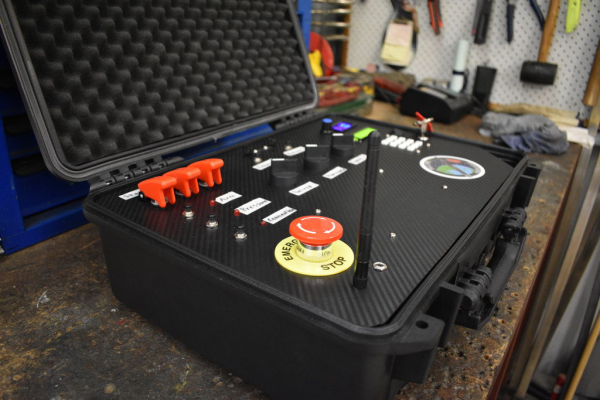
What could be more thrilling than launching a complex rocket that you built yourself? For starters, launching it with literally anything better than the stock ignition system would be a step in the right direction. How about a briefcase full of fantastically fun overkill?

[FastEddy59] is in the middle of building a model rocket complete with a Thrust Vector Control (TVC) system to help with stabilization. Much to our delight, he’s designed an equally ambitious controller to spice up the launch sequence with security codes and a physical key. And what’s a launch controller without a giant emergency stop button to shut down everything? Incomplete, if you ask us.

Under the carbon fiber-wrapped acrylic hood, there’s an Arduino MEGA engine and an NRF24 LoRa module for transmission to the rocket. There’s even a DHT11 temperature sensor to verify that launch conditions are ideal. It’s still a work in progress with plenty of features to come, like fancier labels and plenty of launch-appropriate sound files for the hidden speaker. There’s a lot to this case, and [FastEddy59]’s video brief is ready and waiting on the pad after the break.

[FastEddy59] plans to hold the first launch in a few months, and we sincerely hope he outfits the rocket with a camera.

Continue reading “Model Rocket Launcher Is So Serious, It Has A Briefcase”

’54 Motorcycle Saved By Electric Conversion

While it’s nice to be able to fully restore something vintage to its original glory, this is not always possible. There might not be replacement parts available, the economics of restoring it may not make sense, or the damage to parts of it might be too severe. [onyxmember] aka [Minimember Customs] was in this position with an old ’54 Puch Allstate motorcycle frame that he found with no engine, rusty fuel tank, and some other problems, so he did the next best thing to a full restoration. He converted it to electric.

This build uses as much of the original motorcycle frame as possible and [onyxmember] made the choice not to weld anything extra to it. The fuel tank was cut open and as much rust was cleaned from it as possible to make room for the motor controller and other electronics. A hub motor was laced to the rear wheel, and a modern horn and headlight were retrofitted into the original headlight casing. Besides the switches, throttle, and voltmeter, everything else looks original except, of course, the enormous 72V battery hanging off the frame where the engine used to be.

At a power consumption of somewhere between three and five kilowatts, [onyxmember] reports that this bike likely gets somewhere in the range of 55 mph, although he can’t know for sure because it doesn’t have a speedometer. It’s the best use of an old motorcycle frame we can think of, and we also like the ratrod look, but you don’t necessarily need to modify a classic bike for this. A regular dirt bike frame will do just fine.

Continue reading “’54 Motorcycle Saved By Electric Conversion”

RGB Kitchen Uses Pots To Stir Up Color

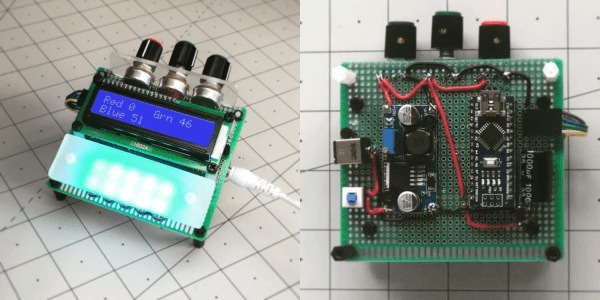
Anyone who has done anything with RGB LEDs knows that their ability to display pretty much any color is somehow both the best and worst thing about them. How do you get it right? How do you make your results repeatable? [Thomas] has the answer. He dug around in the ol’ parts cupboard, found a few pots, and got to work making this stay-home stew of a project — an on-demand RGB LED color mixer.

Three cleverly color-coded potentiometers and an Arduino let [Thomas] step through 0-255 to mix various values of red, blue, and green. The shade that gets made is displayed live on a set of 10 individual NeoPixels that are laid out under a frosty diffusing panel. Each of the RGB values are also shown on an 16×2 LCD.

This is one of those projects that hits a sweet spot of being simple, useful, and fun. It’s even nice-looking and compact. What more could you want from a project cobbled together from ingredients on hand? [Thomas] is even giving away the code recipe.

Once you dial in your ideal colors, why not make a gesture-controlled lamp?

Perfect Wire Hose Clamps With A Simple DIY Tool

Hose clamps have been around as long as we’ve been using flexible hoses. Usually, a clamp consists of a slotted metal strap, and a screw for tightening. Most of us know how quickly they slip when you want to add a bit more torque, or the frustration of not having the right size. Fortunately [Max Egorov] reminded us of DIY wire clamps (video after the break), an excellent alternative that is very effective, covers an infinite size range and is easy to make with a simple tool.

The wire clamp is in effect a doubled girth hitch, that is pulled tight with the ends bent over to keep the tension. [Max] shows you how to easily make your own clamper tool with basic tools and a few bits of steel. Making it as ornate as his one is definitely not required.  You can also buy a commercial tool that is sold under the name ClampTite, which uses a leadscrew type design.

To achieve a tight seal with a hose clamp, the main requirement is constant pressure around its entire circumference. These wire clamps do this very well and are popular among aircraft mechanics, since flying in a plane with a leaky coolant or fuel hose could shorten your lifespan a bit. [Max] also demonstrates a variety of other uses for these including fixing tool handles and even building a ladder.

We love simple but effective tools like this, and we’ll definitely be adding one to our toolbox. Have you used these before? Let us know in the comments!

There is (almost) never such a thing as too many tools, and making your own is very satisfying. We’ve seen people build an outfit a complete carpentry workshop using plywood, and build sheet metal press brake with no welding.

Thanks [Keith O] for the tip!

Continue reading “Perfect Wire Hose Clamps With A Simple DIY Tool”