3D Printed Train Whistles Sound Out At Full Scale

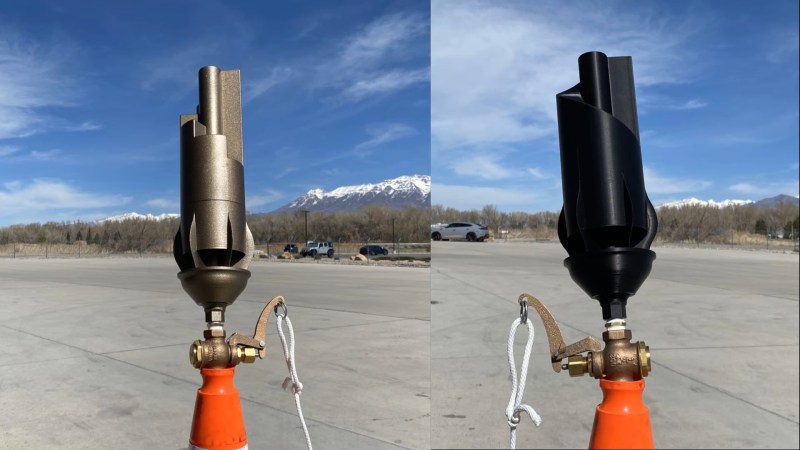
The age of steam is long gone, but there are few railfans who don’t have a soft spot for the old rolling kettles. So you’d best believe when [AeroKoi] talks about 3D printed train whistles, that’s steam whistles. Generally speaking, Diesels have horns.

You would not expect printed plastic to hold up to live steam– but that’s why [AeroKoi] uses compressed air. Besides, it’s a lot easier to both justify and maintain an air compressor than a boiler in the shop. At least some hobbyists say it doesn’t make a huge difference with brass whistles, so it should be good enough for plastic. What’s interesting is that even with 120 PSI blasting through them, these multi-part prints held together and sounded amazing.

[AeroKoi] does demonstrate there was a learning curve to climb before he had a good whistle design, and shows you what features worked best. He shared two successes on Thingiverse: A 6-Chime whistle from the Sante Fe Railroad, and a Northern Pacific 5-chime whistle, both 4″ in diameter and printed in vertically sectioned parts. The Northern Pacific is not to be confused with the totally different Union Pacific Railroad, whose famous “Big Boy” also had a whistle feature in the video — though evidently he’s not as happy with it, since he did not share the design.

Those are all North American designs, but there’s no reason this technique wouldn’t work to replicate a more European sound; one of his early experiments was kind of going in that direction already. Of course if you want a perfect replica, the old ways are the best ways: cast brass and live steam. We’ve had a few articles about train whistles in the past, one of which was a doorbell. 

Continue reading “3D Printed Train Whistles Sound Out At Full Scale”
DIY Electrolysis Machine Removes Hair Permanently

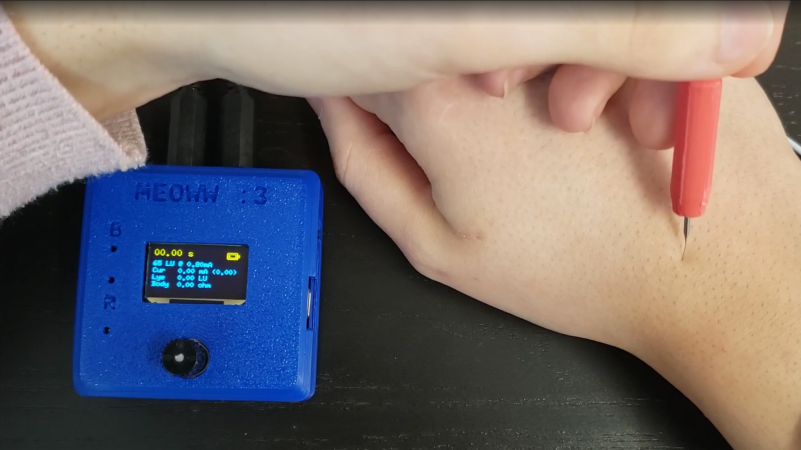
If you talk to the FDA, there’s only one permanent method of hair removal—electrolysis. This involves sticking a needle into a hair follicle, getting it very hot or running a current through it, and then letting heat and/or the lye generated kill the root of the hair dead. Normally, you’d pay someone with a commercial machine to do this for you at great expense. Or, you could do it yourself with a home-built machine, as [n3tcat] did.

Based on the available information out in the wild, [n3tcat] decided to build a galvanic electrolysis machine. This specifically passes current through a needle in the hair follicle to generate lye at the hair bulb, which kills it. The amount of lye generated depends on the amount of current and the time over which it is applied. More lye is more likely to kill a follicle permanently, though there are limits with regards to avoiding scarring, other skin damage, and excessive pain.

Continue reading “DIY Electrolysis Machine Removes Hair Permanently”

Congratulations To The Green Powered Challenge Winners!

For this challenge, we asked you to show off your hacks that power themselves sustainably from the environment around them. After all, nobody likes wires, and changing batteries is just a hassle. What’s better than an autonomous gizmo? Nothing.

Because this is Hackaday, we expected to see some finished-looking projects, some absolutely zany concepts, and basically everything in-between, and you did not disappoint! So without further ado, let’s have a look at the 2026 Green Powered Challenge winners, each of whom will be going on a $150 shopping spree at DigiKey, our contest’s sponsor.

Continue reading “Congratulations To The Green Powered Challenge Winners!”

Wigglegrams With A Pinhole Camera

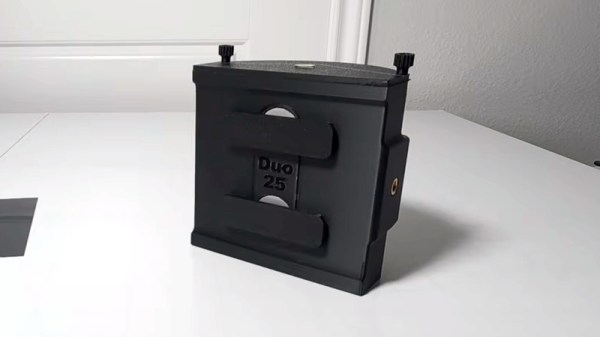
A pinhole camera is almost a rite of passage in photography, given that you can make one so easily with little more than a cardboard box and enough tape to keep the light from coming through the cracks. [Socialmocracy] has made one that’s 3D printed, and it’s a nice design that takes 4″ by 5″ photographic paper. The shutter is held on with magnets, and the lid is attached with thumbscrews.

As neat as printed pinhole cameras are, it’s not as though they’re particularly uncommon. What makes this one stand out from the rest is that it’s actually two cameras in one. One box, two cameras, side by side. Landscape format and it’s a pair of panoramic cameras, while in portrait mode it’s a stereo camera. Even the simplest of cameras can do wigglegrams!

We like this camera, because it manages to add something to such a simple formula.. He’s taking comments on whether to release the STLs, so drop in your two cents.

Continue reading “Wigglegrams With A Pinhole Camera”

There’s More To Global Positioning Than Just GPS

The Global Positioning System (GPS) was developed by the United States military in the 1970s, but it wasn’t long before civilians all over the planet started using it. By the early 2000s the technology was popping up in consumer devices such as mobile phones, and since then its become absolutely integral to our modern way of life.

But although support for GPS in our gadgets is nearly ubiquitous, it’s not the only option when it comes to figuring out where you are on the globe. As you might imagine, not everyone was thrilled with building their infrastructure around one of Uncle Sam’s pet projects, and so today there are several homegrown regional and global satellite navigation systems in operation.

As a follow-up to our recent dive into the ongoing GPS upgrades, let’s take a look at some of the other satellite positioning systems and who operates them.

Continue reading “There’s More To Global Positioning Than Just GPS”

University Of Utah’s TRIGA Research Reactor Set To Produce Electricity

Research reactors come in many forms and sizes, with the TRIGA class being commonly found at universities. The TRIGA reactor at the University of Utah was installed in 1975, and for the past half century the thermal energy it produced was bled off into cooling systems. Now for a world’s first, the reactor will be used to generate electricity instead.

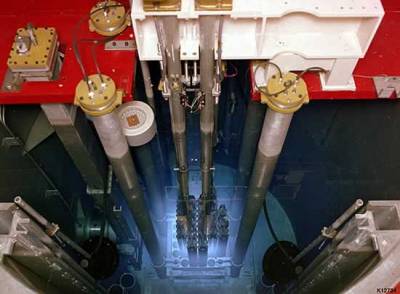
A TRIGA reactor core, with the blue glow from Cherenkov radiation. (Source: DoE, Wikimedia)

What makes the TRIGA design so practical for small research reactors is its inherent safety due to the use of uranium zirconium hydride (UZrH) fuel, which imposes a strong negative thermal coefficient on the reactivity. Along with no need for any kind of containment, these pool-type, water-cooled reactors thus allow for a pretty good look at the literal internals of the reactor core.

Their thermal power outputs range from 0.1 – 16 MWth, with the University of Utah reactor generating on the low end of the scale here, at 50 kWth. This energy will be partially used by a generator that has been developed by Elemental Nuclear, a startup company who looks to be trying to commercialize TRIGA fuel for microreactors with sodium coolant.

The installation at this TRIGA reactor should thus be seen as a proof-of-concept for Elemental Nuclear’s generator design, which uses a closed Brayton cycle with helium gas to generate an output of about 2-3 kWe from the ~13 kW generated by the turbine. This generated power will – of course – be used to power some racks with GPUs for ‘AI’ tasks. If successful, it could show the way for TRIGA-based microreactors to power datacenters.


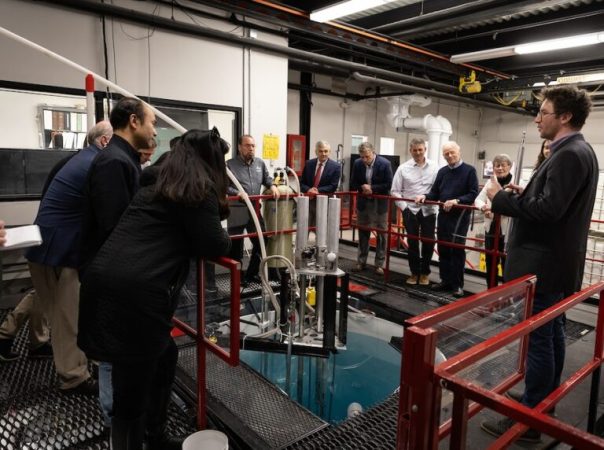
Top image: the TRIGA reactor during a tour. (Credit: University of Utah)

This Az-El Mount Is Worth Following

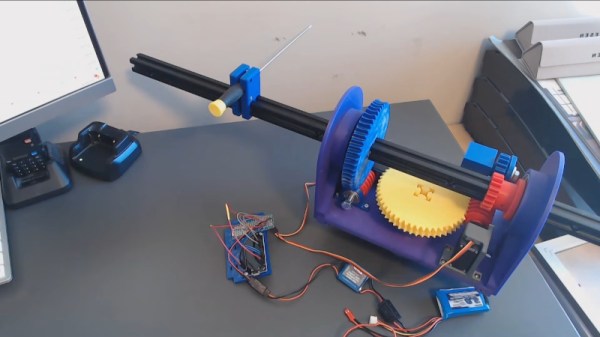
Communication with satellites often involves the use of high-gain directional antennas coupled with careful positioning to find and track the target. With a geostationary satellite the mount is either fixed or a single-axis polar mount, but when the craft is moving in a different orbit it becomes more of a challenge to stay locked on. An azimuth-elevation mount is needed to cover the whole sky, and [Ham Radio Passion] has one as a work in progress. It’s 3D printed and looks straightforward, making it a project to watch.

An az-el mount has two parts, the first being a turntable to set the azimuth, and the second being a horizontal rotating axis to set the elevation. He’s mounting the antenna to a piece of aluminium extrusion and driving it through a set of 3D printed gears driven from a 360 degree servo with a worm drive. He explains why the servo makes more sense to him here.

The result is not yet a finished project, but it shows enough promise to make it worth keeping an eye on. It’s by no means big enough for a huge antenna array, but we can imagine antennas for higher frequencies would be well within its capabilities. Meanwhile it’s certainly not the first az-el mount we’ve seen.

Continue reading “This Az-El Mount Is Worth Following”