
Build Yourself A Set Of Glowing Wings

Humans didn’t come with wings from the factory, and most efforts to fit them after the fact have been at least as far as flight is concerned, largely fruitless. That doesn’t mean you can’t cut a devastatingly sharp aesthetic though, and [Natalina’s] fiber optic wings are a great way to do just that. 

The wings are a leathercraft project, consisting of a harness worn around the torso. This serves as the mounting point for the fiber optics, as well as the RGB Critter flashlight used to drive the lightshow. Leather parts are lasercut to the right shape, making it easy to create the delicate feather shapes in the design. The pieces are then dyed appropriately and sewn together into the final shape. Bundles of optical fibers are then wound through the harness, sprouting from either shoulder of the wearer. EVA foam is used to help create the right shape for the wings, allowing the different layers to remain separated to create more visual depth.

It’s a build that looks absolutely striking at night, and unlike some other wing-based cosplays, doesn’t have as many drawbacks as far as crowds and transportation. It would make a killer look if you’re going as a Hacker Angel for Halloween this.

Makers certainly know how to craft some cutting-edge wearables. Got your own sweet build? Throw it at the tips line!
An Optocoupler Doorbell Notifier

Over the years we’ve seen several attempts at adding Internet connectivity to the lowly wired doorbell. Generally, these projects aim to piggyback on the existing wiring, bells, and buttons rather than replace them entirely. Which invariably means at some point the AC wiring is going to need to interface with a DC microcontroller. This is often where things get interesting, as it seems everyone has a different idea on how best to bridge these two systems.

That’s the point where [Ben Brooks] found himself not so long ago. While researching the best way to tap into the 20 VAC pumping through his doorbells, he found a forum post where somebody was experimenting with optocouplers. As is unfortunately so often the case, the forum thread never really had a conclusion, and it wasn’t clear if the original poster ever figured it out.

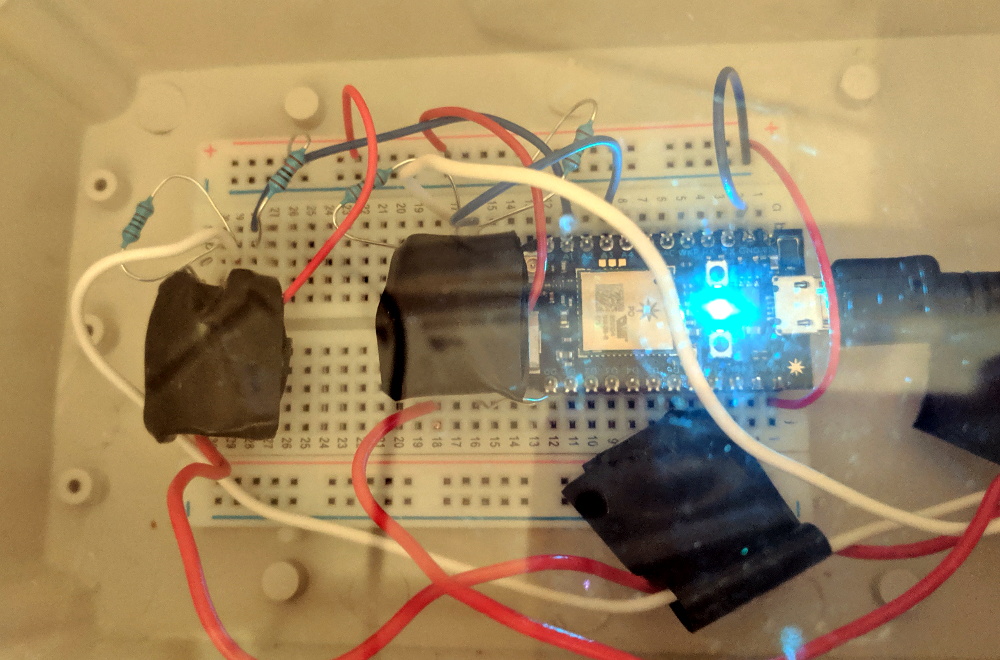
DIY optocouplers wrapped in electrical tape

[Ben] liked the idea though, so he thought he would give it a shot. But before investing in real optocouplers, he created his own DIY versions to use as a proof of concept. He put a standard LED and photoresistor together with a bit of black tape, and connected the LED to the doorbell line with a resistor. Running the LED on 60 Hz AC meant it was flickering rapidly, but for the purposes of detecting if there was voltage on the line, it worked perfectly.

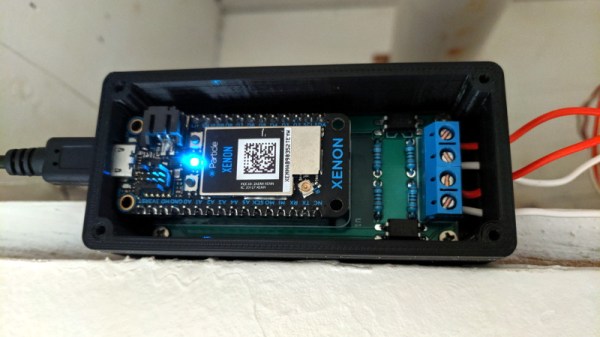
Wanting something slightly more professional for the final product, [Ben] eventually evolved his proof of concept to include a pair of 4N35s, a custom PCB, and a 3D printed enclosure. Powered by a Particle Xenon, the device uses IFTTT to fire off smartphone notifications and blink the lights in the house whenever somebody pushes the bell.

If you’re still wondering why it’s so tricky to connect a microcontroller up to your door bell, a quick look at some of the similar projects we’ve covered should give you a pretty good idea of how annoying these systems can be to modernize.

A DIY Retrocomputer Programmed In Pure Rust

Can you generate VGA and handle a PS/2 keyboard with a Cortex-M4 in Rust? That’s precisely what [theJPster] wanted to find out with Monotron, a 1980s style home computer programmed in pure Rust.

In order to run embedded Rust without a working operating system, some tools are necessary: an LLVM back-end for generating machine code, a target file for specifying memory sizes and other configs, and a pre-compiled libcore as a substitute for a compiler when running an operating system. Rust takes the place of C running on top of the board support package (BSP) and hardware abstraction layer (HAL), and peripheral access crates (PACs) that specify the hardware and allow the code to be portable across different chips.

The implementation generates a 800 x 600 VGA video signal at 60 Hz, displays text on a 48 character by 36 line display, displays color graphics using color lookup (stored in flash memory), and runs applications that take less than 24 KiB for all data. Monotron also generates 8-bit audio with PWM and sports a synthesizer that uses a three-channel wavetable allowing it to make sounds with square waves, sine waves, sawtooth waves, and create white noise.

So far, the Monotron has been able to work with an Atari joystick, a PS/2 keyboard, and has outputs to VGA, MIDI, SD card, and audio. Next up for the Monotron: writing a programming language (tentatively named Monotronian), adding support for Sega Megadrive pads, displaying sprites, and many more exciting developments.

Continue reading “A DIY Retrocomputer Programmed In Pure Rust”

How To Make An Electric Scooter Chain Sprocket With Nothing But Hand Tools

Sometimes, mechanical parts can be supremely expensive, or totally unavailable. In those cases, there’s just one option — make it yourself. It was this very situation in which I found myself. My electric scooter had been ever so slightly bested by a faster competitor, and I needed redemption. A gearing change would do the trick, but alas, the chain sprocket I needed simply did not exist from the usual online classifieds.

Thus, I grabbed the only tools I had, busied myself with my task. This is a build that should be replicable by anyone comfortable using a printer, power drill, and rotary tool. Let’s get to work!

Continue reading “How To Make An Electric Scooter Chain Sprocket With Nothing But Hand Tools”

Open Hardware Month Hack Chat

Join us on Wednesday, October 23 at noon Pacific for the Open Hardware Month Hack Chat with Michael Weinberg!

It seems like everything and everyone has a special day set aside on the calendar. You know the drill – a headline declaring it National Grilled Cheese Day (sorry, you missed it – April 12) or National Bundt Pan Day (not even kidding, November 15). It seems only fair with all these silly recognition days floating around that we in the hacking community should have a day of our own, too, or even a whole month. That’s why the Open Source Hardware Association declared the entire month of October to be Open Hardware Month.

Open hardware is all about accessible, collaborative processes that let everyone see and understand the hardware they’re using. The technological underpinnings of our lives are increasingly hidden from us, locked away as corporate secrets. Open hardware tries to turn that on its head and open up devices to everyone, giving them the freedom to not only use their devices but to truly understand what’s happening in them, and perhaps repair, extend, and even modify them to do something new and useful. Celebrating that and getting the message out to the general public is certainly something worth doing.

Michael Weinberg is a board member at OSHWA, and he’ll be joining the Hack Chat on October 23 (National Boston Cream Pie Day) to discuss Open Hardware Month and open-source hardware in general. We’ll learn about some of the events planned for Open Hardware Month, how open hardware is perceived beyond the hacker community, and what’s on tap for the 10th anniversary Open Hardware Summit in 2020.

join-hack-chatOur Hack Chats are live community events in the Hackaday.io Hack Chat group messaging. This week we’ll be sitting down on Wednesday, October 23 at 12:00 PM Pacific time. If time zones have got you down, we have a handy time zone converter.

Click that speech bubble to the right, and you’ll be taken directly to the Hack Chat group on Hackaday.io. You don’t have to wait until Wednesday; join whenever you want and you can see what the community is talking about.

A Drone Sprouts Wings

While there are some fixed-wing drones in the hobby world, most of us around here think of the quadcopter when this word is mentioned. There have been some fixed-wings around, and lots of multi-rotors, but not much of a mix of the two. [Paweł] wanted to see what would happen if he mixed these two together, and created a quadcopter drone with retractable wings, essentially just to see what would happen.

This isn’t something that can convert from fixed-wing flight to helicopter-style hovering like a V22 Osprey or Harrier, either. The lift and thrust is entirely generated by the rotors, and the “wings” are essentially deployable air brakes that allow the drone to slow down quickly without consuming as much energy under propeller power alone. The air brake wings are designed to automatically deploy as a function of throttle position, too, so there’s a lot that could be built on this idea in the future, in theory.

[Paweł] notes that this design is somewhat controversial, and although few of us are in the drone racing community we can imagine how a functional change like this might impact in an arena such as that. He also only saw marginal performance increases and isn’t planning on perusing this idea much further. If you’re interested in a drone with “true” wings, though, check out this one which gets fired out of a grenade launcher.

Continue reading “A Drone Sprouts Wings”

DNS-over-HTTPS Is The Wrong Partial Solution

Openness has been one of the defining characteristics of the Internet for as long as it has existed, with much of the traffic today still passed without any form of encryption. Most requests for HTML pages and associated content are in plain text, and the responses are returned in the same way, even though HTTPS has been around since 1994.

But sometimes there’s a need for security and/or privacy. While the encryption of internet traffic has become more widespread for online banking, shopping, the privacy-preserving aspect of many internet protocols hasn’t kept pace. In particular, when you look up a website’s IP address by hostname, the DNS request is almost always transmitted in plain text, allowing all the computers and ISPs along the way to determine what website you were browsing, even if you use HTTPS once the connection is made.

The idea of also encrypting DNS requests isn’t exactly new, with the first attempts starting in the early 2000s, in the form of DNSCrypt, DNS over TLS (DoT), and others. Mozilla, Google, and a few other large internet companies are pushing a new method to encrypt DNS requests: DNS over HTTPS (DoH).

DoH not only encrypts the DNS request, but it also serves it to a “normal” web server rather than a DNS server, making the DNS request traffic essentially indistinguishable from normal HTTPS. This is a double-edged sword. While it protects the DNS request itself, just as DNSCrypt or DoT do, it also makes it impossible for the folks in charge of security at large firms to monitor DNS spoofing and it moves the responsibility for a critical networking function from the operating system into an application. It also doesn’t do anything to hide the IP address of the website that you just looked up — you still go to visit it, after all.

And in comparison to DoT, DoH centralizes information about your browsing in a few companies: at the moment Cloudflare, who says they will throw your data away within 24 hours, and Google, who seems intent on retaining and monetizing every detail about everything you’ve ever thought about doing.

DNS and privacy are important topics, so we’re going to dig into the details here. Continue reading “DNS-over-HTTPS Is The Wrong Partial Solution”