Warshipping: A Free Raspberry Pi In The Mail Is Not Always A Welcome Gift

Leading edge computer security is veiled in secrecy — a world where novel attacks are sprung on those who do not yet know what they need to protect against. Once certain tactics have played out within cool kids’ circles, they are introduced to the rest of the world. An IBM red team presented what they’re calling “warshipping”: sending an adversarial network to you in a box.

Companies concerned about security have learned to protect their internet-accessible points of entry. Patrolling guards know to look for potential wardrivers parked near or repeatedly circling the grounds. But some are comparatively lax about their shipping & receiving, and they are the ideal targets for warshipping.

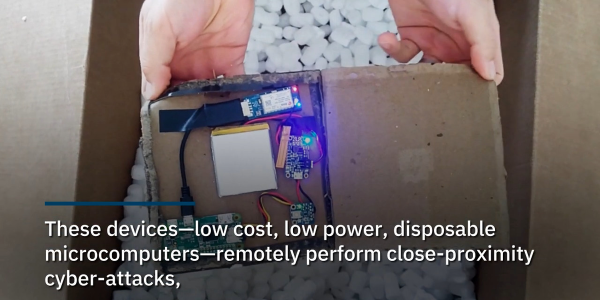
Bypassing internet firewalls and security perimeters, attack hardware is embedded inside a shipping box and delivered by any of the common carriers. Security guards may hassle a van bristling with antennas, but they’ll wave a FedEx truck right through! The hardware can be programmed to stay dormant through screening, waiting to probe once inside the walls.

The presentation described several ways to implement such an attack. There is nothing novel about the raw hardware – Raspberry Pi, GPS receiver, cellular modems, and such are standard fare for various projects on these pages. The creative part is the software and in how they are hidden: in packing material and in innocuous looking plush toys. Or for persistence, they can be hidden in a wall mounted plaque alongside some discreet photovoltaic panels. (Editor’s note: What? No Great Seals?)

With this particular technique out in the open, we’re sure others are already in use and will be disclosed some years down the line. In the meantime, we can focus our efforts on more benign applications of similar technology, whether it is spying on our cat or finding the nearest fast food joint. The hardware is evolving as well: a Raspberry Pi actually seems rather heavyweight for this, how about a compact PCB with both an ESP32 and a cellular modem?

Via Ars Technica.
The Thermochromic Display You Didn’t Know You Needed

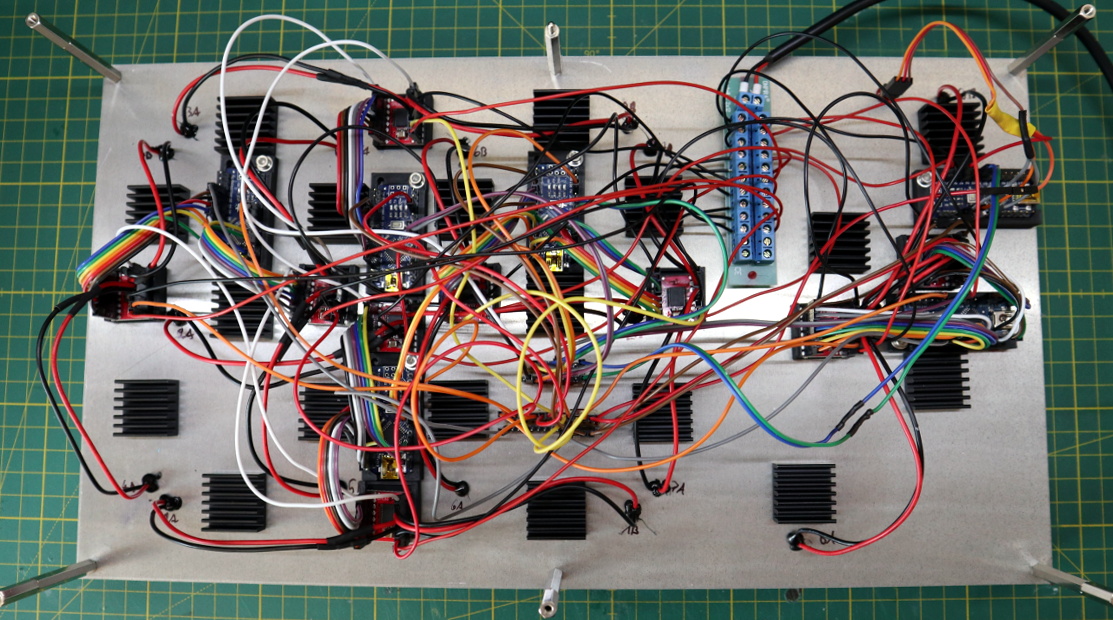
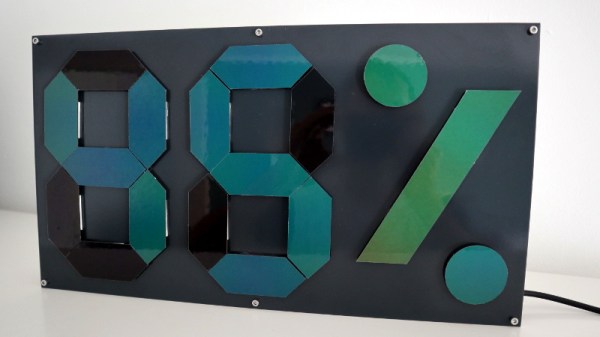
We love unique ways of displaying data here at Hackaday, and this ingenious thermochromic display created by [Moritz v. Sivers] more than fits the bill. Using sheets of color changing liquid crystals and careful temperature control of the plates they’re mounted on, he’s built a giant seven-segment display that can colorfully (albeit somewhat slowly) show the current temperature and humidity.

The sheets of temperature sensitive liquid crystals are a bit like flattened out Mood Rings; they starts out black, but as heat is applied, their color cycles through vibrant reds, greens, and blues. The sheets are perhaps best known as the sort of vaguely scientific toys you might see in a museum gift shop, but here [Moritz] has put their unique properties to practical use.

To achieve the effect, he first cut each segment out of copper. The crystal sheets were applied to the segments, thanks to their handy self-stick backing, and the excess was carefully trimmed away. Each segment was then mounted to a TES1-12704 Peltier module by way of thermally conductive epoxy. TB6612FNG motor controllers and a bevy of Arduino Nano’s are used to control the Peltier modules, raising and lowering their temperature as necessary to get the desired effect.

You can see the final result in the video after the break. It’s easily one of the most attractive variations on the classic seven-segment display we’ve ever seen. In fact, we’d go as far as to say it could pass for an art installation. The idea of a device that shows the current temperature by heating itself up certainly has a thoughtful aspect to it.

This actually isn’t the first display we’ve seen that utilized this concept, though it’s by far the largest. Back in 2014 we featured a small flexible display that used nichrome wires to “print” digits on a sheet of liquid crystals.

Continue reading “The Thermochromic Display You Didn’t Know You Needed”

MIDI Controller In A Concertina Looks Sea Shanty-Ready

Did you know that the English concertina, that hand-pumped bellows instrument favored by sailors both legitimate and piratical in the Age of Sail, was invented by none other than [Sir Charles Wheatstone]? We didn’t, but [Dave Ehnebuske] knew that the venerable English gentleman was tickling the keys of his instrument nearly two decades before experimenting with the bridge circuit that would bear his name.

This, however, is not the reason [Dave] built a MIDI controller in the form of an English concertina. That has more to do with the fact that he already knows how to play one, they’re relatively easy to build, and it’s a great form factor for a MIDI controller. A real concertina has a series of reeds that vibrate as air from the hand bellows is directed over them by valves controlled by a forest of keys. [Dave]’s controller apes that form, with two wind boxes made from laser-cut plywood connected by a bellows made from cardboard, Tyvek, and nylon fabric. The keys are non-clicky Cherry MX-types that are scanned by a Bluefeather microcontroller. To provide some control over expression, [Dave] included a pressure sensor, which alters the volume of the notes played depending on how hard he pushes the bellows. The controller talks MIDI over Bluetooth, and you can hear it in action below.

We’ve seen MIDI controllers in just about everything, from a pair of skate shoes to a fidget spinner. But this is the first time we’ve seen one done up like this. Great job, [Dave]!

Continue reading “MIDI Controller In A Concertina Looks Sea Shanty-Ready”

Exploring The Science Behind Dirty Air Filters

Obviously, if the air filters in your home HVAC system are dirty, you should change them. But exactly how dirty is dirty? [Tim Rightnour] had heard it said that if you didn’t change your filter every month or so, it could have a detrimental effect on the system’s energy consumption. Thinking that sounded suspiciously like a rumor Big Filter™ would spread to bump up their sales, he decided to collect his own data and see if there was any truth to it.

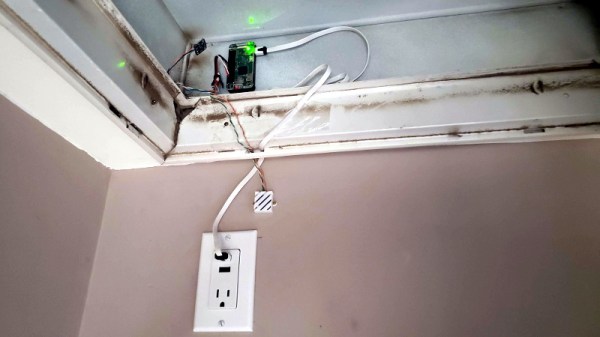
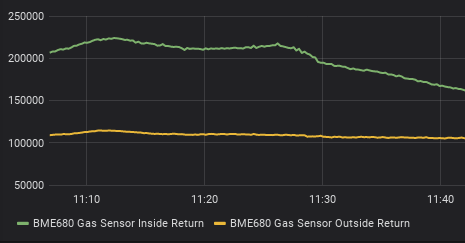
There’s a number of ways you could tackle a project like this, but [Tim] wanted to keep it relatively simple. A pressure sensor on either side of the filter should tell him how much it’s restricting the airflow, and recording the wattage of the ventilation fan would give him an idea on roughly how hard the system was working.

Now [Tim] could have got this all set up and ran it for a couple months to see the values gradually change…but who’s got time for all that? Instead, he recorded data while he switched between a clean filter, a mildly dirty one, and one that should have been taken out back and shot. Each one got 10 minutes in the system to make its impression on the sensors, including a run with no filter at all to serve as a baseline.

The findings were somewhat surprising. While there was a sizable drop in airflow when the dirty filter was installed, [Tim] found the difference between the clean filter and mildly soiled filter was almost negligible. This would seem to indicate that there’s little value in preemptively changing your filter. Counter-intuitively, he also found that the energy consumption of the ventilation fan actually dropped by nearly 50 watts when the dirty filter was installed. So much for a clean filter keeping your energy bill lower.

With today’s cheap sensors and virtually infinite storage space to hold the data from them, we’re seeing hackers find all kinds of interesting trends in everyday life. While we don’t think your air filters are spying on you, we can’t say the same for those fancy new water meters.

Hackaday Links Column Banner

Hackaday Links: August 18, 2019

To the surprise of nobody with the slightest bit of technical intuition or just plain common sense, the world’s first solar roadway has proven to be a complete failure. The road, covering one lane and stretching all of 1,000 meters across the Normandy countryside, was installed in 2016 to great fanfare and with the goal of powering the streetlights in the town of Tourouvre. It didn’t even come close, producing less than half of its predicted power, due in part to the accumulation of leaves on the road every fall and the fact that Normandy only enjoys about 44 days of strong sunshine per year. Who could have foreseen such a thing? Dave Jones at EEVBlog has been all over the solar freakin’ roadways fiasco for years, and he’s predictably tickled pink by this announcement.

I’m not going to admit to being the kid in grade school who got bored in class and regularly filled pages of my notebook with all the binary numbers between 0 and wherever I ran out of room – or got caught. But this entirely mechanical binary number trainer really resonates with me nonetheless. @MattBlaze came up with the 3D-printed widget and showed it off at DEF CON 27. Each two-sided card has an arm that flops down and overlaps onto the more significant bit card to the left, which acts as a carry flag. It clearly needs a little tune-up, but the idea is great and something like this would be a fun way to teach kids about binary numbers. And save notebook paper.

Is that a robot in your running shorts or are you just sporting an assistive exosuit? In yet another example of how exoskeletons are becoming mainstream, researchers at Harvard have developed a soft “exoshort” to assist walkers and runners. These are not a hard exoskeleton in the traditional way; rather, these are basically running short with Bowden cable actuators added to them. Servos pull the cables when the thigh muscles contract, adding to their force and acting as an aid to the user whether walking or running. In tests the exoshorts resulted in a 9% decrease in the amount of effort needed to walk; that might not sound like much, but a soldier walking 9% further on the same number of input calories or carrying 9% more load could be a big deal.

In the “Running Afoul of the FCC” department, we found two stories of interest. The first involves Jimmy Kimmel’s misuse of the Emergency Alert System tones in an October 2018 skit. The stunt resulted in a $395,000 fine for ABC, as well as hefty fines for two other shows that managed to include the distinctive EAS tones in their broadcasts, showing that the FCC takes very seriously indeed the integrity of a system designed to warn people of their approaching doom.

The second story from the regulatory world is of a land mobile radio company in New Jersey slapped with a cease and desist order by the FCC for programming mobile radios to use the wrong frequency. The story (via r/amateurradio) came to light when someone reported interference from a car service’s mobile radios; subsequent investigation showed that someone had programmed the radios to transmit on 154.8025 MHz, which is 5 MHz below the service’s assigned frequency. It’s pretty clear that the tech who programmed the radio either fat-fingered it or misread a “9” as a “4”, and it’s likely that there was no criminal intent. The FCC probably realized this and didn’t levy a fine, but they did send a message loud and clear, not only to the radio vendor but to anyone looking to work frequencies they’re not licensed for.

Suntracker Optimizes Solar Panels While Visualizing Sun’s Path

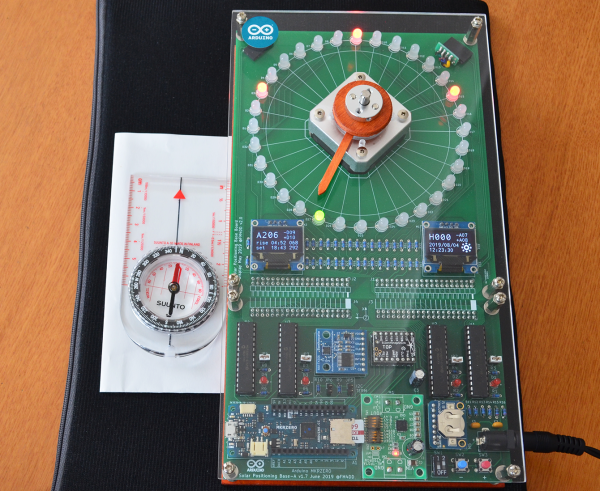
If you have solar panels, you want soak up as much sunshine as you can to get your money’s worth. If you don’t have space for a lot of panels, the next best thing is repositioning the panels to catch the most rays. For his entry into the Hackaday Prize, [Frank] built a gorgeous solar tracker prototype to both validate his theories and to serve as a learning platform.

A solar tracker’s purpose is — you guessed it — tracking the Sun’s location to determine optimal positioning for solar panels and other sun-seeking payloads. In the latest revision, [Frank]’s tracker follows the Sun’s azimuth angle, aka its horizontal movement.

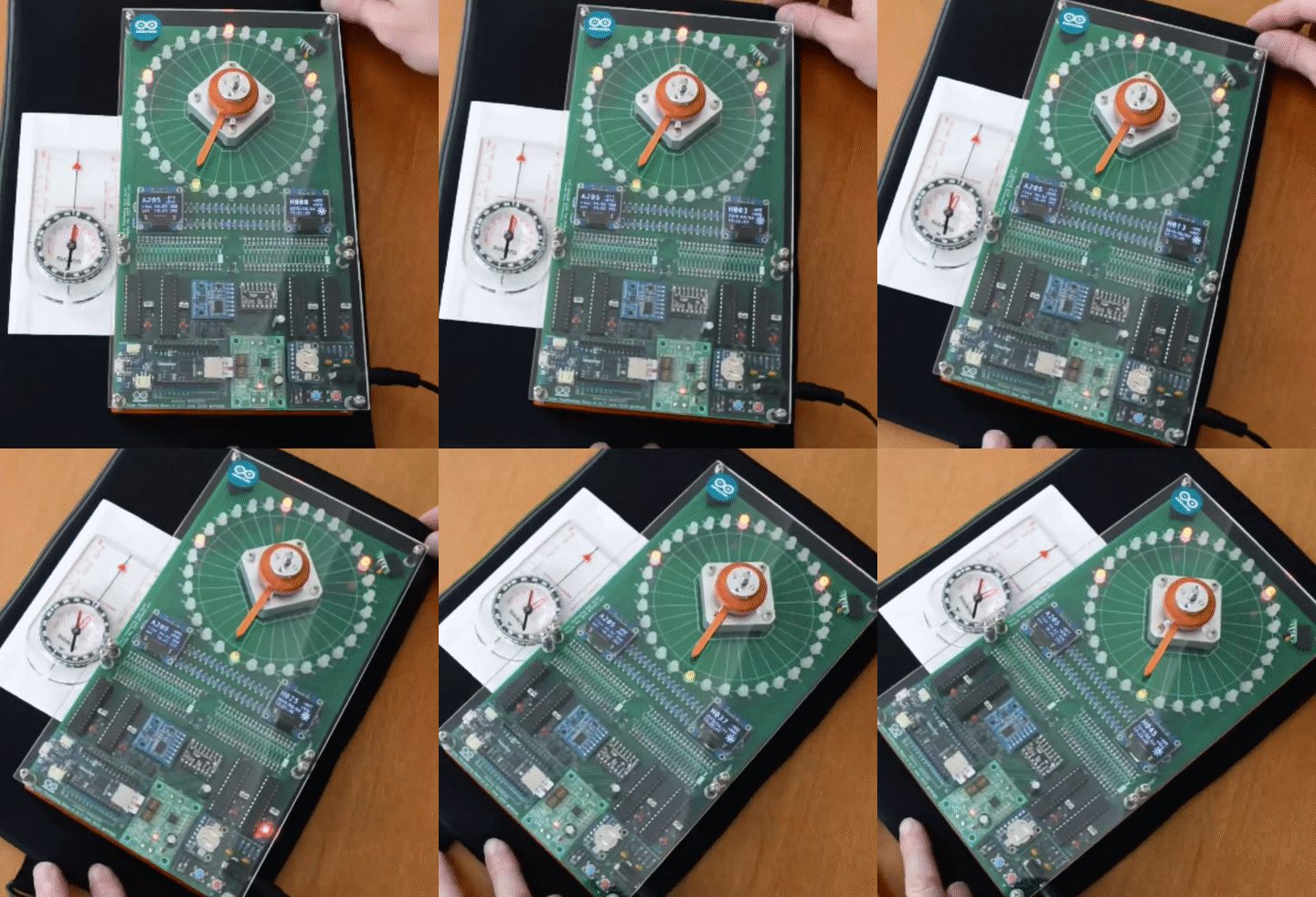
The Sun’s path is represented along a ring of 32 red/green LEDs. It moves around the ring as a green LED, according to a real-time clock and a set of pre-determined solar positions stored on an SD card.

Two red LEDs show the sunrise and sunset azimuth angles, and a third LED indicates North as detected with a magnetometer and adjusted for local magnetic declination. In the center of the ring, a stepper motor drives an arrow that always points at the Sun LED. As the tracker is moved around, all the LEDs shift around the ring to follow their targets.

Though it already shines, we think this ongoing project has a bright future. Be sure to check out the demo video after the break.

Continue reading “Suntracker Optimizes Solar Panels While Visualizing Sun’s Path”

An All-In-One Conference Video Streaming Box

When running a hacker camp or other event, one of the many challenges faced by the organisers concerns the production and distribution of event videos. As the talks are recorded they must be put online, and with a load of talks to be processed it quickly becomes impractical to upload them one by one through a web interface such as that provided by YouTube. At the BornHack 2019 hacker camp in Denmark they were using a particularly well-integrated unit to do the video uploading in real time, and its creator [Mikkel Mikjær Christensen]  was good enough to share the video we’ve put below the break, a talk he gave about it at The Camp 2017, a Danish open source software camp.

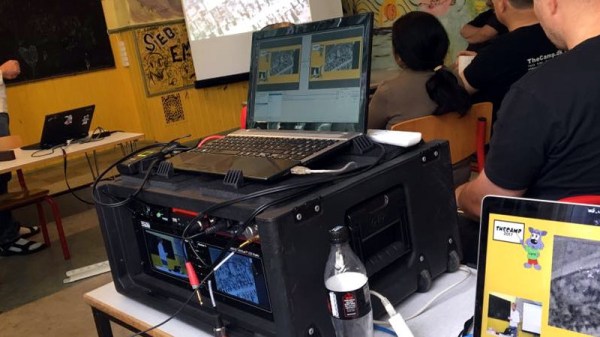
It takes the viewer through the evolution over several years, from simple camcorders with integrated microphones and post-event processing, through a first-generation system with a laptop and rack-mount monitors, and into a final system in a rugged portable case with a significantly powerful laptop running OBS with a hardware MPEG encoder. Careful choice of power supplies and the use of good quality wireless microphones now give instantaneous video streaming to events such as BornHack without the need for extensive infrastructure.

If you were wondering where you might have heard that name before, [Mikkel] is the [Mike] from the Retrocomputing with Mike YouTube channel. It’s being honest to say that more of our conversation was about retrocomputers than the video box.

Continue reading “An All-In-One Conference Video Streaming Box”