Adding Linux To A PDP-11

The UNIBUS architecture for DEC’s PDPs and Vaxxen was a stroke of genius. If you wanted more memory in your minicomputer, just add another card. Need a drive? Plug it into the backplane. Of course, with all those weird cards, these old UNIBUS PDPs are hard to keep running. The UniBone is the solution to this problem. It puts Linux on a UNIBUS bridge, allowing this card to serve as a memory emulator, a test console, a disk emulator, or any other hardware you can think of.

The key to this build is the BeagleBone, everyone’s second-favorite single board computer that has one feature the other one doesn’t: PRUs, or a programmable real-time unit, that allows you to blink a lot of pins very, very fast. We’ve seen the BeagleBone be used as Linux in a terminal, as the rest of the computer for an old PDP-10 front panel and as the front end for a PDP-11/03.

In this build, the Beaglebone’s PRU takes care of interfacing to the UNIBUS backplane, sending everything to a device emulator running as an application. The UniBone can be configured as memory or something boring, but one of these can emulate four RL02 drives, giving a PDP-11 an amazing forty megabytes of storage. The real killer app of this implementation is giving these emulated drives a full complement of glowing buttons for load, ready, fault, and write protect, just like the front of a real RL02 drive. This panel is controlled over the I2C bus on the Beaglebone, and it’s a work of art. Of course, emulating the drive means you can’t use it as the world’s largest thumb drive, but that’s a small price to pay for saving these old computers.

Choosing Cell Modems: The Drama Queen Of Hardware Design

So you went to a tradeshow and heard about this cool new idea called the Internet Of Things; now it’s time to build an IoT product of your own. You know that to be IoT, your Widget D’lux® has to have a network connection but which to choose?

You could use WiFi or Bluetooth but that would be gauche. Maybe LoRaWAN? All the cool kids are using LoRa for medium or long range wireless these days, but that still requires a base station and Widget D’lux® will be a worldwide phenomenon. Or at least a phenomenon past your bedroom walls. And you know how much user’s hate setting things up. So a cell modem it is! But what do you have to do to legally include one in your product? Well that’s a little complicated.

Continue reading “Choosing Cell Modems: The Drama Queen Of Hardware Design”

Cyborg Mushrooms

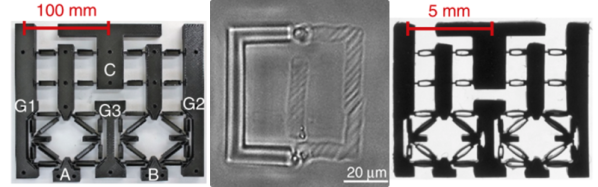
Of all the fictional cyborgs who turn against humanity to conquer the planet, this is as far from that possibility as you can get. These harmless mushrooms seem more interested in showing off their excellent fashion sense with a daring juxtaposition of hard grid lines with playful spirals. But the purpose of this bacteria-fungus-technology hybrid is to generate electricity. The mushrooms are there to play nurse to a layer of cyanobacteria, the green gel in the photo, while the straight black lines harvest electricity.

Cyanobacteria do not live very long under these kinds of conditions, so long-term use is out of the question, but by giving the cyanobacteria somewhere it can thrive, the usefulness grows. The interplay between bacterial and supportive organics could lead to advances in sensors and hydrogels as well. At some point, we may grow some of our hardware and a green thumb will be as useful as a degree in computer science.

Hydrogels could be the next medical revolution, and we’ve already made hydrogels into tattoos, used them as forms for artificial muscles, and hydrogels can be a part of soft tissue printing.

The Smaller, More Powerful Raspberry Pi 3 Model A+

It’s that time of year again, and the Raspberry Pi Foundation has some new hardware for you. This time, it’s an improved version of the Raspberry Pi Model A, bringing it the speed and power of its bigger brother, the Raspberry Pi Model 3 B+.

The Raspberry Pi Model A is the weird middle child of the Raspberry Pi lineup, or maybe it’s the Goldilocks choice. It’s not as powerful and doesn’t have the USB ports or Ethernet jack found in the latest revision of the family, the Raspberry Pi Model 3 B+, and it’s not as small or as cheap as the Raspberry Pi Zero W. If you’re running a Pi as just something that takes in power and spits out data on the GPIO pins, the Model A might be all you need.

The full specs include:

  • Broadcom BCM2837B0 Cortex A-53 running at 1.4GHz
  • 512 MB of LPDDR2 SRAM
  • 2.4 GHz and 5 GHz 802.11 b/g/n/ac wireless LAN, Bluetooth 4.2/BLE
  • Full size HDMI
  • MIPI DSI display port / CSI camera port
  • Stereo Output and composite video port

In short, we’re looking at a cut-down version of the Raspberry Pi Model 3 B+ released earlier this year, without an Ethernet port and only one USB port. The wireless chipset is hidden under a lovely embossed can, and until we get our hands on this new model and a pair of pliers, we’re assuming this is a CYW43455, the Cypress chipset found in the Pi 3 B+.

The price of the Raspberry Pi 3 Model A+ will be $25 USD, with availability soon at the usual retailers. Since there’s no such thing as a Pi Zero 3 yet, if you’re looking for a powerful Linux computer, with wireless, in a small form factor, you’re not going to do much better than this little guy. You could of course desolder a Pi 3 B+, but for now this is the smallest, most powerful single board computer with good software support.

Re-enacting TRON On The Apple IIgs

TRON is a science fiction classic, hitting cinemas in the midst of the burgeoning home computer era. It’s the film that created the famous light cycle, which spawned many video game recreations in the following years. Many years ago now, [Daniel] decided to flex his programming muscles by coding a version of the game for the Apple IIgs, with accidentally excellent results.

In the film, the characters find an escape from the light cycle game by forcing another player to crash into the walls of the play area. The resulting explosion left a hole, allowing the players to exit the light cycle game and explore the rest of the computer. Amusingly, due to a coding oversight, [Daniel] had created exactly this same flaw in his own code.

[Daniel]’s game differed from the original in that players were provided with missiles to destroy enemy trails. However, these missiles did not discriminate, and due to the simplicity of the code, were able to destroy the boundary on the play area. This was discovered when the computer player tried to escape an otherwise impossible situation. Upon blowing a hole in the arena wall, the computer player proceeded to drive off the screen – into invalid memory. This led to the computer crashing in short order, due to the unprotected memory space of the Apple II platform.

It’s a case of code imitating art – and completely by accident. The game managed to replicate the light cycle escape from the film entirely due to the unexpected behaviour of the simple missile code. [Daniel] steps through the code and how the bug happened, and covers the underlying principle behind the resulting crashes. It’s an entertaining tale of the risks of coding at low level; something we don’t always run into with today’s modern interpreted languages.

Thirsty for more tales of hacking the Apple II? How about going back in time to fix a 37 year old bug?

Centurion Bridge Layer, Now In RC

Radio controlled models are great fun. Most of us have had a few RC cars as children and maybe dabbled with the occasional helicopter or drone. It’s a rare breed of modeler, however, that gets to drive a radio-controlled bridge laying tank.

The lads prepare to fight the good fight.

The model is a replica of the British Centurion Bridgelayer – a modified tank designed to allow mechanized units to readily cross rivers and similar obstacles in European battlefields. While the genuine article relied on hydraulics, the RC version takes a different tack. [hawkeye3guns] built custom linear actuators out of motors, gears, and brass to deploy the bridge.

The build shows other smart techniques of the enterprising modeler. Rather than start from scratch, the Centurion is built on a modified KV tank hull. After the modifications were complete, the tank received a lick of paint in the requisite British Army green. The final result is rather impressive.

It goes to show what can be achieved with some off-the-shelf parts and ingenuity. We’ve seen other impressive RC tanks before – like this French build with a homebrew targeting computer.

Rock Out To The Written Word With BookSound

With his latest project, [Roni Bandini] has simultaneously given the world a new type of audiobook and music. Traditional audiobooks are basically the adult equivalent of having somebody read you a bedtime story, but BookSound actually turns the written word into electronic music. You won’t be able to boast to your friends that as a matter of fact, you have read that popular new novel, but at least you might be able to dance to it.

[Roni] says he’s still working on perfecting the word to music mapping, so the results shown in the video after the break are still a bit rough. But even in these early stages there’s no denying this is an exceptionally unique project, and we’re excited to see where it goes from here.

Inside the classy looking 3D printed enclosure is a Raspberry Pi, an OLED display, and the button and switch which make up the extent of the device’s controls. At the end of the arm is a standard Raspberry Pi Camera module, which gives the BookSound a bird’s eye view of the book to be songified.

To turn your favorite book into electronic beats, simply open it up, put it under the gaze of BookSound, and press the button on the front. Because the Raspberry Pi isn’t exactly a powerhouse, it takes about two minutes for it to scan the page, perform optical character recognition (OCR), and compose the track before you start to hear anything.

If you’re wondering what the secret sauce is to turn words into music, [Roni] isn’t ready to share his source code just yet. But he was able to give us a few high-level explanations of what’s going on inside BookSound. For example, to generate the song’s BPM, the software will count how many words per paragraph are on the page: so a book with shorter paragraphs will consequently have a faster tempo to match the speed at which the author is moving through ideas. Similarly, drum kicks are generated based on the number of syllables in each paragraph. In the future, he’s looking at adding “lyrics” by running commonly used words on the page through a text to speech engine and inserting them into the beat.

We’ve seen practical applications of OCR on the Raspberry Pi in the past and even similar looking book scanning arrangements. But nothing quite like BookSound before, which at this point, is really saying something.

Continue reading “Rock Out To The Written Word With BookSound”