Bunnie Weighs In On Tariffs

[Bunnie] has penned his thoughts on the new 25% tariffs coming to many goods shipped from China to the US. Living and working both in the US and China, [Bunnie] has a unique view of manufacturing and trade between the two countries. The creator of Novena and Chumby, he’s also written the definitive guide on Shenzen electronics.
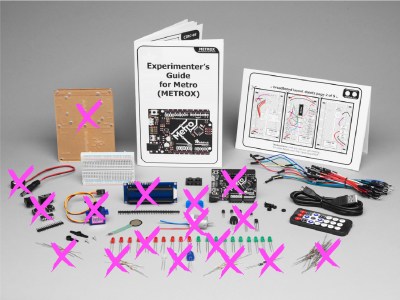
All the marked items are included in the new tariffs

The new US tariffs come into effect on July 6th. We covered the issue last week, but Bunnie has gone in-depth and really illustrates how these taxes will have a terrible impact on the maker community. Components like LEDs, resistors, capacitors, and PCBs will be taxed at the new higher rate. On the flip side, Tariffs on many finished consumer goods such as cell phone will remain unchanged.

As [Bunnie] illustrates, this hurts small companies buying components. Startups buying subassemblies from China will be hit as well. Educators buying parts kits for their classes also face the tax hike. Who won’t be impacted? Companies building finished goods. If the last screw of your device is installed in China, there is no tax. If it is installed in the USA, then you’ll pay 25% more on your Bill of Materials (BOM). This incentivizes moving assembly offshore.
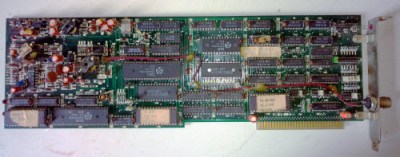
What will be the end result of all these changes? [Bunnie] takes a note from Brazil’s history with a look at a PC ISA network card. With DIP chips and all through-hole discrete components, it looks like a typical 80’s design. As it turns out the card was made in 1992. Brazil had similar protectionist tariffs on high-tech goods back in the 1980’s. As a result, they lagged behind the rest of the world in technology. [Bunnie] hopes these new tariffs don’t cause the same thing to happen to America.

[Thanks to [Robert] and [Christian] for sending this in]

Would You Look At That Yaw Control

[Jeff Bezos] might be getting all the credit for developing a rocket that can take off and land vertically, but [Joe Barnard] is doing it the hard way. He’s doing it with Estes motors you can pick up in any hobby shop. He’s doing it with a model of a Falcon 9, and he’s on his way to launching and landing a rocket using nothing but solid propellant.

The key to these launches is, of course, the flight controller, This is the Signal flight controller, and it has everything you would expect from a small board meant to mount in the frame of a model rocket. There’s a barometer, an IMU, a buzzer (important!), Bluetooth connectivity, and a microSD card slot for data logging. What makes this flight computer different is the addition of two connectors for standard hobby servos. With the addition of a 3D printed adapter, this flight controller adds thrust vectoring control. That means a rocket will go straight up without the use of fins.

We’ve seen [Joe]’s work before, and things have improved significantly in the last year and a half. The latest update from last weekend was a scale model (1/48) of the Falcon Heavy. In a 45-second video, [Joe]’s model of the Falcon Heavy launches on the two booster rockets, lights the center core, drops the two boosters and continues on until the parachutes unfurl. This would be impressive without active guidance of the motor, and [Joe] is adding servos and launch computers to the mix. It’s awesome, and certainly unable to be exported from the US.

A YouTube Subscriber Counter With A Tetris Twist

When it comes to YouTube subscriber counters, there’s not much wiggle room for creativity. Sure, you can go with Nixies or even more exotic displays, but in the end a counter is just a bunch of numbers.

But [Brian Lough] found a way to jazz things up with this Tetris-playing YouTube sub counter. For those of you not familiar with [Brian]’s channel, it’s really worth a watch. He tends toward long live-stream videos where he works on one project for a marathon session, and there’s a lot to learn from peeking over his virtual shoulder. This project stems from an earlier video, posted after the break, which itself was a condensation of several sessions hacking with the RGB matrix that would form the display for this project. He’s become enamored of the cheap and readily-available 64×32 pixel RGB displays, and borrowing an idea from Mc Lighting author [toblum], he decided that digits being assembled from falling Tetris blocks would be a nice twist. [Brian] had to port the Tetris-ifying code to Arduino before getting the ESP8266 to do the work of getting the subs and updating the display. We think the display looks great, and the fact that the library is open and available means that you too can add Tetris animations to your projects.

None of this is to say that more traditional sub counters can’t be cool too. From a minimalist display to keeping track of all your social media, good designs are everywhere. And adding a solid copper play button is a nice touch too.

Continue reading “A YouTube Subscriber Counter With A Tetris Twist”

Calm Down: It’s Only Assembly Language

Based on [Ben Jojo’s] title — x86 Assembly Doesn’t have to be Scary — we assume that normal programmers fear assembly. Most hackers don’t mind it, but we also don’t often have an excuse to program assembly for desktop computers.

In fact, the post is really well suited for the typical hacker because it focuses the on real mode of an x86 processor after it boots. What makes this tutorial a little more interesting than the usual lecture is that it has interactive areas, where a VM runs your code in the browser after assembling with NASM.

Continue reading “Calm Down: It’s Only Assembly Language”

Refurbishing A DEC 340 Monitor

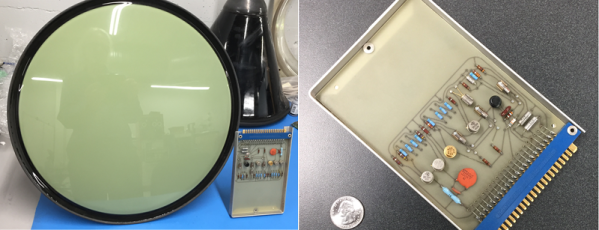
Back in the “good old days” movie theaters ran serials. Every week you’d pay some pocket change and see what happened to Buck Rogers, Superman, or Tex Granger that week. Each episode would, of course, end in a cliffhanger. [Keith Hayes] has started his own serial about restoring a DEC 340 monitor found in a scrap yard in Australia. The 340 — not a VT340 — looks like it could appear in one of those serials, with its huge cabinets and round radar-like display. [Keith] describes the restoration as “his big project of the year” and we are anxious to see how the cliffhangers resolve.

He’s been lucky, and he’s been unlucky. The lucky part is that he has the cabinet with the CRT and the deflection yoke. Those would be very difficult to replace. The unlucky part is that one entire cabinet of electronics is missing.

Continue reading “Refurbishing A DEC 340 Monitor”

Laser Cutter Turns Scrapped To Shipped

We’ll go way out on a limb here and say you’ve probably got a ridiculous amount of flattened cardboard boxes. We’re buying more stuff online than ever before, and all those boxes really start to add up. At the least we hope they’re making it to the recycling bin, but what about reusing them? Surely there’s something you could do with all those empty shipping boxes…

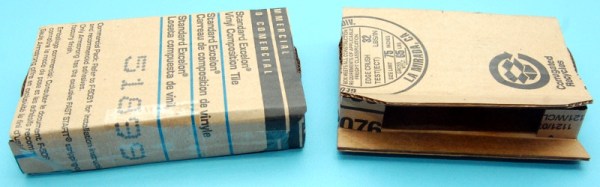
Here’s a wild idea…why not use them to ship things? But not exactly as they are, unless you’re in the business of shipping big stuff, the probably won’t do you much good as-is. Instead, why not turn those big flattened cardboard boxes into smaller, more convenient, shippers? That’s exactly what [Felix Rusu] has done, and we’ve got to say, it’s a brilliant idea.

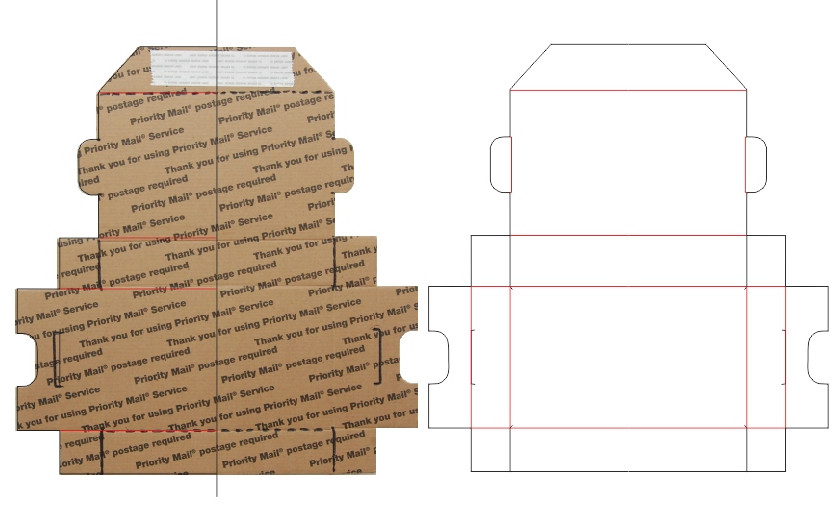
[Felix] started by tracing the outline of the USPS Priority Small Flat Rate Box, which was the perfect template as it comes to you flat packed and gets folded into its final shape. He fiddled with the design a bit, and in the end had a DXF file he could feed into his 60W CO2 laser cutter. By lowering the power to 15% on the fold lines, the cutter is even able to score the cardboard where it needs to fold.

Assuming you’ve got a powerful enough laser, you can now turn all those Amazon Prime boxes into the perfect shippers to use when your mom finally makes you sell your collection of Yu-Gi-Oh! cards on eBay. Otherwise, you can just use them to build a wall so she’ll finally stay out of your side of the basement.

[Thanks to Adrian for the tip.]

Continue reading “Laser Cutter Turns Scrapped To Shipped”

Printing Strain Wave Gears

We just wrapped up the Robotics Module Challenge portion of the Hackaday Prize, and if there’s one thing robots need to do, it’s move. This usually means some sort of motor, but you’ll probably want a gear system on there as well. Gotta have that torque, you know.

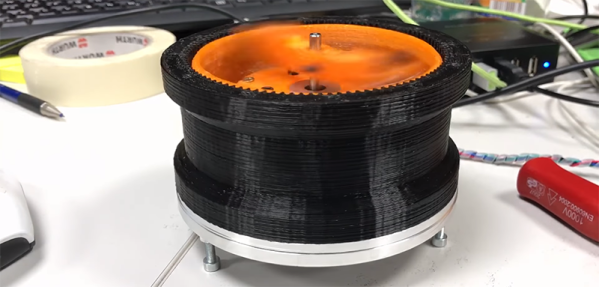
For his Hackaday Prize entry, [Johannes] is building a 3D printed Strain Wave Gear. A strain wave gear has a flexible middle piece that touches an outer gear rack when pushed by an oval central rotor. The difference in the number of teeth on the flexible collar and the outer rack determine the gear ratio.

This gear is almost entirely 3D printed, and the parts don’t need to be made of flexible filament or have weird support structures. It’s printed out of PETG, which [Johannes] says is slippery enough for a harmonic drive, and the NEMA 17 stepper is completely contained within the housing of the gear itself.

Printing a gear system is all well and good, but what do you do with it? As an experiment, [Johannes] slapped two of these motors together along with a strange, bone-like adapter to create a pan/tilt mount for a camera. Yes, if you don’t look at the weird pink and blue bone for a second, it’s just a DSLR on a tripod with a gimbal. The angular resolution of this setup is 0.03 degrees, so it should be possible to use this setup for astrophotography. Impressive, even if that particular implementation does look a little weird.

Continue reading “Printing Strain Wave Gears”