Shining A Light On Hearing Loss

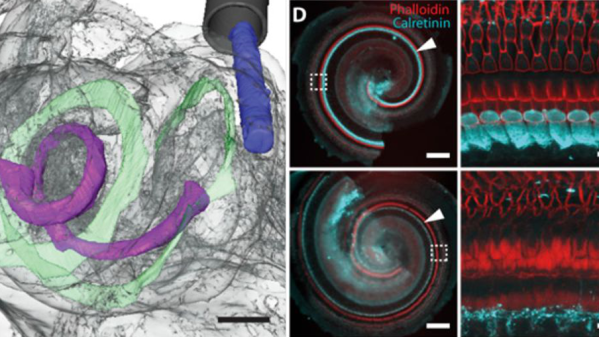
When auditory cells are modified to receive light, do you see sound, or hear light? To some trained gerbils at University Medical Center Göttingen, Germany under the care of [Tobias Moser], the question is moot. The gerbils were instructed to move to a different part of their cage when administrators played a sound, and when cochlear lights were activated on their modified cells, the gerbils obeyed their conditioning and went where they were supposed to go.

In the linked article, there is software which allows you to simulate what it is like to hear through a cochlear implant, or you can check out the video below the break which is not related to the article. Either way, improvements to the technology are welcome, and according to [Tobias]: “Optical stimulation may be the breakthrough to increase frequency resolution, and continue improving the cochlear implant”. The first cochlear implant was installed in 1964 so it has long history and a solid future.

This is not the only method for improving cochlear implants, and some don’t require any modified cells, but [Tobias] explained his reasoning. “I essentially took the harder route with optogenetics because it has a mechanism I understand,” and if that does not sound like so many hackers who reach for the tools they are familiar with, we don’t know what does. Revel in your Arduinos, 555 timers, transistors, or optogenetically modified cells, and know that your choice of tool is as powerful as the wielder.

Optogenetics could become a hot ticket at bio maker spaces. We have talked about optogenetics in lab rodents before, but it also finds purchase in zebrafish and roundworm.
Continue reading “Shining A Light On Hearing Loss”

Dual-Port Memory And Raspberry Pi Team Up For Retro Console Multicart

There’s something powerful about reliving the experience of using a game console from our personal good old days, especially the tactile memories stored up from hundreds of hours handling a chintzy joystick or the sound and feel of inserting a game cartridge. Emulators have their place, but they fall far short of period-correct hardware in the nostalgia department.

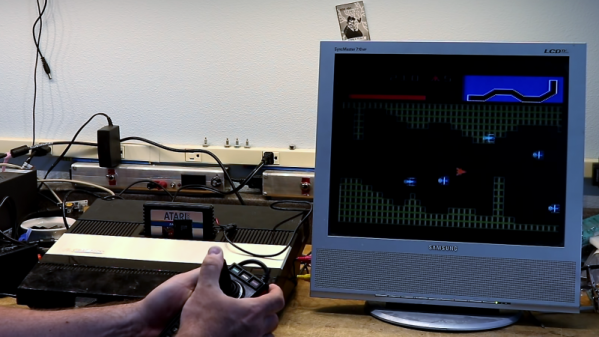
That’s not to say that the retro gear can’t use a little help in terms of usability, which is why [Scott M. Baker] built this Raspberry Pi multi-cartridge for his Atari 5200. The idea is to maintain the experience of the cartridge interface without having to keep stacks of cartridges around for all the games he wants to play. [Scott] leveraged the approach he used when he built a virtual floppy drive for a homebrew PC/XT: dual-port memory. The IDT7007 is a 32k chip that lives between the Atari 5200 and a Raspberry Pi Zero and can be addressed by both systems; the Pi to write ROM images to the memory, and the console to read them. He had to deal with some fussy details like chip select logic and dealing with the cartridge interlock signals, not to mention the difference in voltage between the memory chip’s logic levels and that of the Pi. Retro game-play occupies the first part of the video below; skip to 6:45 for build details.

The one quibble we have is trying to jam everything into an old cartridge. It’s critical to replicating the tactile experience, and while we don’t think we’d have gone so far as to injection mold a custom cartridge to house everything without any protrusions, we might have 3D-printed a custom cartridge instead. In the end it doesn’t detract much from the finished project, though, and we appreciate the mix of old and new tech.

Continue reading “Dual-Port Memory And Raspberry Pi Team Up For Retro Console Multicart”

An MRI-Safe 3D Printed Pneumatic Stepper Motor

You will no doubt have seen those videos where MRI machines suck up all sorts of metallic objects with hilariously disastrous results. The magnetic field in one of these machines can easily pull in metal objects from across the room, exerting a force of several hundred pounds on any ferrous object unlucky enough to wander too close. As you can probably imagine, designing mechanical devices that can operate in such an intense magnetic field is exceptionally difficult.

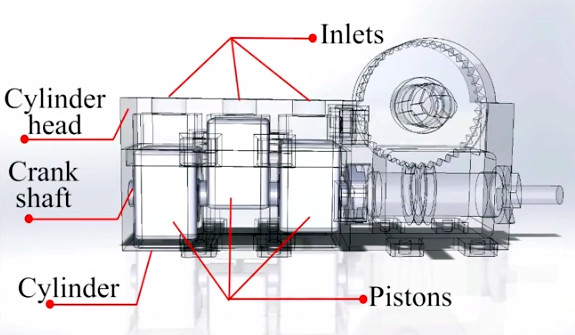
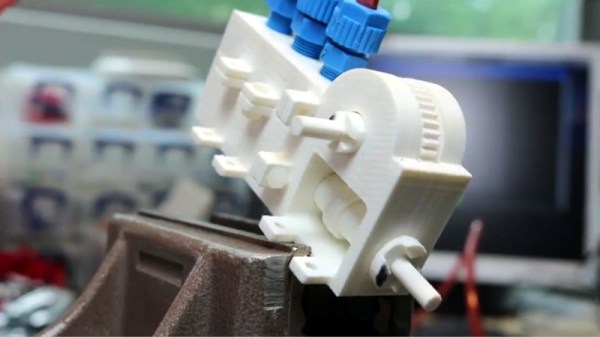
But this fully 3D printed pneumatic stepper motor designed by [Foad Sojoodi Farimani] might one day change that. The PneuAct, which he presented at the recent International Conference on Robotics and Automation (ICRA) in Brisbane, Australia, manages to run at up to 850 RPM with full position control using bursts of air rather than electronic pulses. Made entirely of plastic and without any electronic components, the PneuAct can not only operate in intense magnetic fields but also areas with flammable gases where sparks could potentially cause an explosion.

We often say that a design is “fully” 3D printable, even though it might require screws or other bits of hardware. But in the case of the PneuAct, it’s truly all printed. It has to be, or else the whole thing would be ripped apart when it got to close to the MRI machine. Each and every piece of the motor is printed in ABS, and can be used without any additional machining or cleanup. No lubrication is required, and [Foad] mentions that the whole thing is so cheap that it can be disposable. Which is a huge advantage in medical environments where contamination could be a concern.

Design-wise the PneuAct is essentially an expanded version of the 3D printed air motors we’ve seen previously, but it would be fair to say that none has ever been studied so closely before.

Continue reading “An MRI-Safe 3D Printed Pneumatic Stepper Motor”

Bringing Augmented Reality To The Workbench

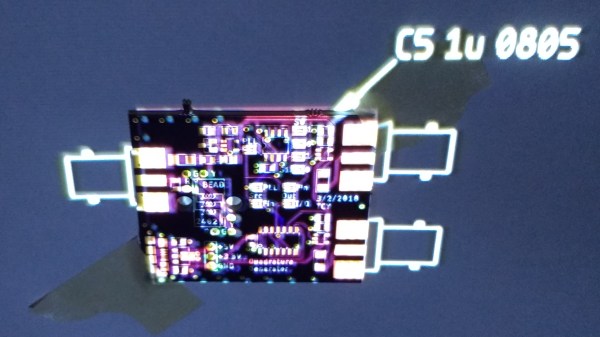
[Ted Yapo] has big ideas for using Augmented Reality as a tool to enhance an electronics workbench. His concept uses a camera and projector system working together to detect objects on a workbench, and project information onto and around them. [Ted] envisions virtual displays from DMMs, oscilloscopes, logic analyzers, and other instruments projected onto a convenient place on the actual work area, removing the need to glance back and forth between tools and the instrument display. That’s only the beginning, however. A good camera and projector system could read barcodes on component bags to track inventory, guide manual PCB assembly by projecting which components go where, display reference data, and more.

An open-sourced, accessible machine vision system working in tandem with a projector would open a lot of doors. Fortunately [Ted] has prior experience in this area, having previously written the computer vision code for room-scale dynamic projection environments. That’s solid experience that he can apply to designing a workbench-scale system as his entry for The Hackaday Prize.

Hackaday Belgrade: Luka Mustafa On Exploiting IoT Niches

Ecology is a strange discipline. At its most basic, it’s the study of how living things interact with their environment. It doesn’t so much seek to explain how life works, but rather how lives work together. A guiding principle of ecology is that life finds a way to exploit niches, subregions within the larger world with a particular mix of resources and challenges. It’s actually all quite fascinating.

But what does ecology have to do with Luka Mustafa’s talk at the 2018 Hackaday Belgrade Conference? Everything, as it turns out, and not just because Luka and his colleagues put IoT tools on animals and in their environments to measure and monitor them. It’s also that Luka has found a fascinating niche of his own to exploit, one on the edge of technology and ecology. As CEO of Institute IRNAS, a non-profit technology development group in Slovenia, Luka has leveraged his MEng degree, background in ham radio, and interest in LoRaWAN and other wide-area radio networks to explore ecological niches in ways that would have been unthinkable even 10 years ago, let alone in the days when animal tracking was limited by bulky radio collars.

Continue reading “Hackaday Belgrade: Luka Mustafa On Exploiting IoT Niches”

This Cetus Printer Is Rigged For Silent Running

The entry-level 3D-printer market is a rich one, with offerings from many vendors that are surprisingly good. But nothing is perfect, and to hit the $200 price point some compromises are inevitable. That doesn’t mean you have to live with those engineering choices, of course, which makes these cheap printers a great jumping off point for aftermarket mods.

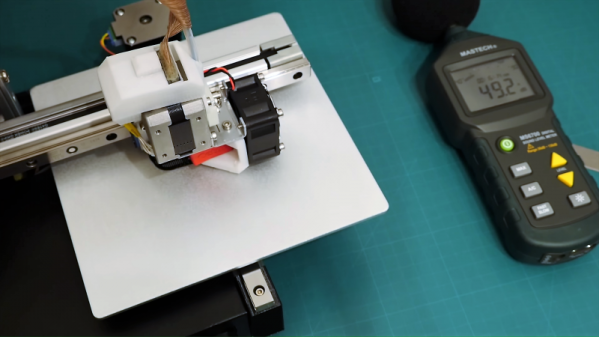
[Linas K] took this route and in the process made his Cetus 3D-printer essentially silent. The first part of the video below reviews the shortcomings of the stock machine and the mechanical changes [Linas] made, including new brackets for the Z-axis slide, relocating the WiFi antenna to someplace sensible, and adding limit switches for each slide. Inside the case, the electronics get a complete reworking, with a custom PCB to house Trinamic stepper drivers for ultraquiet operation. The new board also supports the limit switches as well as thermostatic control of the extruder fan and pads for a platform heater. As a bonus, the new PCB is much smaller than the original, leaving room to tuck the power supply into the case, which is a nice touch. It wasn’t cheap, and it meant basically gutting the printer, but the results are impressively quiet.

We’re tempted to try these silencing mods on our own Cetus, if [Linas] ever publishes the BOM and PCB designs (hint, hint). And Cetus hacking is becoming quite a thing around here. From a trio of Cetus pro-tips to turning a Cetus into a PCB machine, the little printer has a lot to offer.

Continue reading “This Cetus Printer Is Rigged For Silent Running”

Working On A Startup? New Fund Is Building Portfolio From Hard Technology

Root Ventures just announced it has raised a second fund and is in search of startups to invest the $76,726,900 they now have burning a hole on their balance sheet. Their first fund of $31,415,926.53 went to some very cool hardware companies like Shaper, Particle, Plethora, and Prynt. For those keeping score, the first fund is Pi and the second is the speed of sound — it’s a geeky engineer thing.

This is a seed fund, and founding partner Avidan Ross described their role in your company as being the world’s “greatest sherpa to take you on a really tumultuous path”. That path is one of building a product around which a great company can arise. Repeatedly during the conference call with Hackaday, Avidan stressed that what makes Root Ventures stand out is that the partners in the firm are themselves engineers and have hardware backgrounds. For instance, Avidan spoke at the 2016 Hackaday Superconference about his 45-second pizza oven and other food/automation hacks. Partner Chrissy Meyer was an engineering manager at Apple and led hardware programs at Square, before founding a vehicle technology startup. Their point is that if you’re going to entrust part of your company to someone, it’s nice if they have the background to understand it.

Whether or not you have a startup in the works, it’s interesting to know what the keepers of the cash are looking for. Avidan described this as a engineering-heavy seed fund, but stopped short of calling it a hardware seed fund, using the more coy term “hard-tech fund”  although more than half of the portfolio companies already on board are building new, original hardware. It’s impossible to nail down exactly what the fund is seeking — they’ll know it when they see it — but we had a nice conversation of some of the future trends he has in mind.

While economies of scale in the smartphone industry delivered low cost sensors such as accelerometers, GPS, and cameras, along with connectivity, the next wave may be from the self-driving industry. Avidan foresees rising availability of ASICs, specialized GPUs, and the sensing hardware currently under heavy R&D in the automotive industry. His take is that not only will this be a hardware boon for startups, but the machine learning aspects of it will produce both talent and opportunity for new companies.

Pull together those proofs of concept and get your presentation decks ready. That $76 million is just waiting for a great idea to come along. If you make it big, Hackaday still wants an early look at your awesome new hardware!