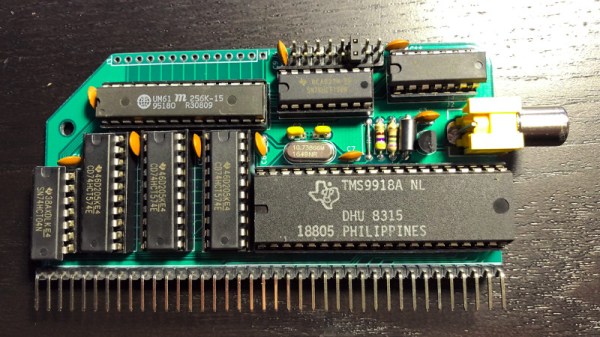
One of the outliers in the home computer wars of the early 1980s was the Texas Instruments TI99/4A. It may not have had the games library of its rivals and its TMS9900 processor may not have set the world on fire with its registers-in-RAM architecture, but its range of support chips included one whose derivatives would go on to delight subsequent generations. If you had an MSX or one of the 8 or 16-bit Sega consoles, the TMS9918A graphics chip provided the architecture that sat behind Sonic in his adventures.
A few decades later, there is still significant interest in this classic chip. [J.B. Langston] has an RC2014 retrocomputer, and wishing to play MSX demos upon it, has created a TMS9918A-based graphics card for the RC2014 bus. The success of the board hinges upon a circuit showing how to interface the 9918A to SRAM, and since it is mapped to the same ports as its MSX equivalent it should in theory be compatible with Z80 demos written for that platform. He’s already achieved some success with that aim, as can be demonstrated by the video we’ve placed below the break of the Bold MSX demo running on an RC2014.
The RC2014 has gained a significant following in the retrocomputer scene, and has appeared here many times. We reviewed an early model in 2016. Surprisingly though the TMS9918A has only appeared here once, as part of a homebrew 6809-based system.
Continue reading “There’s RC2014 Life In The TMS9918A Display Chip Yet”

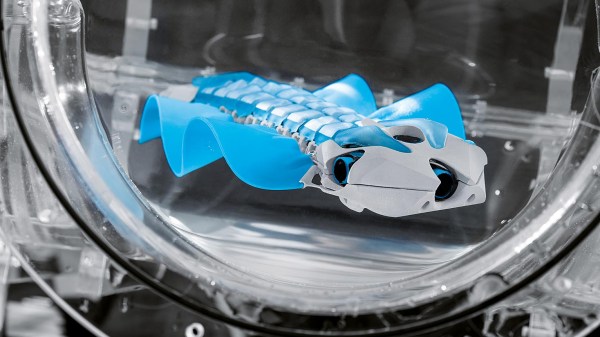
 What was their elegant solution for making the fins undulate? Nine lever arms are attached to each fin. Those lever arms are controlled by two crankshafts which extend from the front of the body to the rear, one for each side. A servo motor then turns each crankshaft. Since the crankshafts are independent, that means each fin operates independently. This allows for turning by having one fin move faster than the other. A third motor in the head flexes the body, causing the robot to swim up or down.