Heartwatch Monitors Your Ticker

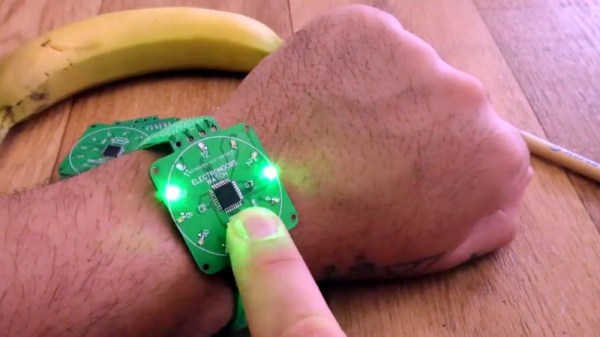
The heart! A pump of the most fantastical kind, it is capable of operating for decades without rest. It’s responsible for supplying vital oxygen to the body’s subsystems, and can be readily monitored with modern technology. [Dave Vernooy] wanted to build a watch that could take heartrate and blood oxygen measurements – so he did.

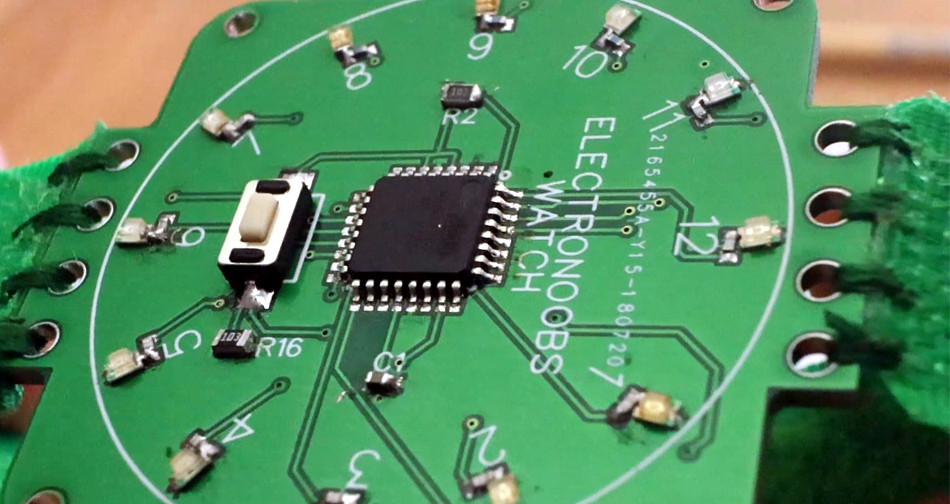
Named Heartwatch, the device is a DIY smartwatch build with a bunch of exciting features. Heart monitoring is taken care of by the MAX30102 sensor which integrates all the hardware to sense heart rate and oxygen saturation into a single tiny plastic package. There’s then an assortment of accelerometers, gyros and even a color LCD to display all the wonderful information.

It’s all wrapped up in a 3D printed case, with an ATMEGA1284 running the show. The project just goes to show how much can be achieved with an 8-bit processor – there’s not always a need to run a high-powered ARM chip for an embedded project.

There are a fair few DIY smartwatch builds out there – like this classy unit with an OLED screen.

PCB Holder Quick-fix Turns Out To Be Big Improvement

When something needs improving, most hacks often make a small tweak to address a problem without changing how things really work. Other hacks go a level deeper, and that’s what [Felix Rusu] did with his 3D printed magnetic holders. Originally designed to address a shortcoming with the PCB holders in his LE40V desktop pick-and-place machine, they turned out to be useful for other applications as well, and easily modified to use whatever size magnets happen to be handy.

The problem [Felix] had with the PCB holders on his pick-and-place was that they hold the board suspended in midair by gripping the sides. The board is held securely, but the high density of parts on panelized PCB designs leads to vibrations in the suspended board as the pick-and-place head goes to work. Things are even worse when the board is v-scored for the purpose of easily snapping apart the smaller boards later; they sometimes break along the score lines due to the stress.

Most people would solve this problem by putting a spacer underneath the board to stabilize things, but [Felix] decided to go a level deeper and change the mounting system altogether with a simple mod. The boards now lie on a flat metal plate, and his magnetic holders are simple to make and easily do the job of holding any size PCB secure. As a bonus, it turns out that the holders also do a passable job of holding work materials down on a laser cutter’s honeycomb table. A video overview is embedded below, and the design files are available on Thingiverse.

Continue reading “PCB Holder Quick-fix Turns Out To Be Big Improvement”

Aquarium Controller Starring Arduino Gets A Long Video Description

There’s an old saying that the cobbler’s children have no shoes. Sometimes we feel that way because we stay busy designing things for other people or for demos that we don’t have time to just build something we want. [Blue Blade Fish] wanted to build an Arduino-based aquarium controller. He’s detailed the system in (so far) 14 videos and it looks solid.

This isn’t just a simple controller, either. It is a modular design with an Arduino Mega and a lot of I/O for a serious fish tank. There are controls for heaters, fans, lights, wave makers and even top-off valves. The system can simulate moonlight at night and has an LCD display and keys. There’s also an Ethernet port and a Raspberry Pi component that creates a web interface, data storage, and configures the system. Even fail safes have been designed into the system, so you don’t boil or freeze expensive fishes. No wonder it took 14 videos!

Continue reading “Aquarium Controller Starring Arduino Gets A Long Video Description”

Wireless SMD microscope ring light

Wireless Ring Light For SMD Microscope

When [Felix Rusu], maker of the popular Moteino boards which started life as wireless Arduino compatibles, says he’s made a wireless ring light for his SMD microscope, we redirect our keystrokes to have a look. Of course, it’s a bit of wordplay on his part. What he’s done is made a new ring light which uses a battery instead of having annoying wires go to a wall wart. That’s important for someone who spends so much time hunched over the microscope. Oh, and he’s built the ring light on a rather nice looking SMD board.

The board offers a few power configurations. Normally he powers it from a 1650 mAh LiPo battery attached to the rear of his microscope. The battery can be charged using USB or through a DC jack for which there’s a place on the board, though he hasn’t soldered one on yet. In a pinch, he can instead power the light from the USB or the DC jack, but so far he’s getting over 6 hours on a single charge, good enough for an SMD session.

The video below shows his SMD board manufacturing process, from drawing up the board in Eagle, laser cutting holes for a stencil, pasting, populating the board, and doing the reflow, along with all sorts of tips along the way. Check it out, it makes for enjoyable viewing.

Here’s another microscope ring light with selectable lighting patterns for getting rid of those pesky shadows. What features would make your SMD sessions go a little easier?

Continue reading “Wireless Ring Light For SMD Microscope”

Reverse-Engineering Brains, One Neuron At A Time

Most posts here are electrical or mechanical, with a few scattered hacks from other fields. Those who also keep up with advances in biomedical research may have noticed certain areas are starting to parallel the electronics we know. [Dr. Rajib Shubert] is in one such field, and picked up on the commonality as well. He thought it’d be interesting to bridge the two worlds by explaining his research using analogies familiar to the Hackaday audience. (Video also embedded below.)

He laid the foundation with a little background, establishing that we’ve been able to see individual static neurons for a while via microscope slides and such, and we’ve been able to see activity of the whole living brain via functional MRI. These methods gradually improved our understanding of neurons, and advances within the past few years have reached an intersection of those two points: [Dr. Shubert] and colleagues now have tools to peer inside a functional brain, teasing out how it works one neuron at a time.

[Dr. Shubert]’s talk makes analogies to electronics hardware, but we can also make a software analogy treating the brain as a highly optimized (and/or obfuscated) piece of code. Virus stamping a single cell under this analogy is like isolating a single function, seeing who calls it, and who it calls. This pairs well with optogenetics techniques, which can be seen as like modifying a function to see how it affects results in real time. It certainly puts a different meaning on the phrase “working with live code”!

Continue reading “Reverse-Engineering Brains, One Neuron At A Time”

DDL-4 Is A Visually Pleasing Modular CPU

Today’s CPUs are so advanced that they might as well be indistinguishable from magic, right? Wrong! Fundamentally, modern CPUs can be understood logically like any other technology, it’s just that they’re very fast, very small, and very complex, which makes it hard to get to grips with their inner workings. We’ve come a long way from the dawn of the home computer in the 80s, but what if there was something even simpler again, built in such a way as to be easily understandable? Enter the DDL-4-CPU, courtesy of [Dave’s Dev Lab].

The DDL-4 is a project to build a modular 4-bit CPU using bitslice methods. This is where computations are broken down into simple operations with two-bit inputs, which are executed with basic logic gates like NOR and XOR. This is great for building a CPU from individual parts, as logic chips are readily available and their operation is readily understood. That’s what’s used here – good old 74-series logic, which you can find just about anywhere!

The build consists of a series of modules, each on its own colourful PCB and labeled on the silkscreen. These modules can then be configured and plugged together with edge connectors to build the CPU. The work builds upon [Dave]’s earlier work on the Mega-One-8-One, a recreation of the 74181 Arithmetic Logic Unit for educational purposes.

If you’re learning about computing in a bare-metal sense, projects like these that create CPUs from the ground up are a great way to get to grips with the basic concepts of computation. Once you’ve tried this, you could always graduate to building a 6502 in Minecraft.

DEXTER Has The Precision To Get The Job Done

Robotic arms – they’re useful, a key part of our modern manufacturing economy, and can also be charming under the right circumstances. But above all, they are prized for being able to undertake complex tasks repeatedly and in a highly precise manner. Delivering on all counts is DEXTER, an open-source 5-axis robotic arm with incredible precision.

DEXTER is built out of 3D printed parts, combined with off-the-shelf carbon fiber sections to add strength. Control is through five NEMA 17 stepper motors which are connected to harmonic drives to step the output down at a ratio of 52:1. Each motor is fitted with an optical encoder which provides feedback to control the end effector position.

Unlike many simpler projects, DEXTER doesn’t play in the paddling pool with 8-bit micros or even an ARM chip – an FPGA lends the brainpower to DEXTER’s operations. This gives DEXTER broad capabilities for configuration and expansion. Additionally, it allows plenty of horsepower for the development of features like training modes, where the robot is stepped manually through movements and they are recorded for performance later.

It’s a project that is both high performing and open-source, which is always nice to see. We look forward to seeing how this one develops further!