These Small PCBs Are Made For Model Rocketry

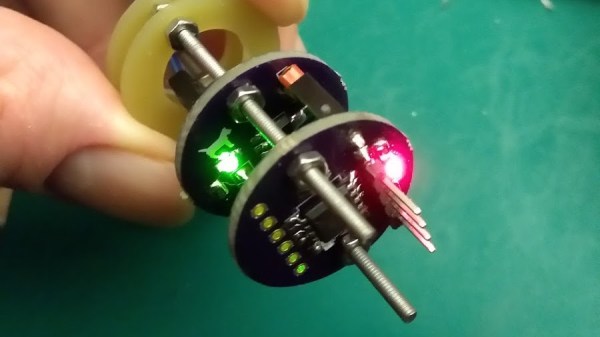
Model rocketry hobbyists are familiar with the need to roll their own solutions when putting high-tech features into rockets, and a desire to include a microcontroller in a rocket while still keeping things flexible and modular is what led [concretedog] to design a system using 22 mm diameter stackable PCBs designed to easily fit inside rocket bodies. The system uses a couple of 2 mm threaded rods for robust mounting and provides an ATTiny85 microcontroller, power control, and an optional small prototyping area. Making self-contained modular sleds that fit easily into rocket bodies (or any tube with a roughly one-inch inner diameter) is much easier as a result.

The original goal was to ease the prototyping of microcontroller-driven functions like delayed ignition or altimeter triggers in small Estes rockets, but [concretedog] felt there were probably other uses for the boards as well and made the design files available on GitHub. (Thanks!)

We have seen stackable PCBs for rocketry before with the amazingly polished M3 Avionics project, but [concretedog]’s design is much more accessible to some hobbyist-level tinkering; especially since the ATTiny85 can be programmed using the Arduino IDE and the boards themselves are just an order from OSH Park away.

[via Dangerous Prototypes Blog]

 

Fully 3D Printed Nerf Thirst Zapper

In case you weren’t aware, there is a whole community out there that revolves around customizing NERF guns. In that community is a subculture that builds their own NERF guns, and within that group is a sub-subculture that 3D prints NERF guns. So next time you are contemplating how esoteric your little corner of the hacking world is, keep that in mind.

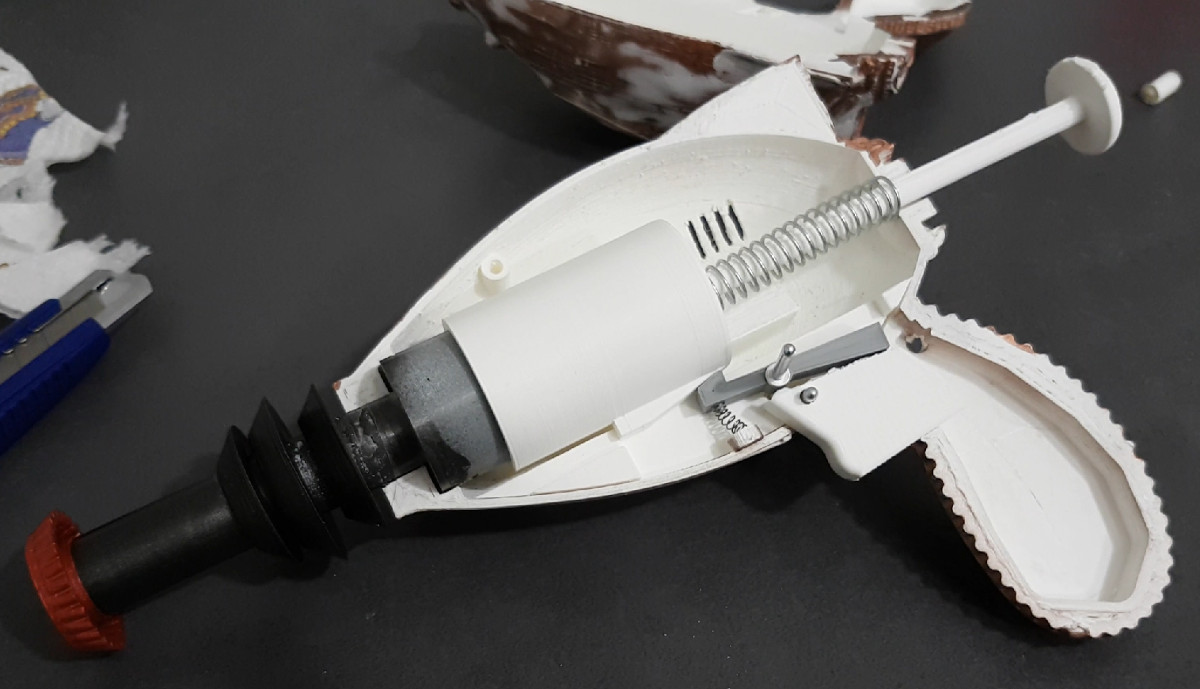
Anyway, [Wekster] is currently making his way in the world of 3D printed one-off NERF guns, and has unveiled his latest creation: a fully 3D printed “Thirst Zapper” from Fallout 4. Except for the springs, each and every piece of this gun was printed on his CR-10 printer. You could even wind your own springs if you really wanted to, and keep the whole thing in-house. Because if you’re going to do something this niche, you might as well go all in.

Even if you aren’t a member of the NERF-elite, the video [Wekster] has put together for this project is a fantastic look at what it takes to design, print, and finish a custom build. From creating the model to mixing the paint to match the in-game model, this video has a little something for everyone.

This isn’t the first time we’ve covered 3D printed NERF guns, but it’s surely the most ornate we’ve ever seen. Interestingly, the bar is set pretty high for Fallout-themed builds in general, so perhaps there’s some unwritten rule out there in regards to Fallout prop builds.

Continue reading “Fully 3D Printed Nerf Thirst Zapper”

Microchip Introduces Tiny Cheap Linux Modules

Linux is in everything these days, and that means designers and engineers are crying out for a simple, easy-to-use module that simplifies the design of building a product to do something with Linux. The best example of this product category would probably be the Raspberry Pi Compute Module, followed by the C.H.I.P. Pro and its GR8 module. There are dozens of boards with Allwinner and Mali chips stuffed inside that can be used to build a Linux product, and the ‘BeagleBone on a Chip’ is a fantastic product if you need Linux and want to poke pins really, really fast.

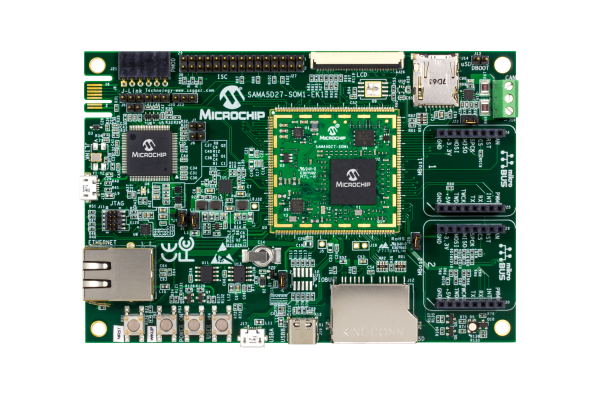
Now Microchip is rolling out with their answer to the Linux System on Module. The SAMA5D2 is a single chip in a BGA package with a small footprint that runs Linux. It’s capable, it’s cheap, and if you want to put Linux in a project, this is your newest option.

The core product in this new Microchip lineup is the SAMA5D2 SIP, a system in package that puts an ARM Cortex-A5 CPU and DDR2 memory in a single BGA package that, with a cursory examination, looks easy enough to design a PCB around and reflow. There are four chips in this lineup, with 128 Mbit, 512 Mbit, and 1 Gbit of DDR2 memory. The 128 Mbit chip is meant for bare metal and RTOS applications, with the higher memory chips capable of running Linux at least as well as a repurposed router.

This chip is at the core of Microchip’s ATSAMA5D2 SOM, a system on module that adds power management (that only requires a single 3.3V supply), an Ethernet PHY, and boot memory into a single package that’s effectively as hand-solderable as a QFN package. It’s Linux on a Chip, or at least as close as we’ve gotten to such a concept.

Adding Linux to a project is hard, and while there are modules and systems that can do it, we’re always welcoming more options given to designers. While these modules and systems aren’t exactly cheap compared to a beefy ARM microcontroller — the SIP starts at around $9, the SOM is available for $39 in 100-unit quantities — this price is quite low compared to other Linux-on-Modules available.

You’ve Never Seen A Flipping Eyeball Like This One!

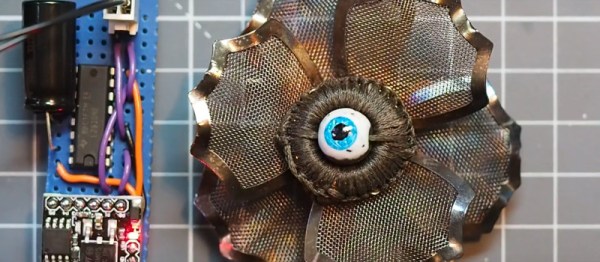
Inspired by some impressive work on textile flip-bit displays, and with creative steampunk outfits to create for Christmas, [Richard Sewell] had the idea for a flippable magnetic eye in the manner of a flip-dot display. These devices are bistable mechanical displays in which a magnet is suspended above a coil of wire, and “flipped” in orientation under the influence of a magnetic field from the coil.

In [Richard]’s case the eyeball was provided by a magnetic bead with a suitable paint job, and the coil was a hand-wound affair with some extremely neat lacing to keep it all in place. The coil requires about 200 mA to ensure the eye flips, and the job of driving it is performed by a Digispark ATTiny85 board with an LM293 dual H-bridge driver upon which the two bridges are wired in parallel. The whole is mounted in the centre of a charity shop brooch that has been heat-treated to give a suitable aesthetic.

You can see the eyeball in all its glory in the two videos below the break, and should you be curious you can also read our write-up of the original pieces from [Irene Posch] that inspired it.

Continue reading “You’ve Never Seen A Flipping Eyeball Like This One!”

Tachometer Uses Light, Arduinos

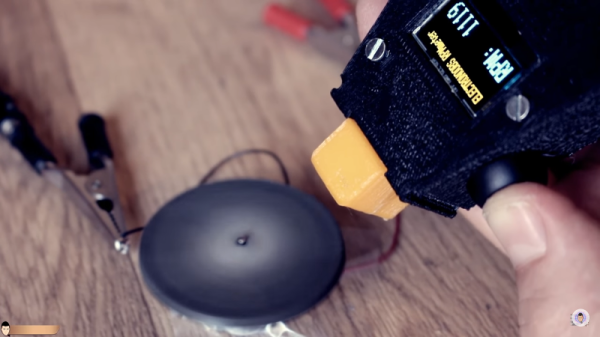
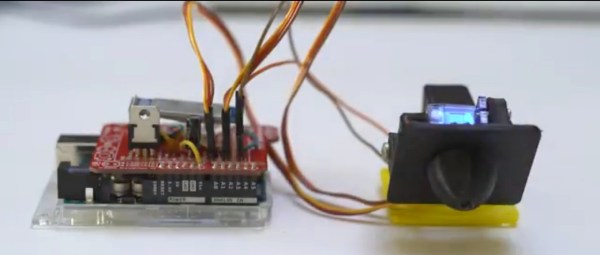
To measure how fast something spins, most of us will reach for a tachometer without thinking much about how it works. Tachometers are often found in cars to measure engine RPM, but handheld units can be used for measuring the speed of rotation for other things as well. While some have mechanical shafts that must make physical contact with whatever you’re trying to measure, [electronoobs] has created a contactless tachometer that uses infrared light to take RPM measurements instead.

The tool uses an infrared emitter/detector pair along with an op amp to sense revolution speed. The signal from the IR detector is passed through an op amp in order to improve the quality of the signal and then that is fed into an Arduino. The device also features an OLED screen and a fine-tuning potentiometer all within its own self-contained, 3D-printed case and is powered by a 9 V battery, and can measure up to 10,000 RPM.

The only downside to this design is that a piece of white tape needs to be applied to the subject in order to get the IR detector to work properly, but this is an acceptable tradeoff for not having to make physical contact with a high-speed rotating shaft. All of the schematics and G code are available on the project site too if you want to build your own, and if you’re curious as to what other tools Arduinos have been used in be sure to check out the Arduino-based precision jig.

Continue reading “Tachometer Uses Light, Arduinos”

Cat laser on a pan-tilt robot

Robotic Laser Keeps Cat Entertained While You Hack

Whether it’s our own cat or a neighbor’s, many of us have experienced the friendly feline keeping us company while we work, often contributing on the keyboard, sticking its head where our hands are for a closer look, or sitting on needed parts. So how to keep the crafty kitty busy elsewhere? This roboticized laser on a pan-tilt mechanism from the [circuit.io team] should do the trick.

The laser is a 650 nm laser diode mounted on a 3D printed pan-tilt system which they found on Thingiverse and modified for attaching the diode’s housing. It’s all pretty lightweight so two 9G Micro Servos do the grunt work just fine. The brain is an Arduino UNO running an open-source VarSpeedServo library for smooth movements. Also included are an HC-05 Bluetooth receiver and an Android app for controlling the laser from your phone. Set it to Autoplay or take a break and use the buttons to direct the laser yourself. See the video below for build instructions and of course their cat, [Pepper], looking like a Flamenco dancer chasing the light.

Continue reading “Robotic Laser Keeps Cat Entertained While You Hack”

Stretched PC Case Turned GPU Cryptominer

We don’t do financial planning here at Hackaday, so we won’t weigh in on the viability of making money mining cryptocurrency in such a volatile market. But we will say that if you’re going to build a machine to hammer away at generating Magical Internet Monies, you might as well make it cool. Even if you don’t turn a profit, at least you’ll have something interesting to look at while you weep over your electricity bill.

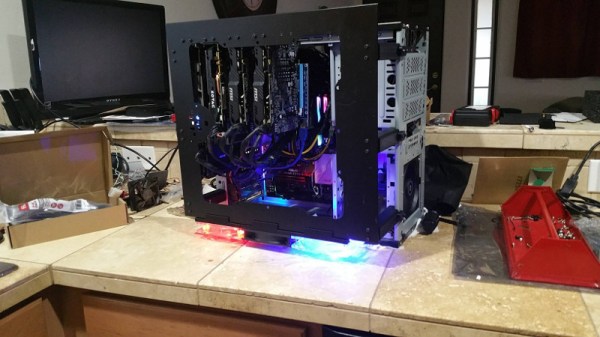
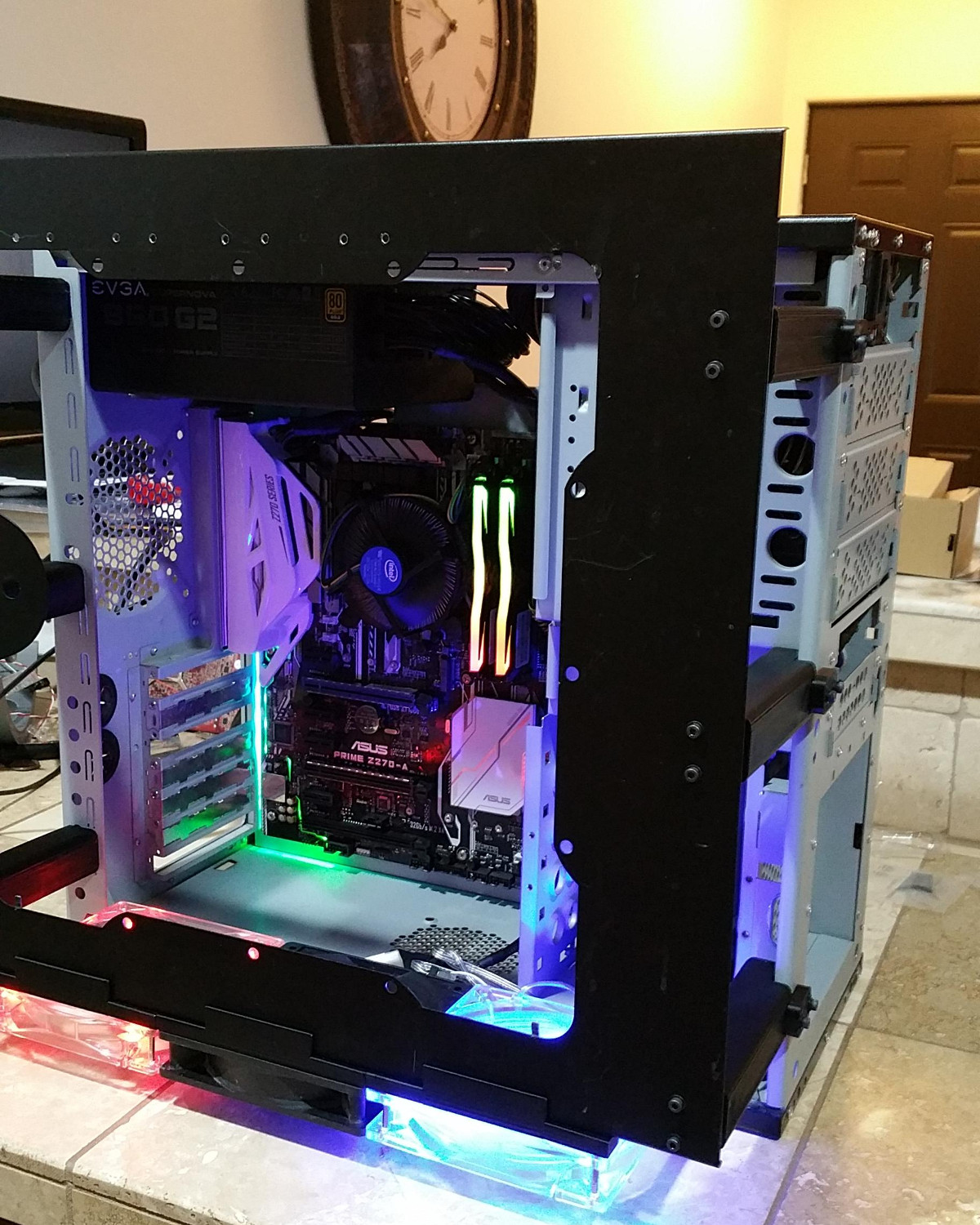
Sick of seeing the desktop machine he built a decade ago gathering dust, [plaggle24w5] decided to use it as the base for a cryptocurrency mining rig. Of course, none of the original internals would do him any good, but the case itself ended up being a useful base to expand on. With the addition of some 3D printed components, he stretched out the case and installed an array of video cards.

To start with, all the original plastic was ripped off, leaving just the bare steel case. He then jammed a second power supply into the original optical drive bays to provide the extra power those thirsty GPUs would soon be sucking down. He then designed some 3D printed arms which would push out the side panel of the case far enough that he could mount the video cards vertically alongside the case. Three case fans were then added to the bottom to blow air through the cards.

While [plaggle24w5] mentions this arrangement does work with the case standing up, there’s obviously not a lot of air getting to the fans on the bottom when they’re only an inch or so off the ground. Turning the case on its side, with the motherboard parallel to the floor, allows for much better airflow and results in a measurable dip in operating temperature. Just hope you never drop anything down onto the exposed motherboard…

Mining Bitcoin on desktop computers might be a distant memory, but the latest crop of cryptocurrencies are (for now) giving new players a chance to relive those heady early days.