How To Build An Airplane In A Month And A Half

For the last few weeks, RC pilot extraordinaire [Peter Sripol] has been working on his biggest project to date. It’s effectively a manned RC plane, now legally a Part 103 ultralight. Now all that work is finally bearing fruit. [Peter] is flying this plane on some short hops down a grass runway. He’s flying it, and proving that you can build a plane in a basement, in under two months, constructed almost entirely out of insulation foam.

[Peter] has been documenting this build on his YouTube channel, and although the materials for this plane are mostly sourced from either Home Depot or Lowes, the construction is remarkably similar to what you would expect to find in other homebuilt aircraft. This thing has plywood gussets, the foam is wearing a thin layer of fiberglass, and the fasteners are from Aircraft Spruce.
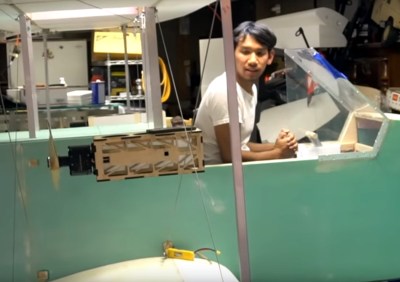
The power system is another matter entirely. The engines (all two of them!) are electric and are designed for very large RC aircraft. These engines suck down power from a massive battery pack in the nose, and the twin throttles are really just linear potentiometers hacked onto servo testers. There’s a surprising amount of very important equipment on this plane that is just what [Peter] had sitting around the workshop.

As far as the legality of this ultralight experiment is concerned, [Peter] is pretty much above-board. This is a Part 103 ultralight, and legally any moron can jump in an ultralight and fly. There are some highly entertaining YouTube videos attesting this fact. However, in one of [Peter]’s livestreams, he flew well after sunset without any strobes on the plane. We’re going to call this a variant of go-fever, technically illegal, and something that could merit a call from the FAA. We’re going to give him a pass on this, though.

This build still isn’t done, though. The pitot tube is held onto the windshield with duct tape. The plane was slightly nose heavy, but shifting the batteries around helped with that. [Peter] is running the motors on 12S batteries, and the prop/motor combo should be run on 14S batteries — $1200 of batteries are on order. The entire plane needs a paint job, but there’s no indication that will ever be done. With all that said, this is a functional manned aircraft built in a basement in less than two months.

With the plane complete and ground tests quickly moving on to flight tests, it’s only fitting to mention [Peter]’s GoFundMe page for a parachute. [Peter] is going to fly this thing anyway, and this is a great way to deflect Internet concern trolls. [Peter]’s just short of the $2600 needed for a parachute, but if the funds received go over that amount by a few hundred, a ballistic parachute will save [Peter] and the plane.


Beyond Conway: Cellular Automata From All Walks Of Life

There’s a time in every geek’s development when they learn of Conway’s Game of Life. This is usually followed by an afternoon spent on discovering that the standard rule set has been chosen because most of the others just don’t do interesting things, and that every idea you have has already been implemented. Often enough this episode is then remembered as ‘having learned about cellular automata’ (CA). While important, the Game of Life is not the only CA out there and it’s not even the first. The story starts decades before Life’s publication in 1970 in a place where a lot of science happened at that time: the year is 1943, the place is Los Alamos in New Mexico and the name is John von Neumann.

Recap: What is a CA?

A cyclic CA making some waves

The ‘cellular’ part in the name comes from the fact that CAs represent a grid of cells that can be in a number of defined states. The grid can have any number of dimensions, but with three dimensions the visual representation starts to get into the way, and above that most human brains stop working, so two-dimensional grids are the most common — with the occasional one-dimensional surprise. The cells’ states are in most cases discrete but a subset of continuous CAs exists. During the operation of a CA the future state of every cell in the grid is determined from each cells state according to a set of rules which in most cases take into account the states of neighboring cells.

Continue reading “Beyond Conway: Cellular Automata From All Walks Of Life”

Mercy Me, Thanks For The Heals

Sometimes, you have to call in the experts. [CorSec Props], builders of fine props, costumes and more, were commissioned to replicate Mercy’s healing staff from the game Overwatch. Sounds simple, but the customer — right as they always are — requested that it spin and light up just like the original.

To get a look at the electronics, the rotating head slides off after removing a screw. Inside, the rechargeable 18650 lithium-ion 3.7V battery — via a DC to DC converter — is bumped up to 5.5V in order to run a 12V, 120rpm motor. At full voltage the staff’s head rotates too fast, and so it’s deliberately under-powered for a more replica-appropriate speed.

A ring of RGB LEDs as well as a pair pointed at the tip of the staff toggle between yellow and blue hues. To switch between these different lighting modes, a double-pole, triple throw switch was modified to function like a more-suited-to-the-task-than-what-we-had-in-the-shop three position, double-pole, double-throw switch.

On the motor shaft, pair of studs slot into a piece of acrylic at the tip of the staff. This stops it from slipping, but also allows the LED glow to diffuse out the top as well as the portholes on the side of the staff. Check out the build after the break!

Continue reading “Mercy Me, Thanks For The Heals”

Bluetooth Bedroom Clock!

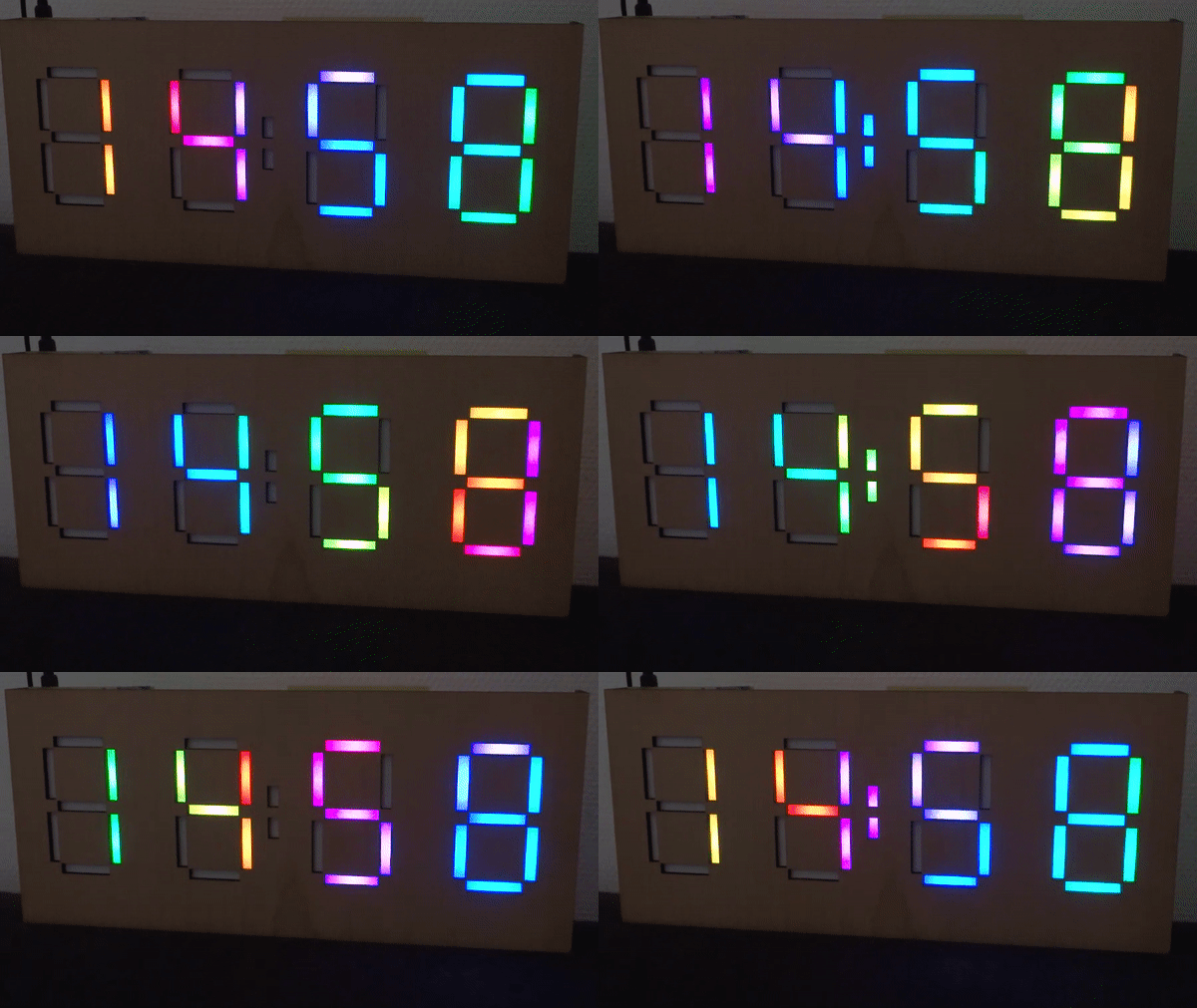
When [decino]’s old bedroom clock finally bit the dust, he built himself a new one from scratch for fun and functionality.

Initially, he wanted to solder Adafruit NeoPixel lights onto four prototype boards, using a mini-USB for power and a DS1307 to keep the time. However, after soldering the board for the first digit and realizing that carrying on with the other three would be a huge pain, he switched to etching the boards instead — a far more efficient solution. In keeping with this time-saving mindset, he added a Bluetooth module that would allow him to update the clock from his phone whenever the DS1307 started dropping minutes or whenever daylight savings time is in effect.

Continue reading “Bluetooth Bedroom Clock!”

Graphene Biosensors Are Extra Quiet

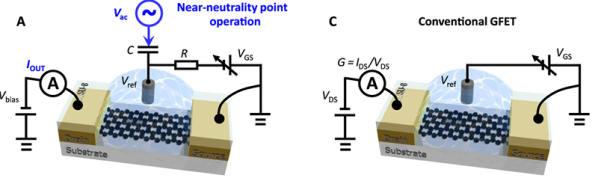
Graphene has attracted enormous interest for electrically detecting chemical and biological materials. However, because the super material doesn’t act like a normal semiconductor, transistors require multiple layers of the material, and that’s bad for 1/f noise especially when the transistors operate at maximum transconductance. Researchers have found a way to operate graphene transistors at a neutral point, significantly reducing 1/f noise while not impacting the sensor’s response.

The team created a proof-of concept sensor that could detect an HIV-related DNA hybridization. The sensor was able to detect very tiny concentrations of the material.

Continue reading “Graphene Biosensors Are Extra Quiet”

Ben Krasnow hacks E-paper

[Ben Krasnow] Hacks E-Paper For Fastest Refresh Rate

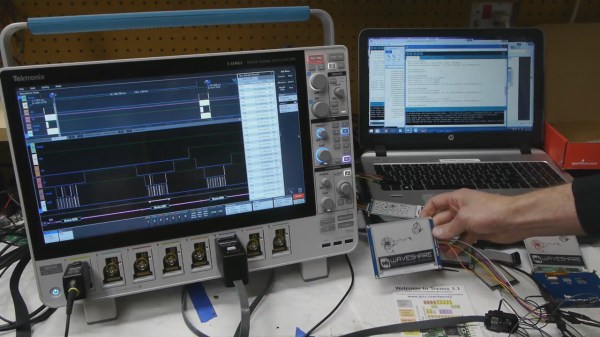
[Ben Krasnow] is known for his clear explanations alongside awesome hardware, being one of only a few hackers who owns an electron microscope. This time he’s explaining how E-paper works while modifying the firmware of a 4.2 inch E-paper module to get a higher refresh rate. As for the awesome hardware, he also analyses the signals going to the E-paper using an ultra-fancy loaner oscilloscope.

E-paper explanation diagram

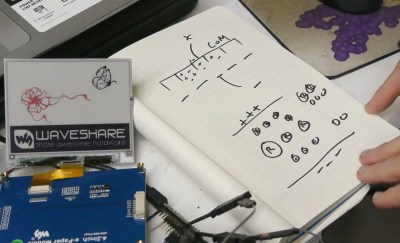
After starting out with a demo of the firmware in action before and after his modification, he explains how the E-paper works. The display is made up of many isolated chambers, each containing charged particles in a liquid. For example, the positive particles might be black and the negative might be white. By putting an electric field across each chamber, the white particles would be attracted to one end while the black would be attracted to the other, which could be the end you’re looking at. He also explains how it’s possible to get a third color by using different sized particles along with some extra manipulation of the electric field. And he talks about the issue of burn-in and how to avoid it.

Having given us that background, he then walks us through some of the firmware and shows how he modified it to make it faster, namely by researching various datasheets and subsequently modifying some look-up-tables.

Turning back to the hardware, he shows how he scratches out some traces so that he can attach scope probes. This alone seems like a notable achievement, though he points out that the conductive layer holds up well to his scratching. At that point he analyses the signals while running some demos.

The result is the very informative, interesting and entertaining video which you can watch below.

Continue reading “[Ben Krasnow] Hacks E-Paper For Fastest Refresh Rate”

Making Braille Signs Out Of PCBs

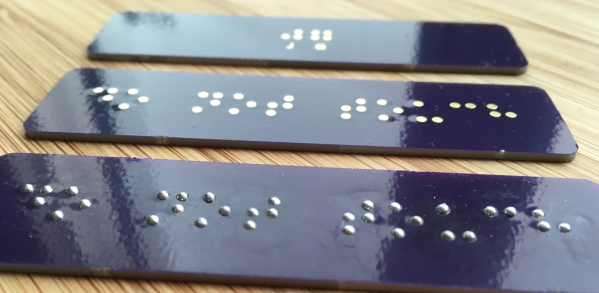
[jg] recently passed some damaged Braille signs and took on the challenge of repairing them. Informed by his recent work on PCB lapel pins, [jg] immediately thought of using circuit boards for this project. He’d noticed that round solder pads made for uniform hills of solder, and this reminded him of the bumps in Braille.

He began by reading up on the standards of the Braille Authority of North America, which stipulates a dot height of 0.6mm. He loaded up the PharmaBraille font system and laid it out the dots in photoshop, then and imported it into KiCad and laid out the boards. When the PCBs had arrived from OSH Park, [jg] soldering up the pads (lead free, but of course) to see if he could get the hills to 0.6mm. He’s experimenting with different methods of melting the solder to try to get more even results.

Braille interfaces crop up a surprising amount in hacker projects. This refreshable Braille display and keyboard and the Braigo LEGO Braille printer are prime examples.

[thanks, Drew!]