3D Print Yourself A Flame Thrower

For a large proportion of the world’s population, it’s now winter, which means there’s plenty of rain and snow to go around. With the surrounding environment generally cooler and wetter than usual, it’s a great time to experiment with dangerous flame based projects, like this wrist mounted flame thrower.

It’s a build that does things in both a simple and complicated way, all at once. Fuel is provided by a butane canister with a nozzle that needs to be pressed to release the gas.  A servo is used to push the canister into a 3D printed housing, releasing the gas into a pipe to guide the fuel towards the end of the user’s wrist. The fuel is then ignited by a heated coil of wire. The heated wire and the servo are both controlled by standard radio control gear typically seen on RC cars or buggies. Using the brushed speed controller to run the heated coil is particularly off-beat, but it does the job admirably.

Overall, it goes without saying that this build presents some serious risks of burns and other injuries. However, the fundamental premise is sound, and it does what it says on the tin with parts that could be readily found in the average junk box.

For another take on a wrist-mounted flame thrower, check out this version using a scavenged solenoid valve.


The British Drone Law Reaches Parliament

We’ve brought you a variety of stories over the years covering the interface between multirotor fliers and the law, and looked at the credibility gap between some official incident reports and the capabilities of real drones. In the news this week is a proposed new law in front of the British House of Commons that would bring in a licensing scheme for machines weighing over 250 g, as well as new powers to seize drones. We’ve previously told you about the consultation that led up to it, and its original announcement.

As a British voter with some interest in the matter, I decided to write to my Member of Parliament about it, and since my letter says what I would have written to cover the story anyway it stands below in lieu of the normal Hackaday article format. If you are a British multirotor flier this is an issue you need to be aware of, and if you have any concerns you should consider raising them with your MP as well. Continue reading “The British Drone Law Reaches Parliament”

Grabbing Better Images From A Newer Russian Satellite

The Soviet Union took the world by surprise when it sent its Sputnik satellite into low earth orbit way back in 1957. The event triggered a space race between the Soviets and the United States and ushered in technologies that would go on to touch the lives of every human on earth. Today, several nations have a space program. And one of the more useful things to put in orbit are weather satellites.

In 2014, the Russians launched their Meteor N M-2 weather satellite into a polar orbit. The part that were most interested in is the fact that it transmits images at 137.1 MHz using the standard LRPT protocol. However, the newer Meteor N M-2 transmits images at twelve times the resolution of US NOAA satellites. No typo there –  that’s twelve (12!) times. Have we got your attention now?

We shouldn’t have to tell you to jump on over to [phasenoise’s] blog which gives you everything you need to start grabbing some of these awesome images.

Now, before you get your jumper wires in a bunch – we are well aware that receiving satellite images is nothing new.

Thanks to [Roy Tremblay] for the tip!

Making A Motorized Turntable Portable

[Robin Reiter] needed a better way to show off his work. He previously converted an electric TV stand into a full 360-degree display turntable, but it relied on an external power supply to get it spinning. It was time to give it an upgrade.

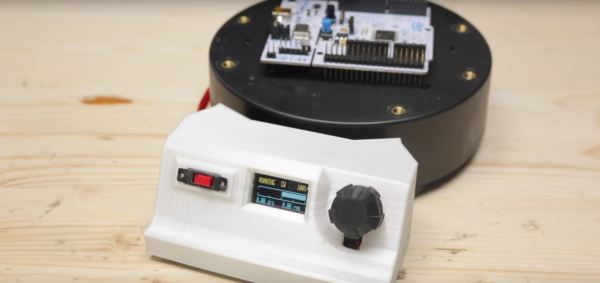
Putting his spacial organization skills to work, [Reiter] has crammed a mini OLED display, rotary encoder, a LiPo 18650 battery and charging circuit, a pair of buck converters, a power switch, and an Arduino pro mini into the small control console. To further maximize space, [Reiter] stripped out the pin headers and wired the components together directly. It attaches to the turntable in question with magnets, so it can be removed out of frame, or for displaying larger objects!

When first powered on, the turntable holds in pause mode giving [Reiter] time to adjust the speed and direction. He also took the time to add an optical rotary encoder disk to the turntable and give the gearing a much needed cleaning. Check out the project video after the break!

Continue reading “Making A Motorized Turntable Portable”

Upgrading A USB Soldering Iron!

Seeing the popularity of the TS-100 soldering iron, GitHub user [ole00] found himself desirous of a few of its features, but was put off by its lack of a power supply. What is a hacker to do? Find a cheaper option, and hack it into awesomeness.

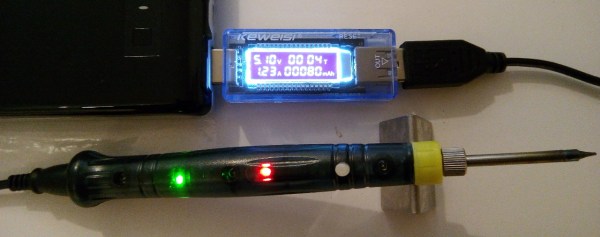
[ole00] stumbled across the inexpensive ZD-20U and — despite a handful (sorry!) of issues — saw potential: it’s compact, lightweight, and powered via a USB power cable. Wanting to use as much of the ZD-20U’s original board as possible, the modifications were restricted to a few trace cuts and component swaps. The major change was swapping out the 555 timer IC controlling the iron with am ATtiny13a MCU to give it a bit more control.

Continue reading “Upgrading A USB Soldering Iron!”

Oil Barrel Smoker

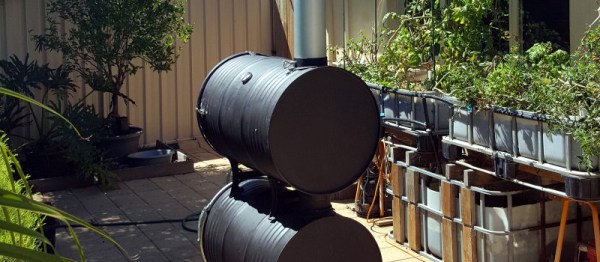
What would you do with a pair of oil drums and a craving for delicious food? Like any sane person, redditor [Kilgore_nrw] made the logical choice and built a smoker.

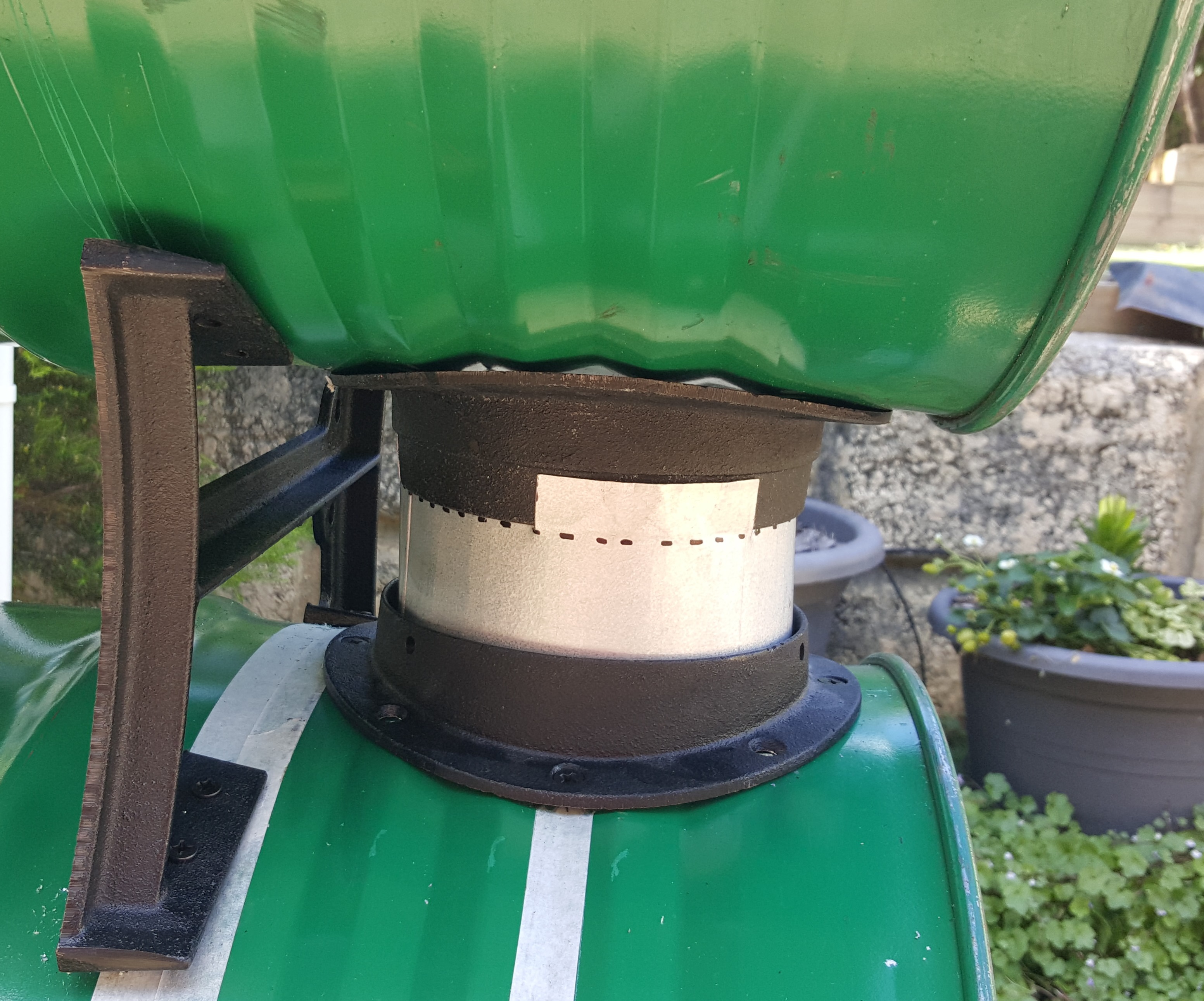
To make the build easier, he picked up a double barrel stove kit which came with a door, hinges, legs and flue connectors. While fixing the legs and mounting the stove door — high enough for a bed of bricks in the fire barrel — went as planned, he had to improvise the installation of the smoke flue. It ended up being the exact same diameter as the flue connectors, but notching it enough to slide into place made a satisfactory seal.

Not liking the look of having the stack at the ‘front’ of the smoker, he mounted it above the flue at the rear and added two sandstone slabs in the smoking chamber to evenly distribute the heat. Finishing touches included heavy duty drawer slides for the cooking rack — ensuring easy access to deliciousness — and painstakingly grinding off the old paint to apply a new heat resistant coating. For any fans out there, the finished pictures are a sight to behold.

Continue reading “Oil Barrel Smoker”

Let There Be Automated Blinds!

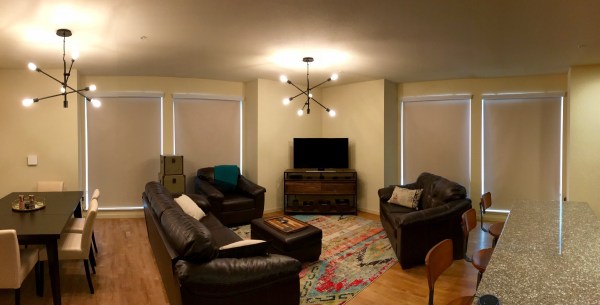
More than once a maker has wanted a thing, only to find it more economical to build it themselves. When your domicile has massive windows, closing what can feel like a mile of blinds becomes a trial every afternoon — or every time you sit down for a movie. [Kyle Stewart-Frantz] had enough of that and automated his blinds.

After taking down and dismantling his existing roller blinds, he rebuilt it using 1-1/4 in EMT conduit for the blinds’ roll to mount a  12V electric shade kit within — the key part: the motor is remote controlled. Fitting it inside the conduit takes a bit of hacking and smashing if you don’t want to or can’t 3D print specific parts. Reattaching the roller blind also takes a fair bit of precision lest they unroll crooked every time. He advises a quick test and fit to the window before moving on to calibrating and linking all your blinds to one remote — unless you want a different headache.

Now, to get Alexa to do your bidding.

Continue reading “Let There Be Automated Blinds!”