Kristin Paget Is Hacking Carrier Grade LTE ENodeB

Every once in a while you get lucky and a piece of cool gear lands on your bench to tear down and explore. On that measuring stick, Kristin Paget hit the jackpot when she acquired a fascinating piece of current generation cellphone infrastructure. She’s currently researching a carrier-grade LTE eNodeB and walked through some of the findings, along with security findings of two IoT products, during her talk on the Laws of IoT Security at the 2017 Hackaday Superconference.

Evolved Node B (eNodeB) is the meat and potatoes of the LTE cellular network. It connects the antenna to backhaul — this is not something you’d expect to see on the open market but Kristin managed to pick one up from a vendor at DEF CON. Hearing her walk through the process of testing the hardware is a real treat in her talk and we’ll get to that in just a minute. But first, check out our video interview with Kristin the morning after her talk. We get into the progress of her eNodeB research, and touch on the state of IoT security with advice for hardware developers moving forward.

Continue reading “Kristin Paget Is Hacking Carrier Grade LTE ENodeB”

The German Space Program That Never Was

A previous post discussed the creation of the V-2 rocket, the first man-made object to reach space. Designed and built at the Peenemünde Army Research Center during World War II, the V-2 was intended to be a weapon of mass destruction, but ended up being far more effective as a tool of discovery than it ever did on the battlefield. In fact, historians now estimate that more people died during the development and construction of the V-2 than did in the actual attacks carried out with it. But even though it failed to win the war for Germany, it still managed to change the world in another way: as it served as the basic blueprint for all subsequent rockets right up to modern-day vehicles.

But the V-2 wasn’t the only rocket-powered vehicle that the Germans were working on, a whole series of follow-up vehicles were in the design phase when the Allies took Berlin in 1945. Some were weapons, but not all. Pioneers like Walter Dornberger and Wernher von Braun saw that rocketry had more to offer mankind than a new way to deliver warheads to the enemy, and the team at Peenemünde had begun laying the groundwork for a series of rockets that could have put mankind into space years before the Soviets.

Continue reading “The German Space Program That Never Was”

Current Measurement With Oscilloscopes

What do a Rogowski coil, a magnetic core, and a hall effect sensor have in common? They are all ways you can make oscilloscope probes that measure current. If you think of a scope as a voltage measurement device, you ought to watch the recent video from Keysight Technology (see below). It is true that Keysight would love to sell you a probe, but the video is not a sales pitch, just general technical information about making current measurements with an oscilloscope.

Of course, you can always measure the voltage across a shunt resistor — either one that is naturally in the circuit or one you’ve put inline just for measuring purposes. But if you add a resistor it will change the circuit subtly and it may have to handle a lot of power.

The Keysight video points out that there are different probes for different current measurement regimes. High current, medium current, and low current all use different probes with different technologies. The video is only about 6 minutes long and if you’ve never thought about measuring current with a scope, it is worth watching.

The video shares some high-level details of how the current probes work — that’s where the Rogowski coil comes in, for example. Of course, you can’t expect a vendor to tell you how to build your own current probes. That’s OK, though, because we will. Current probes are often expensive, but you can sometimes pick up a deal on a used one.

Continue reading “Current Measurement With Oscilloscopes”

The Physics Of Healing: Radiation Therapy

Few days are worse than a day when you hear the words, “I’m sorry, you have cancer.” Fear of the unknown, fear of pain, and fear of death all attend the moment when you learn the news, and nothing can prepare you for the shock of learning that your body has betrayed you. It can be difficult to know there’s something growing inside you that shouldn’t be there, and the urge to get it out can be overwhelming.

Sometimes there are surgical options, other times not. But eradicating the tumor is not always the job of a surgeon. Up to 60% of cancer patients will be candidates for some sort of radiation therapy, often in concert with surgery and chemotherapy. Radiation therapy can be confusing to some people — after all, doesn’t radiation cause cancer? But modern radiation therapy is a remarkably precise process that can selectively kill tumor cells while leaving normal tissue unharmed, and the machines we’ve built to accomplish the job are fascinating tools that combine biology and engineering to help people deal with a dreaded diagnosis.

Continue reading “The Physics Of Healing: Radiation Therapy”

Classic Tomy Toy Gets AIY Makover

A few months ago the Raspberry Pi magazine The MagPi gave away a piece of hardware, the Google AIY voice control kit. Subscribers all received one, but as always the eBay scalpers cleaned up all the in-store copies and very few lucky enthusiasts scored a kit of their own.

Among these frustrated Pi owners was [Circuitbeard], who decided instead to make his own kit. And since a cardboard case lacked style, he decided to do so in the shell of a 1980s Tomy Mr. Money toy novelty bank. Into it went a Raspberry Pi Zero W and an audio pHat, with a servo to operate the head and a microswitch connected to the toy’s arm as a trigger.

The Python code to run everything is all included in the write-up, and he’s posted a video of the device in operation which we’ve placed below the break.

Continue reading “Classic Tomy Toy Gets AIY Makover”

A Futuristic Plant To Inspire Bright Ideas

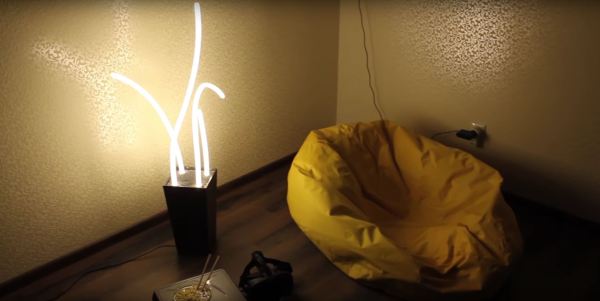
A good video game prop can really spruce up the decor — doubly so if it’s a glowing, futuristic potted plant transplanted(sorry!) straight from Deus Ex: Human Revolution.

Since it’s a bit difficult to grow neon light vines, this project is more lamp than plant. The maker with the green thumb is [Phil], from [JumperOneTV], and he is using five meters of warm white strip LEDs cut to varying vine lengths. He’s also procured a store-bought flower pot that conveniently mirrors the in-game model. The vines are made of 16mm polyethylene tubing which he’s shaped using a heat gun — setting their shape by pumping water through it — and secured in the pot with insulation foam. Feeding the LED strips through and wiring them in parallel was simple compared to his next conundrum: supplying the power.

Continue reading “A Futuristic Plant To Inspire Bright Ideas”

Minimizing ESP8266 Battery Drain

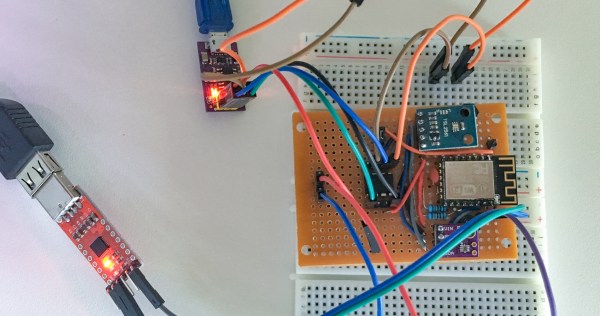
[Alex Jensen] wanted to build a battery-powered weather station, using an ESP8266 breakout board to connect to WiFi. However, [Alex]’s research revealed that the ESP chip uses around 70mA per hour when the radio is on — meaning that he’d have to change batteries a lot more than he wanted to. He really wanted a low power rig such that he’d only have to change batteries every 2 years on a pair of AAs.

The two considerations would be, how often does the ESP get powered up for data transmissions — and how often the weather station’s ATtiny85 takes sensor readings. Waking up the ESP from sleep mode takes about 16mA — plus, once awake it takes about 3 seconds to reconnect, precious time at 70mA. However, by using a static IP address he was able to pare that down to half a second, with one more second to do the actual data transmission. In addition to the hourly WiFi connection, the Tiny85 must be powered, though its relatively modest 1.5mA per hour doesn’t amount to much, even with the chip awake for 36 hours during the year. All told, the various components came to around 500 mAh per year, so using a pair of AA batteries should keep the rig going for years.

We’re intrigued by stories of hackers eking out every last drop of power to make their projects work. We’ve posted about ESPs low-power mode before, and what can be more low-power than a watch running off a coin cell?