LED Bulb-shade Cityscapes

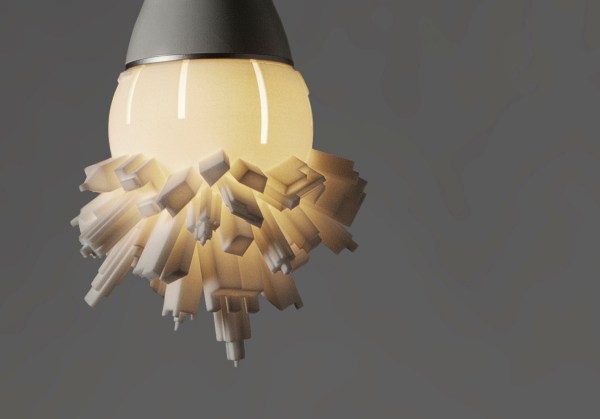
Cost-effective LED lighting for your home has opened up many doors for more efficient living, but also some more creative illumination for your living space. If you want to bring the dazzle of city lights right into your home, [David Grass] has two projects to sate this desire in perhaps the most literal way possible: Huddle and Stalaclights.

These clever, 3D printed bulbshades are possible since LEDs emit very little heat, and can be printed in a variety of designs. Huddle is named for — and illustrates — humanity’s coalescing into cities as the centre of modern life from which most of our information and technology emits. Stalaclights offers an inverted perspective on the straining heights of skyscrapers and is inspired by the Art Deco era and the expansion of cities like New York and Chicago.

Continue reading “LED Bulb-shade Cityscapes”

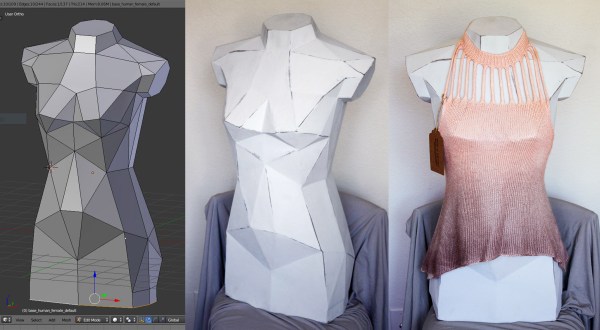
Fashion Mannequin Is Fiberglass Reinforced Paper Craft

[Leah and Ailee] run their own handmade clothing business and needed a mannequin to drape their creations onto for display and photography. Since ready-made busts are quite pricey and also didn’t really suit their style, [Leah] set out to make her own mannequins by cleverly combining paper craft techniques and fiberglass.

Continue reading “Fashion Mannequin Is Fiberglass Reinforced Paper Craft”

Tiny Smoothies At Maker Faire

For almost the last decade, desktop 3D printing has, at its heart, been centered around 8-bit microcontrollers. The ATmegas and other Atmel chips are good enough to move a few steppers and squirt some plastic. With faster processors, you get smoother acceleration, leading to better prints. Modern ARM devices have a lot of peripherals, allowing for onboard WiFi and Ethernet connectivity. The future is 32-bit print controllers.

Right now there are a few 32-bit controllers, from the very weird, out-of-nowhere controller for the Monoprice Mini 3D printer to the more traditional SmoothieBoard. Only one of these boards has the open hardware cred for a proper 3D printer controller, and a this year’s Maker Faire, Cohesion3D introduced a few machine control boards built on top of Smoothie that add a few interesting features and techniques.

Continue reading “Tiny Smoothies At Maker Faire”

Basement 3D Printer Builds Are Too Easy. Try Building One On Mars.

[Tony Stark Elon Musk] envisions us sending one million people to Mars in your lifetime. Put aside the huge number or challenges in that goal — we’re going to need a lot of places to live. That’s a much harder problem than colonization where mature trees were already standing, begging to become planks in your one-room hut. Nope, we need to build with what’s already up there, and preferably in a way that prepares structures before their inhabitants arrive. NASA is on it, and by on it, we mean they need you to figure it out as part of their 3D Printed Hab Challenge.

The challenge started with a concept phase last year, awarding $25k to the winning team for a plan to use Martian ice as a building material for igloo-like habs that also filter out radiation. The top 30 entries were pretty interesting so check them out. But now we’re getting down to the nitty-gritty. How would any of these ideas actually be implemented? If you can figure that out, you can score $2M.

Official rules won’t be out until Friday, but we’d love to hear some outrageous theories on how to do this in the comments below. The whole thing reminds us of one of the [Brian Herbert]/[Kevin J. Anderson] Dune prequels where swarms of robot colonists crash-land on planets throughout the universe and immediately start pooping out building materials. Is a robot vanguard the true key to planet colonization, and how soon do you think we can make that happen? We’re still waiting for robot swarms to clean up our oceans. But hey, surely we can do both concurrently.

Two-Stage Tentacle Mechanisms Part II: The Cable Controller

A few weeks back, we got a taste for two-stage tentacle mechanisms. It’s a look at how to make a seemily complicated mechanism a lot less mysterious. This week, we’ll take a close look at one (of many) methods for puppeteering these beasts by hand. Best of all, it’s a method you can assemble at home!

Without a control scheme, our homebrew tentacle can only “squirm around” about as much as an overcooked noodle. It’s pretty useless without some sort of control mechanism to keep all the cables in check at proper tension. Since the tentacle’s motion is driven by nothing more than four cable pairs, it’s not too difficult to start imagining a few hobby servos and pulleys doing the job. To get us started, though, I’ve opted for hand controllers just like the puppeteers of the film industry.

Enter Manual Control

Hand controllers? Of all the possibilities offered by electronics, why select such an electronics-devoid caveman approach? Fear not. Hand controllers offer us a unique set of opportunities that aren’t easy to achieve with most alternatives.

Continue reading “Two-Stage Tentacle Mechanisms Part II: The Cable Controller”

Reverse Engineering The Sony PocketStation

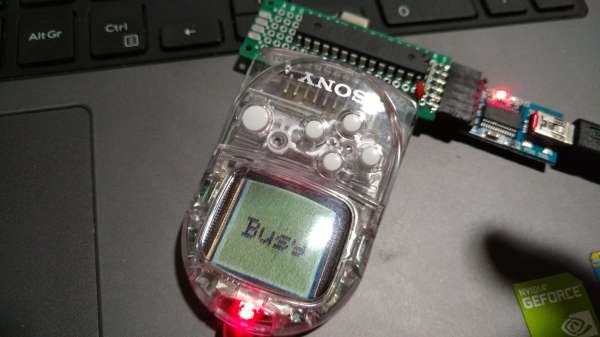
[Robson Couto] never actually owned a PlayStation in his youth, but that doesn’t mean he can’t have a later in life renaissance. In particular a Japan-only accessory called the PocketStation caught his interest.

The item in question resided in the PlayStation’s memory card slot. It’s purpose was to add additional functionality to games and hopefully sell itself. Like the PokeWalker, Kinect, etc. It’s an age old tactic but the PocketStation had some interesting stuff going on (translated).

The biggest was its processor. Despite having a pathetic 32×32 mono screen, it hosted the same processor as the GameBoy Advance. Having acquired a card from an internet auction house [Robson] wanted to load up some of the ROMs for this device and see what it was like.

It took quite a bit of work. Luckily there is a ton of documentation floating around the internet thanks to the emulation scene and it wasn’t long before he convinced a microcontroller to pretend to be the memory card slot. Now anyone with some skill and a small piece of gaming history can play around with the rare ROM dump for the PocketStation.

Win Loot With The Enlightened Raspberry Pi Contest

Have an awesome Raspberry Pi project in mind (or maybe sitting on your bench right now)? Show it off for the Enlightened Raspberry Pi contest and you can score some excellent loot.

The Raspberry Pi has changed the face of experimental computers. These little $35 Linux powered boards can do incredible things. An active community has sprung up around the Pi. With it have come thousands of projects published on the web, in books, and in magazines. Many of the best Raspberry Pi projects are seen right here on Hackaday and published on Hackaday.io, which boasts over 1000 user created Pi powered projects (yes, we counted). Show us how you pull off those projects and you’ll be eligible to win.

Prizes and Judges

One thing we’d like to see more are really well documented projects — showing off everything anyone with an average skill set needs to perform the cool hack themselves. Do that and you’re well on your way to claiming one of eight great prizes! The grand prize winner gets a Pi-top Raspberry Pi laptop. First prize is the new Pi-top Ceed all in one. Second place is a 32×32 RGB Matrix kit. And the list goes on.

Submit your entry as a project on Hackaday.io and use the “Submit Project To…” option on the left sidebar of your project page to add it to the Enlightened Raspberry Pi contest. When entries close on November 9th, the Hackaday Staff will begin judging, bringing in some help to choose the top winners. This help comes in the form of a few VIP judges!

[Alvaro Prieto] is a Firmware/Electrical engineer who works on electronics for work and for fun. He previously worked at TI, Apple, and Planet. You’ve seen him hacking micro quadcopters, and as a presenter at the 2015 Hackaday SuperCon,

[Matt Richardson] is a Product Evangelist for the Raspberry Pi Foundation and the co-author of Getting Started with Raspberry Pi. We’ve seen [Matt] building heads up displays for bicycles, and removing celebrity gossip from our TV’s.

[Ken Shirriff] writes a popular blog (righto.com) on reverse engineering everything from chargers to microprocessors. Ken was formerly a programmer at Google and has a PhD in computer science from UC Berkeley. We’ve covered his microprocessor work as well as his teardowns of knockoff laptop chargers.

It’s All in the Details:

Entries are open now, show us the details that make great Raspberry Pi projects happen! The full rules can be found on the Enlightened Raspberry Pi Contest page. Fire up your soldering irons, warm up your 3D printers, and load up your favorite code editor. It’s time to start hacking!

enlightenpi