Ourobot: What Happens When A Snake Bot Swallows Its Own Tail

For all their joking about “reinventing the wheel”, the team behind Ourobot made a very cool robot (German, automatic translation here). The team, at the University of Applied Sciences in “Bielefeld, Germany“,  built their wheel out of twelve segments, each with its own servo motor, a 3D-printed case, and a pressure sensor mounted on the outside of the wheel. The latter, plus some clever programming, allows the robot wheel to vary its circular gate and climb up over obstacles automatically.
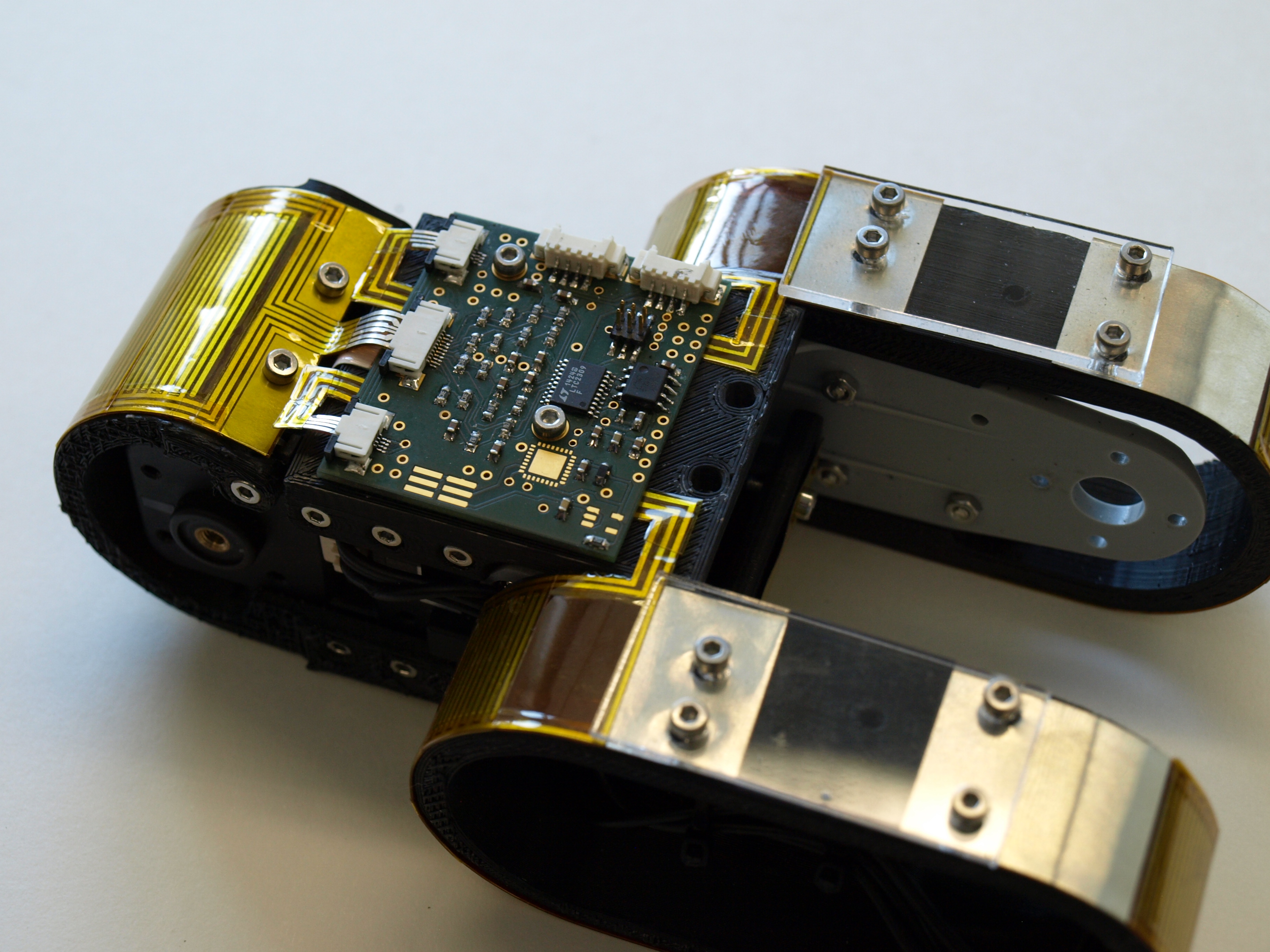
One link in the chain

There are a bunch of interesting constraints in designing the control for this bot. The tracks on the ground, naturally, have to adjust their relative angles so that they lie each flat on the surface, even if that surface isn’t itself flat or level. The segments in the air are unconstrained, but the sum of all the servos’ interior angles has to add up to 1800 degrees, and these angles control where its center of gravity is.

Our head is spinning. The paper, “OUROBOT – A Self-Propelled Continuous-Track-Robot for Rugged Terrain” is unfortunately behind the IEEE paywall, but goes into detail if you can find it. Continue reading “Ourobot: What Happens When A Snake Bot Swallows Its Own Tail”


3D Printering: G-Code Post Processing With Perl

Most of our beloved tools, such as Slic3r, Cura or KISSlicer, offer scripting interfaces that help a great deal if your existing 3D printing toolchain has yet to learn how to produce decent results with a five headed thermoplastic spitting hydra. Using scripts, it’s possible to tweak the little bits it takes to get great results, inserting wipe or prime towers and purge moves on the fly, and if your setup requires it, also control additional servos and solenoids for the flamethrowers.

This article gives you a short introduction in how to post-process G-code using Perl and Slic3r. Perl Ninja skills are not required. Slic3r plays well with pretty much any scripting language that produces executables, so if you’re reluctant to use Perl, you’ll probably be able to replicate most of the steps in your favorite language.

Continue reading “3D Printering: G-Code Post Processing With Perl”

Simple Beetle Robot Uses Smoking Soldering Iron

As robot projects go, [creative ideas km]’s isn’t going to impress many Hackaday readers. Still, as an art project or something to do with the kids, it might be fun. But the reason it caught our interest wasn’t the actual robot, but the improvised soldering iron used in its construction.

The robot itself isn’t really autonomous. It is just a battery, a motor, and a switch. The motor vibrations make the robot scoot around on its bent copper wire legs. Some hot glue holds it all together, but the electrical wiring is soldered.

If you look at the video below, you’ll see the soldering is done with an unusual method. A disposable lighter generates a flame that hits an attached copper wire with a coil wound in it. The coil acts as a heat exchanger, and the wire becomes a soldering iron tip.

Continue reading “Simple Beetle Robot Uses Smoking Soldering Iron”

Hot Russian Tubes

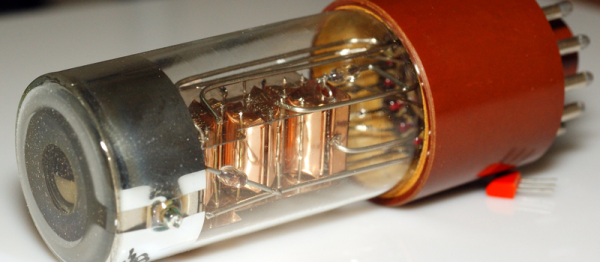
On the heels of our post on retro-Soviet transistor teardowns and die-shots, [nikitas] wrote in to tell us about a huge thread on rare vacuum devices of all varieties: oddball cathode-ray tubes, obscure Nixies, and strange Soviet valves. We thought the other forum post was overwhelming at just over 110 pages, but how about 391 pages (and counting) of blown-glass electronics?

If you read through the decaptholon, we mentioned that a particularly enthusiastic poster, [lalka], looked to be cataloguing every Soviet oscillator circuit. It turns out that he’s also the one behind this incredible (random) compendium of everything that’s had the air sucked out of it.

Continue reading “Hot Russian Tubes”

Hackaday Prize Entry: The Cheapest Logic Analyzer

There are piles of old 128MB and 256MB sticks of RAM sitting around in supply closets and in parts bins. For his Hackaday Prize project, [esot.eric] is turning these obsolete sticks of RAM into something useful – a big, fast logic analyzer. It’s cheap, and simple enough that it can be built on a breadboard.

If using old SDRAM in strange configurations seems familiar, you’re correct. This project is based on [esot.eric]’s earlier AVR logic analyzer project that used a slow AVR to measure 32 channels of logic at 30 megasamples per second. The only way this build was possible was by hacking an old stick of RAM to ‘free run’, automatically logging data to the RAM and reading it out with an AVR later.

This project expands on the earlier projects by using bigger sticks of RAM faster, with the ultimate goal being a 32-bit, 133MS/s logic analyzer that is more of a peripheral than a single, monolithic project. With a Raspberry Pi Zero, a stick of RAM, and a few miscellaneous logic chips, this project can become anything from a logic analyzer to a data logger to an oscilloscope. It’s weird, yes, but the parts to make this very handy tool can be found in any hackerspace or workshop, making it a great trick for the enterprising hardware hacker.

Motorcycling Like It’s 1905 With A Home Made Engine

The modern motorcycle represents the pinnacle of over a century of refinement in design and manufacture of its every component. A modest outlay will secure you a machine capable of three figure speeds with impeccable handling, breathtaking acceleration and stopping power, that somehow seems also to possess bulletproof reliability that will take it to a hundred thousand miles of faithful transport.

At the dawn of the internal combustion engine age it was a different matter. Machines were little more than bicycles with rudimentary engines attached, brakes and tyres were barely capable of doing the job demanded of them, and the early motorcyclists were a hardy and daring breed.

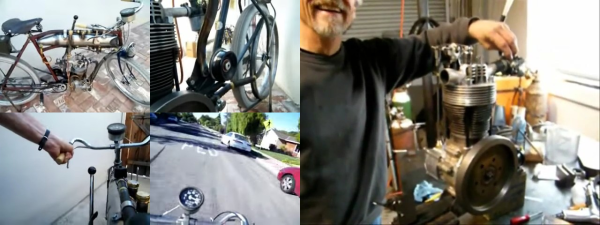
You might think that this article would now head into retrotechtacular territory with a nostalgic look at an early motorcycle, but instead its subject has a much more recent origin. We happened upon [Buddfab]’s contemporary build of a 1905-era motorcycle, and we think it’s a bike you’d all like to see.

The bike itself is a faithful reproduction of a typical Edwardian machine. It has a modified bicycle frame with a belt drive and springer front forks. That’s all very impressive, but the engine is a masterpiece, crafting a more modern parts bin into something resembling a 1905 original. He’s taken the cylinder, piston, and half a cylinder head from an aircooled VW flat four and mated it with the crankshaft of a 125cc Honda, welding the two connecting rods together to join German and Japanese parts. With a custom-made crankcase, Lucas points, and the carburetor from a British Seagull outboard motor it both looks and sounds like an original, though we’d expect it to be significantly more reliable.

You can see videos of both bike and engine below the break, as he takes it for a spin through American suburbia. Sadly we’ll never see it passed to the definitive writer on early motorcycles for an expert view, but it would fool us completely.

Continue reading “Motorcycling Like It’s 1905 With A Home Made Engine”

Make A Smart(ish) Watch From An Old Cell Phone

Looking for a fun junk box hack? Have one of those old Nokia phones that (in contrast to your current smartphone) just won’t give up the ghost? Tinkernut has a nice hack for you: making a smart watch from an old cell phone. Specifically, this project details how to make a smart watch that displays time, date, incoming calls and texts from a Nokia 1100 cell phone display and a few other bits.

This 3-video series covers how to extract the display, connect it to an Arduino and conecting that to an Android phone over Bluetooth. We’ve seen a few similar smart(ish) watch builds, but this one covers the whole process well, including building the Android app in the MIT AppInventor. Sure, the final result is not as polished as an Apple Watch, but it’s a lot cheaper and easier to hack…

Continue reading “Make A Smart(ish) Watch From An Old Cell Phone”