Glue Your Sumo Robot To The Mat With Custom Sticky Tires

Mini Sumo seems like one of those hobbies that starts out innocently enough, and ends up with a special room in the house dedicated to it. One day you’re excitedly opening up your first Basic Stamp kit, and the next you’re milling out mini molds on a mini lathe to make mini extra sticky tires.

[Dave] started out trying to find a part from the local big box store that was just a little bigger than the wheel he wanted to rubberize. He set the wheel inside a plumbing cap and poured the urethane in. It worked, but it required a lot of time with a sharp knife to carve away the excess rubber.

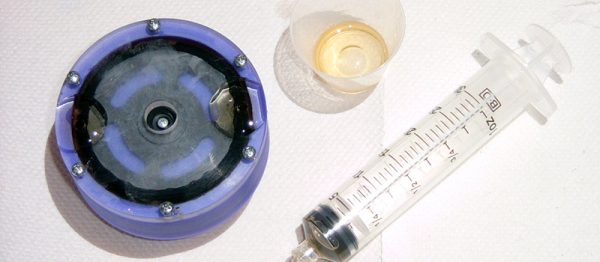
In the meantime he acquired a Sherline Mini Mill and Lathe. With the new tools available to him, he made a new mold out of a bit of purple UHMW and some acrylic. This one produced much nicer results. Using a syringe he squeezed resin into the mold through a hole in the acrylic. Much less cleanup was needed.

He later applied these methods to smaller, wider wheels as his mini sumo addiction took a stronger hold on his life.

Perfecting The DIY BB-8

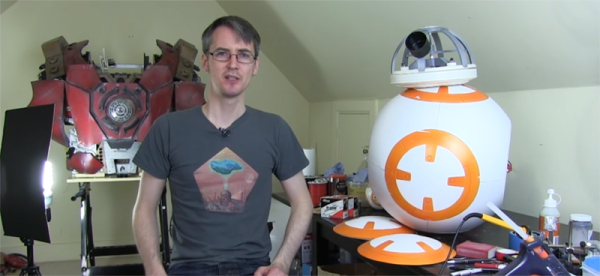
Until about a year ago, the Droid Builder’s Club had just about everything figured out to build any sort of robot from Star Wars. Building an R2D2 clone was easy, and even R5 and R6 droids were common. There were even a few attempts to clone IG-88. Then Disney happened, The Force Awakens was released, and the world was introduced to the hero of the third trilogy, BB-8. Several people have gone to incredible lengths to replicate BB-8 as a unique homebrew robot, but no one has put in more effort than [James Bruton]. He’s wrapping up his third DIY version of BB-8.

[James]’ third version of the BB-8 droid has two older brothers we’ve seen before. [James] started the construction of his earliest BB-8 not long after the trailer for The Force Awakens, and long before we knew the makers of Sphero robot toys weren’t behind this hero puppet. Since then, a number of improvements have been made to the drive system, allowing the third version of [James]’ BB-8 to turn on a dime and roll just like its on-screen counterpart.

Right now, [James] is about 80% done with his newest droid, with just a bit extra circuitry to have all the functionality seen on the ‘real’ stage droid. Like most of the R2D2 builds out there, there might be enough room inside this droid for some additional capabilities. There appears to be enough space behind one of the body panels for an extending arm, making the possibility of a flamethrower thumbs up very real.

[James] is also one of the judges for this year’s Hackaday Prize, and will (hopefully) be at this year’s Hackaday Prize award ceremony and Hackaday SuperConference in San Francisco. If a set of highly likely probabilities pans out, [James]’ BB-8 will also be at the con, and we’ll see it careening down that one weird block of Lombard Street. Awesome.

Entire playlist for the build of BB-8 v.3 below. Pictures are available here.

Continue reading “Perfecting The DIY BB-8”

Designing A High Performance Parallel Personal Cluster

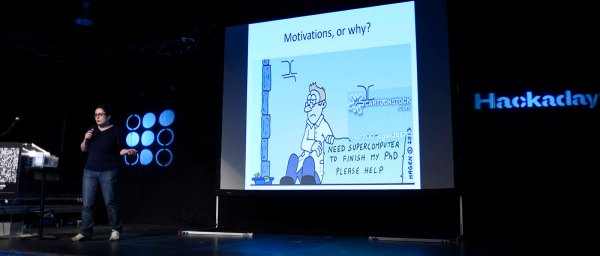
Kristina Kapanova is a PhD student at the Bulgarian Academy of Sciences. Her research is taking her to simulations of quantum effects in semiconductor devices, but this field of study requires a supercomputer for billions of calculations. The college had a proper supercomputer, and was getting a new one, but for a while, Kristina and her fellow ramen-eating colleagues were without a big box of computing. To solve this problem, Kristina built her own supercomputer from off-the-shelf ARM boards.

Continue reading “Designing A High Performance Parallel Personal Cluster”

If You See Anything, Say Something? Math On A Plane

Remember September 2016 2015? That was the month that [Ahmed Mohamed] brought a modified clock to school and was accused of being a terrorist. The event divided people with some feeling like it was ignorance on the part of the school, some felt the school had to be cautious, some felt it was racial profiling, and others thought it was a deliberate provocation from his possibly politically active parents. In the end, [Ahmed] moved to Qatar.

Regardless of the truth behind the affair, this month we’ve seen something that is probably even less ambiguous. The Washington Post reports that a woman told an Air Wisconsin crew that she was too ill to fly. In reality, she was sitting next to a suspicious man and her illness was a ruse to report him to the crew.

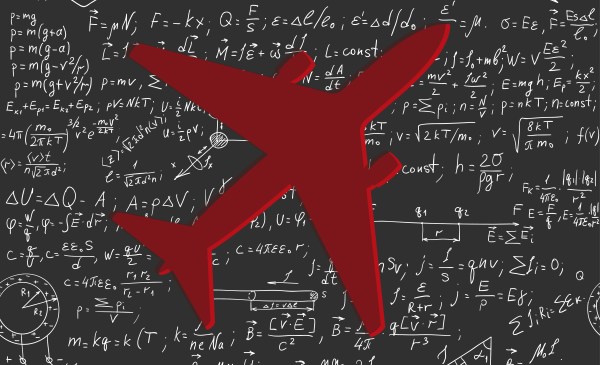
Authorities questioned the man. What was his suspicious activity? Was he assembling a bomb? Carrying a weapon? Murmuring plans for destruction into a cell phone? No, he was writing math equations. University of Pennsylvania economics professor [Guido Menzio] was on his way to deliver a speech and was reviewing some differential equations related to his work.

[Menzio] says he was treated well, and the flight was only delayed two hours (which sounds better in a blog post then it does when you are flying). However, this–to me–highlights a very troubling indicator of the general public’s level of education about… well… everything. It is all too easy to imagine any Hackaday reader looking at a schematic or a hex dump or source code could have the same experience.

Some media has tried to tie the event to [Menzio’s] appearance (he’s Italian) but I was frankly surprised that someone would be afraid of an equation. The pen may be mightier than the sword, but a math equation won’t (by itself) down an aircraft. I’ve heard speculation that the woman might have thought the equations were Arabic. First of all, what? And secondly, what if it were? If a person is writing in Arabic on an airplane, that shouldn’t be cause for alarm.

It sounds like the airline (which is owned by American Airlines) and officials acted pretty reasonably if you took the threat as credible. The real problem is that the woman–and apparently, the pilot–either didn’t recognize the writing as equations or somehow feared equations?

Regardless of your personal feelings about the clock incident, you could at least make the argument that the school had a duty to act with caution. If they missed a real bomb, they would be highly criticized for not taking a threat seriously. However, it is hard to imagine how symbols on a piece of paper could be dangerous.

While the mainstream media will continue to focus on what this means for passenger safety and racial profiling, I see it as a barometer of the general public’s perception of science, math, and technology as dark arts.

Minimal MQTT: Building A Broker

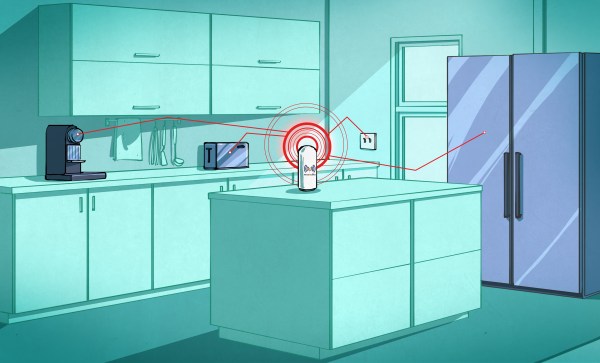
In this short series, we’re going to get you set up with a completely DIY home automation system using MQTT. Why? Because it’s just about the easiest thing under the sun, and it’s something that many of you out there will be able to do with material on-hand: a Raspberry Pi as a server and an ESP8266 node as a sensor client. Expanding out to something more complicated is left as an exercise to the motivated reader, or can be simply left to mission creep.

We’ll do this in four baby steps. Each one should take you only fifteen minutes and is completely self-contained. There’s a bunch more that you can learn and explore, but we’re going to get you a taste of the power with the absolute minimal hassle.

In this installment, we’re going to build a broker on a Raspberry Pi, which is the hub of your MQTT network. Next time, we’ll get an ESP8266 up and running and start logging some data. After that, we’ll do some back-end scripting in Python to make the data speak, and in the last installment, we’ll explore some of the useful frills and fancy bits. Let’s get started!

Continue reading “Minimal MQTT: Building A Broker”

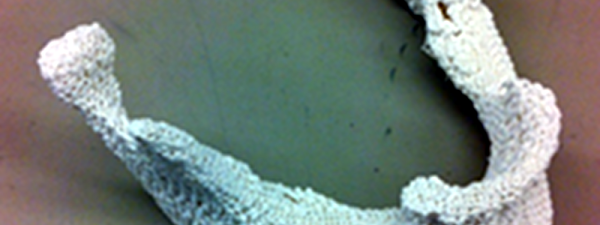
3D Printing Bone

What do you print with your 3D printer? Key chains? More printer parts (our favorite)? Enclosures for PC boards? At Johns Hopkins, they want to print bones. Not Halloween skeletons, either. Actual bones for use in bodies.

According to Johns Hopkins, over 200,000 people a year need head or face bone replacements due to birth defects, trauma, or surgery. Traditionally, surgeons cut part of your leg bone that doesn’t bear much weight out and shape it to meet the patient’s need. However, this has a few problems. The cut in the leg isn’t pleasant. In addition, it is difficult to create subtle curved shapes for a face out of a relatively straight leg bone.

This is an obvious application for 3D printing if you could find a suitable material to produce faux bones. The FDA allows polycaprolactate (PCL) plastic for other clinical uses and it is attractive because it has a relatively low melting point. That’s important because mixing in biological additives is difficult to do at high temperatures.

Continue reading “3D Printing Bone”

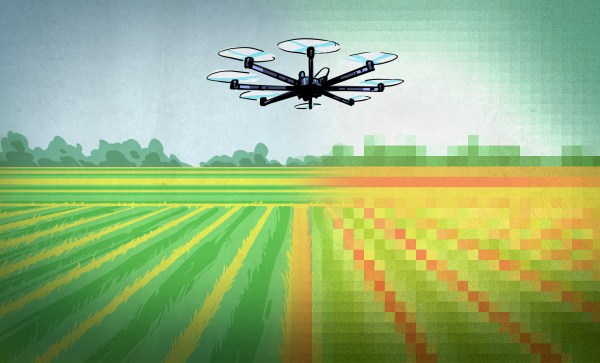
The Coming Wide-Spread Use Of Drones In Agriculture

Whether you call them UAVs (Unmanned Aerial Vehicles), UAS (Unmanned Aerial System), Drones, or something less polite – people are more familiar than ever with them. We’ll call them drones, and we’re not talking about the remote-controlled toy kind – we’re talking about the flying robot kind. They have sensors (GPS and more), can be given a Flight Plan (instructions on where to go), and can follow that plan autonomously while carrying out other instructions – no human pilot required. Many high-end tractors are already in service with this kind of automation and we’ve even seen automated harvesting assistance. But flying drones are small and they don’t plant seeds or pull weeds, so what exactly do they have to do with agriculture?

There are certain things that drones are very good at, and there are things in agriculture that are important but troublesome to do or get. Some of these things overlap, and in those spaces is where a budding industry has arisen.

Continue reading “The Coming Wide-Spread Use Of Drones In Agriculture”