Google Two-factor Authentication In A Wristwatch

chronos_two_factor_authentication

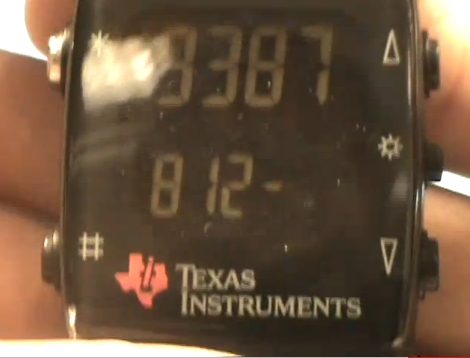
The Chronos watch from Texas Instruments is a handy little piece of hardware if placed in the right hands. If you are not familiar with the platform, it is marketed as a “wearable wireless development system that comes in a sports watch”. In plain English, it’s a wearable wireless MCU mated with a 96 segment LCD, that boasts an integrated pressure sensor and 3-axis accelerometer. It is capable of running custom firmware, which allows it to do just about anything you would like.

[Huan Trong] wanted to take advantage of Google’s new two-factor authentication, and decided his Chronos would make a great fob, since he would likely be wearing the watch most of the time anyhow. He put together some custom firmware that allows the watch to function as an authentication fob, providing the user with a valid Google passcode on command.

He does warn that the software is alpha code at best, stating that it doesn’t even allow the watch to keep time at the moment. We are definitely looking forward to seeing more code in the near future, keep up the great work!

Be sure to stick around to see a video of his watch in action.

Continue reading “Google Two-factor Authentication In A Wristwatch”
Layering Pinball Audio Using Parallel WAV Shields

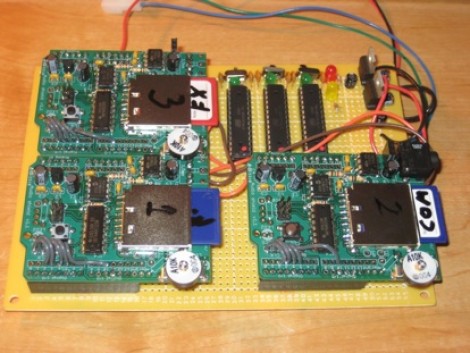
[Ed Zarick] is preparing his pinball project and wants to have authentic sound to go with the game play. The game is modeled after NBA Hangtime and in addition to music he also needs a wide range of sound effects to beef up the experience. To make this all happen at once he developed a set of Arduino WAV shields controlled by an Arduino Mega.

As you can see above, there are three ATmega328 chips which run the Arduino boot loader and each interface with one of the three green WAV shields. That set of chips listens for commands over and i2c protocol, and once they receive instructions they play can play the chosen file without affecting the other shields.

But to have the authentic sounds you first need to acquire the audio samples. [Ed] grabbed a ROM of the original video game and dumped all of the audio samples. From there it was a chore to listen to and catalog the sounds for SD card playback with the pinball version of the game. But it’s well worth the effort as the sound will end up tying the whole experience together.

Continue reading “Layering Pinball Audio Using Parallel WAV Shields”

All-band Receiver Hides In Plain Sight

This handheld radio has a little secret. You’re not going to be able to listen to Limbaugh since the original FM tuning circuit has been removed and replaced by a diode detector. Now [Miguel A. Vallejo] a discreet way to look for interesting radio signals in public.

The first step that he took was to remove the circuit board from the case and depopulate the tuning circuit while leaving the audio amplifier hardware. Next he referenced a proven design and built the diode detector circuit on a piece of protoboard. Finally he patched the new circuit into the original audio amplifier (seen in the image above) and put everything back in the case. Now he can listen in on data burst from a keypress on a computer keyboard, RF data communications, and slew of other noise sources.

This would be really handy for tracking down the electrical noise that’s screwing up your project.

[Thanks Superlopez]

Hackaday Links: February 27, 2011

Odd project materials

[Juliansr] wrote in to tell us about a site that sells bendable, moldable, stretchable, and other ‘able’ materials you might want to use in your next project.

(2 * 9V) = Flashlight

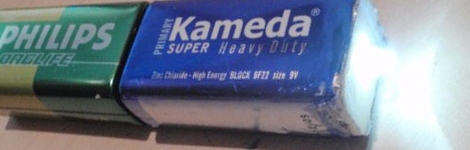
[Lasse] built a flashlight with two 9V batteries. One is a normal battery, the other has been gutted and is used as a connector and enclosure for an LED and resistor.

Ghetto flat screen mount

Don’t despair if you can’t afford a mounting bracket for that new flat screen. All you really need is a few screws and some garbage ties.

Tennis ball stand

This crafty solution to charging a phone makes sure that you’re also able to read the display. Since tennis balls lose their pressurization over time it’s a good use for the flat orbs.

Message visor

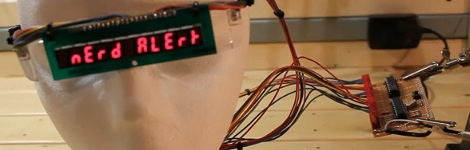
Get your message across while blocking your view of… everything with this message displaying visor. It’s like a Daft Punk helmet without the helmet.

Analog Robotic Concepts

Everyone’s getting on board with the 555 timer projects. But [Tom] didn’t just come up with one project, he shared a slew of ideas related to analog robotics. They’re center around servo motor control. You can see in the video after the break he has a pleasing way of sharing a lot of details while also making an easy to view demonstration video. He’ll put up a schematic for about one second and then move on, saving those that don’t care about the details by not droning on.

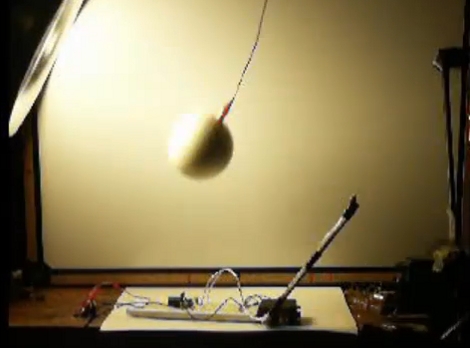
The first schematic that flashes by is the main circuit for controlling the servo motor. The rest of the concepts build from this circuit, using light, sound, flex, and other sensors as inputs. For instance, the setup above is using a light sensor. When the ball blocks the light the servo moves that vertical rod hitting it out of the way. When it swings back the process repeats. It’s striking how lifelike the reactions are, reminding us of insect movements. But this is really just the tip of the iceberg as he’s got a lot of future video ideas that we can’t wait to see.

Continue reading “Analog Robotic Concepts”

Boom Goes The Dynamite – Murals Made With Precision Explosives

explosive_artwork

[Alexandre Farto] is known for some off the wall art displays, but his newest work takes the phrase literally. Using precisely placed explosive charges, he has been sculpting portraits and other murals on walls in various places around London.

The detail at which he is able to produce these images is incredible, considering he is blowing chunks of plaster and brick from walls to form them. We can only guess as to how much preparation time is required to finish even one of these images, let alone to amass the stunning portfolio he has put together.

He has also recently teamed up with musical artist [Orelha Negra] to produce a cool video of his work as it was being sculpted, which is certainly worth the three minutes it takes to watch. The video, embedded below, is chock full of slow-motion shots of the demolition/sculpting in progress.

If you have a few minutes, be sure to check out his site to take a look at some of his work, we think you will be impressed.

Continue reading “Boom Goes The Dynamite – Murals Made With Precision Explosives”

DIY Lightning Special Effects

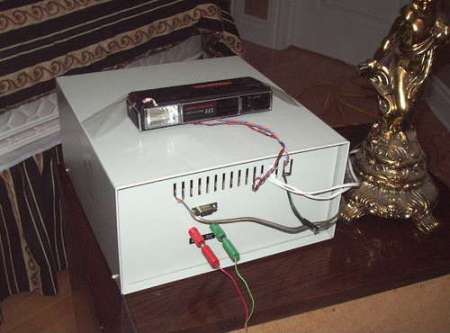
Halloween may have come and gone but thats no reason not to take a look at this neat little special effects setup.  Basically it uses an analogue circuit to monitor an audio signal and triggers some camera flashes using 5V relays.  The idea is that you can play lightning strikes and other spooky sounds, and the system will trigger camera flashes to coincide with the lightning strikes. Adding in some color organs in addition to the camera flashes will dim your lights to help achieve a thunder like effect. Unfortunately there aren’t any schematics for the color organs (which technically might be just light organs) but that doesn’t detract from the seemingly well designed analogue signal processing. Check it out in action after the break.

Continue reading “DIY Lightning Special Effects”