Solar Powered WiFi Repeater

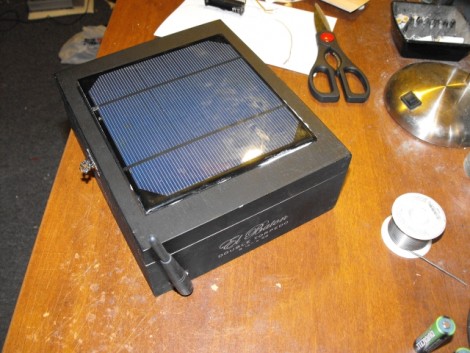
For all those times you need to broadcast your own access point where there’s no outlet [Larry] shows us how to make a solar-powered hotspot. He started by slapping a solar panel on the lid of a cigar box and attaching it to five rechargeable AA batteries inside. These power the mainboard from a router which is the perfect size to friction fit in the opening. It has been flashed with a copy of DD-WRT, and set to scan for open WiFi connections. When it finds one it connects and rebroadcasts its own WiFi signal to the surrounding area. He leaves it in the back window of his car and uses it to get on the net during lunch.

Mini Pinball Is All-pixels

You won’t find those familiar steel balls inside this mini-pinball cabinet. That’s because [Luis’] latest creation is a fun way to play virtual pinball. The playing field is a 10″ LCD screen with an accompanying 8″ screen in the marquee. Inside the well-crafted case you’ll find a mini-ITX motherboard running HyperPin, a frontend software suite for LCD-based virtual pinball. He’s also using PinMame for the score board that was often provided by a gas plasma display on newer mechanical machines. There’s video after the break, and take a moment to check out [Luis’] other mini-cabinet builds.

What’s that you say? No substitute for the real thing? That’s exactly what [Ben Heck] thinks too.

Continue reading “Mini Pinball Is All-pixels”

PIC Programmable Power Supply

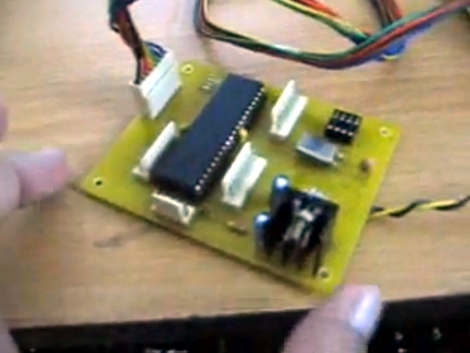
This programmable power supply is the perfect addition to your bench tools. [Debraj Deb], who previously built a whole house power monitor, designed this build around a PIC 18F4520 microcontroller. The desired voltage is set with an attached keypad, resulting in a digital output on the 8-bits of port D. The port connects to another protoboard with an R-2R digital-to-analog converter resulting in the target voltage. A set of transistors amplifies the current and a power transistor then takes care of the final output. After the break you’ll find two videos, the first walks us through the hardware and the second demonstrates the device in action, along with measurements of its performance. This certainly provides a lot more functionality than an ATX power-supply conversion.

Update: A big thanks to [Debraj] who sent us a code package as well as the schematic (PDF) used during testing. We’re having trouble getting the code package up for download right now. Check back later, hopefully we’ll have it up soon.

Continue reading “PIC Programmable Power Supply”

Syyn Labs’ Glowing DNA

This beautiful music syncronized double helix was made by Syyn labs. Last time we saw them, they had created that amazing rube goldberg style music video for OK Go. This 100 foot long LED DNA strand took over 1000 combined man hours to build. It took 512 LEDs, 32 LED controllers, 4 Arduinos, 4 computers, over a mile of wire and a very dedicated team, which included [Eliot Phillips]. It takes input from beatmatching/VU software as well as a 32 button console or an iPad. You can catch a video of it in action after the break, and they plan on releasing a timelapse of the build in the near future.

Continue reading “Syyn Labs’ Glowing DNA”

Rat Propulsion Via Brain-machine Interface

Our little red-eyed friend can drive this vehicle around with his mind. WITH HIS MIND, MAN!

This is the product of research into adaptive technologies. The process is pretty invasive, implanting neural electrodes in the motor cortex of the brain. The hope is that some day this will be a safe and reliable prospect for returning mobility to paralysis victims.

We found it interesting that the vehicle was trained to react to the rats’ movements. They were allowed to move around a test space under their own power while brain signals were monitored by the electrodes. Video tracking was used to correlate their movements with those signals, and that data is used to command the motors for what the Japanese researchers are calling RatCar.

We can see the possibilities opening up for a mechanized cockroach v. RatCar free-for-all. Something of a battlebots with a live tilt. But we kid, this is actually quite creepy.

[via Neatorama and PopSci]

Build A Simple Switch

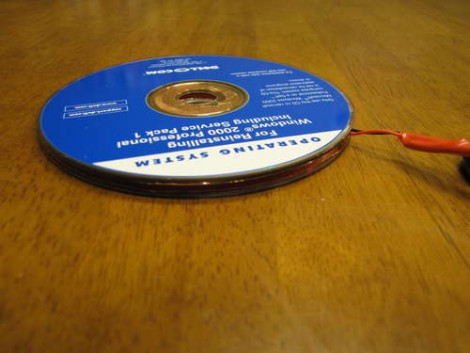
Forget hacking an easy button, grab a couple of those outdated CD-Rs and build your own switch for that next project. This was developed with handicapped accessibility in mind; assembled easily with common products and it’s fairly robust. In fact, our junk box has everything you need except the adhesive backed copper foil. Combine two old CD’s, covered in copper on facing sides, separated by two strips of Velcro to separate the conductors. When pressure is applied, one CD flexes to make contact with the other and complete the circuit. So easy, yet we never thought of it. We’ll add it to our list of homebrew input devices.

[Thanks Michael]

Cheap(er) Biometric Gun Safe

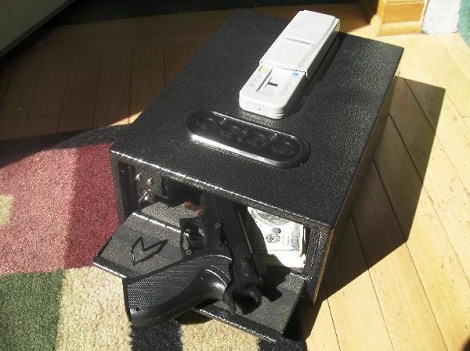
[Greg] sent in his biometric pistol safe lock. He keeps his guide light on details so not every Joe can crack the system (there is a thread to sift through if you really wanted to), but the idea runs fairly simple anyway. [Greg] took an old garage door opening fingerprint scanner and wired it into a half broken keypad based pistol safe. While he did have some issues finding a signal that only fired when the correct fingerprint is scanned, a little magic with a CMOS HEX inverter fixed that problem quick.

This does bring one question to our minds, are fingerprint scanners as easy to crack as fingerprint readers?