Automated Chip Burning

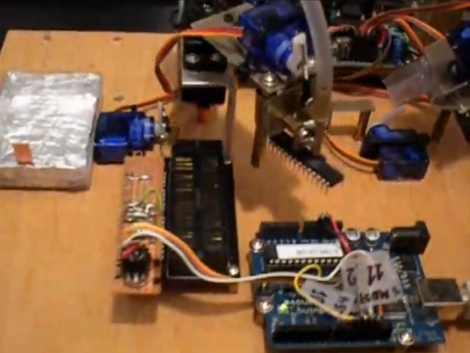
[Alexsoulis] needed to burn the Arduino bootloader to a slew of ATmega328 chips. Instead of sitting there and plugged the chips into a programmer one at a time, he build a robotic microcontroller programmer.

It starts with the DIP package microcontrollers in a tube, with a servo motor to dispense them one-by-one. An arm swings over and picks up the chip with a fish pump powered vacuum tweezers similar to the pick-and-place head we saw recently. From there the chip is dropped into a ZIF socket and programmed by an Arduino. Once the process is complete it is moved to the side and the process repeats.

We’ve reported on using an Arduino as an AVR programmer but we’ve never actually done it ourselves (we use an AVR Dragon programmer). Take a look at the video after the break and let us know if you think the actual programming seems incredibly slow.

Continue reading “Automated Chip Burning”

BIOS Password Cracking

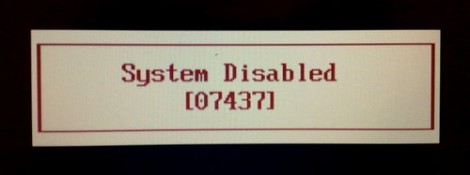
[Dogbert] took a look at the security that goes into BIOS passwords on many laptops. He starts off with a little background about how the systems work. People are bound to forget their passwords, so when you enter a wrong one three times in a row you get a message similar to the one above that locks you out until all power is removed from the system (then you get three more tries). But check out that five-digit number in the picture. That’s a checksum of the password. Some BIOS versions display it automatically, some require you to hold down a certain key during POST, but it’s the pivotal data needed to crack the password.

[Dogbert’s] post doesn’t go into verbose detail about the algorithms he uses to brute force the passwords. But he has posted the Python scripts he uses to do so. Learning how to generate the passwords based on the checksum is as simple as studying the code, which is often the best way to learn.

NYC Resistor Takes On The Machine

Here we are with Episodes two and three (aka, NYC Resistor part one and two) completing the Take on the Machine Hackerspace challenge we mentioned a while back. For the challenge NYC Resistor took an old style slot machine and converted it into a drink mixing deviant; even making the device post a Tweet for every drink. However, it seems to be lacking refrigeration of some kind, could this be the downfall of a potential winner for the challenge? Up next is the Hackerspace Pumping Station: One: do you think they can compete? Is there a particular Hackerspace you can’t wait to see? Let us know!

[Thanks Deven]

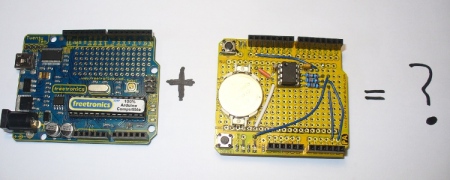
Upgrading The Freetronics Twentyten With A Real-time Clock

[John Boxall] finds himself doing a fair amount of projects that require a realtime clock. He does fast and frequent prototyping, usually using the Freetronics twentyten which is an Arduino alternative that boasts a few features like a nice prototyping area, edge visible LEDs, and Mini USB. What is lacking, however, is a real-time clock. Instead of making another shield type system, he just wanted to permanently add this feature to his board. He shares the whole process is photographed and explained quite well for anyone who would want to follow along.

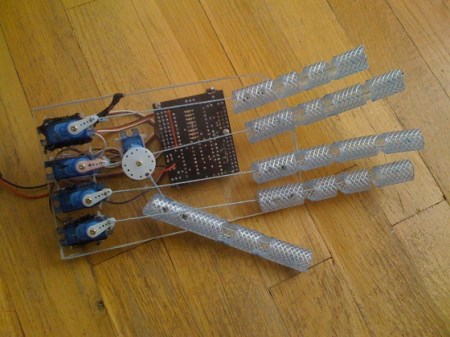
Cheap Robotic Hand

[Mazvydas] shares with us, his cheap robot hand. He was inspired by this project, where someone used an Arduino and a glove with some flex sensors to control a pre-made hand. He wanted to go a little more DIY though. He chose a picaxe microcontroller and constructed the hand himself out of twine, some plexi-glass, and some rubber hose. He does ultimately plan on adding glove control as well.

Unfortunately there’s no schematic or source code. Maybe if we ask really nicely he’ll share.


Continue reading “Cheap Robotic Hand”

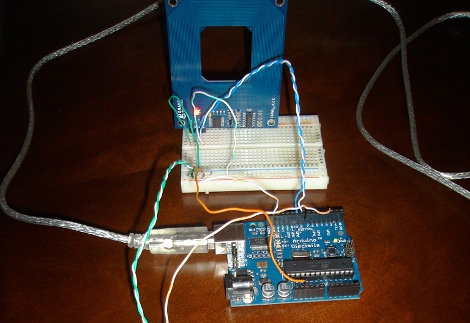
Arduino, RFID, And You

[Matt] has mixed up a batch of two RFID reading door lock systems. While the “door lock” part of the setup has yet to come into existence, the “RFID reading” section is up and running. By using the Parallax RFID readers (for cheap, remember?) and an Arduino, [Matt] is able to parse an RFID tag, look its number up in a database, and then have a computer announce “Access Denied” in a creamy “Douglas Adam’s sliding door of Hitchiker’s Guide” kind of way with Python.

Good books aside, catch a not as exciting as you’re thinking video after the jump.

Continue reading “Arduino, RFID, And You”

Pyrosphere At Burning Man 2010

What’s thirty-seven feet tall, has ninety-one flamethrowers, and is controlled by an Arduino? Why it’s Pyrosphere, an interactive art piece at this year’s Burning Man. It lights up the night along to the music in a way that makes us want to set up a lawn-chair and watch the show. You can see for yourself in the video after the break, but you really should have thrown on the LED fur coat and gone to see it in person.

Continue reading “Pyrosphere At Burning Man 2010”