Automated Rain Barrel Watering System

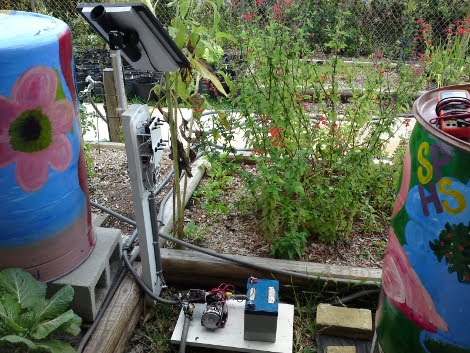
[Dmritard96] built this automated watering system to keep his garden growing while he’s out-of-town. It uses rain barrels, which capture and store rainwater, as a source. These barrels provide very low water pressure so he’s added a battery-powered pump along with a solar array for recharging. Don’t worry, if the rain barrels run dry there’s a float sensor that will switch the system over to city water and stave off those wilted leaves.

Swapping Coins Cells For Capacitors For Noise Filtering

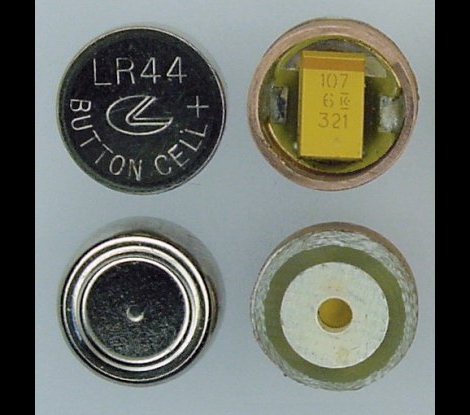
Here’s an interesting idea: replace a disposable coin cell battery with a capacitor in order to filter the noise from an external power supply. [David Cook] is taking advantage of the falling costs of digital calipers. He’s mounted one on his milling machine but noticed that with an external power supply the readings would sometimes reset in the middle of his work. The LR44 cell he’s replacing makes for very difficult in-place soldering so instead of permanently replacing it he built an insert that matched the form factor. The outer ring is from a piece of copper tubing and soldered to a PCB that he etched.

If [David’s] name sounds familiar it’s because we featured his Happy Meal toy scavenging a while back.

[Thanks Thomas]

Beginner Concepts: LPT Instead Of UC

We see it all the time, a post based on an Arduino board with multiple comments calling it overkill. How exactly should you control your homemade peripherals if you’re not using a microcontroller (uC)? [JKAbrams] and [Tim Gremalm] answered that question with this printer port (LPT) adapter. They wanted an indicator light when someone in an IRC room was talking to them. By connecting a blue rotating light through a relay to the output of this fob they’ve done just that, but there’s room for much more.

The adapter uses a Darlington transistor array IC to protect the computer. A resistor between the LPT and the base pin on the chip ensures that current flow will be well within the safe levels for the computer. The Darlington transistor amplifies the output using an external power supply in order to drive heavier loads.

If you want a deeper understanding of the printer port check out this tutorial. LPT ports are becoming less common and that’s why so many projects are migrating over to USB (plus there’s no need for external power with most USB connected projects) but if you’ve got one, it’s probably not being used for anything else.

Turing Machine A Masterpiece Of Craftsmanship

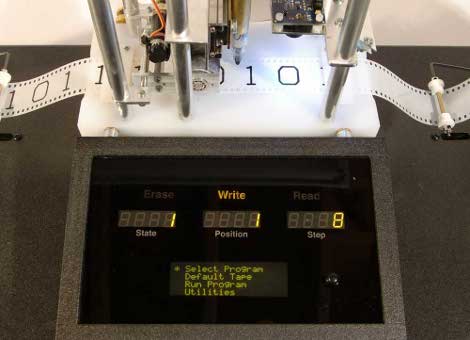
Everything about this Turing machine is absolutely brilliant. A Turing machine uses a strip of material to record, calculate, and change data. [Mike Davey] built this one using servo motors, a Parallax Propeller, felt-tipped pen, and 1000 feet of film leader. The machine writes characters to the leader, reads them using a grayscale camera, and erases them with a rotating felt cylinder.

Watch the video after the break, it covers every one of the intricate details that add up to [Mike’s] perfect build. We loved his Nickel-O-Matic but he really outdid himself with this one. With our mouths still agape we’re going back for our fifth viewing.

Continue reading “Turing Machine A Masterpiece Of Craftsmanship”

8-bit Game Console With Wireless Motion Controller

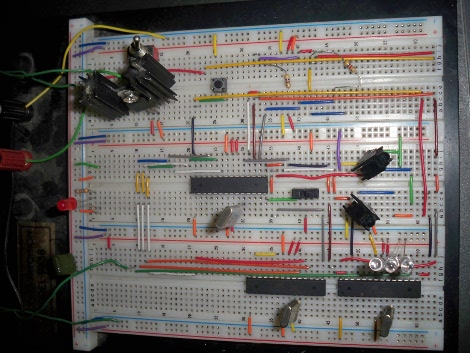
[Luis Cruz] built a gaming console with motion control. The circuit above connects via composite video to a television and communicates with a wireless controller. The controller is on a smaller breadboard which includes an accelerometer for the input and the infrared circuitry necessary for wireless data transmission back to the home system. Take a look at the first game he developed for it in the video after the break. There’s some details available (ie: he’s using ATmega168 and ATmega328 chips) but we’ve asked him to post code and schematics which he is currently cleaning up for mass consumption.

Ah, the 8-bit sound in that game takes us back to the glory days of Atari and Intellivision.

Continue reading “8-bit Game Console With Wireless Motion Controller”

LEGO Automatons

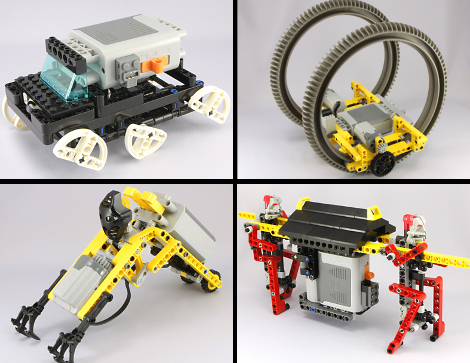
Here’s a collection of little LEGO oddities. Some of them exhibit a purpose, such as this interesting take on a line-following robot. Others, like the four seen above, are just automatons built to bring a smile to your face through their motion. There are dozens to choose from, with several pictures and a video of each. See the clips of these four after the break. Oh, and don’t worry, we didn’t find any LEGO iPhone docks, just cleaver mobile creations.

Continue reading “LEGO Automatons”

That’s A Big Flashlight

Going camping? You’ll need an extra backpack to carry this flashlight along the way. On the business end you’ll find 500 five millimeter super-bright white LEDs, on the opposite end there’s ten times the number of controls you’d expect on a flashlight. At full power, the LED array pulls down 50 Watts, making us question the battery life of the unit. Check out the walk-through after the break. The LEDs are mounted on proto-board, making for some extreme point-to-point soldering. During the control demonstration there’s a background noise like a jet powering up, what’s that all about?

While this terrific torch brings a grin to our faces, we wonder if it wouldn’t do better as a vehicle mounted illuminator. Or if a microcontroller was tossed into the mix some creative code could make this a pretty powerful yet non-lethal weapon.

Continue reading “That’s A Big Flashlight”