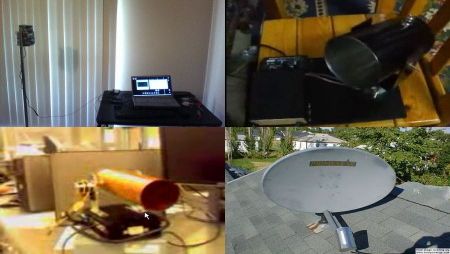
Here is a classic project used to increase wireless signal strength. Cantennas focus using a waveguide very much like a magnifying glass focuses light. [Robert] made a Natural Light beer cantenna, pictured in the upper left. His approach used three beer cans, a paper towel holder, and a shower curtain rod. On the tipline, he noted a signal boost from 11Mbps to 54Mbps. This is certainly something we can hack together if our room lacks adequate signal. Read about parabolic and seeking versions after the break.
Tiny Medical Bot

This tiny bot wants to go inside your body. That’s right, it was designed to travel through veins. The little bot has no on board propulsion system. It is controlled by a magnet outside the body. See those little spines? Those straighten out to keep the bot in place when it isn’t supposed to move. Creepy right? In all the articles we’ve seen on this bot, there aren’t any details about what actually is on board. They mention adding a camera in the near future, but why are they calling it a robot? Surely there’s something cool in that little body. This is a quite practical application of a project we covered recently. Commenters weren’t impressed with the external control system, likening it to the old vibrating football player game. Well, here’s where it could be usefull.
Willow Garage’s PR2 Robot
[youtube=http://www.youtube.com/watch?v=0S2dc_B-6Kg]
We would like you to meet PR2. Made by Willow Garage, PR2 is a platform for research into robotic programming. The bot itself is simple compared to some of the humanoid bots we see, but its behavior is quite complex. In the video above, you see PR2 completing milestone 2 of its development. This includes navigating an office with closed doors and plugging itself into a standard wall outlet for a charge. We’re especially fond of the “wiggle”. You can hear some of the developers talk more about PR2 and its completion of milestone 2 in the video after the break.
DIY AVR USB RGB LED Notifier

Giving us a chance to break out the TLAs, [Blair] sent in his latest hack where he embedded an RGB LED into his EeePC to display twitter, pidgin, and email notifications. It is based around the ATtiny45, and requires very few additional parts. He based the project on a foundation of work laid by [Dennis Schulze] on notifications and the work of [Dave Hillier] that used V-USB, a library for implementing USB on AVRs. The entire circuit was done freehand and crammed inside the netbook. He says that it is a lot easier to see notifications, even when the laptop is shut.
Related: Email notification via RGB LED
C64 USB Keyboard

[Maarten] told us about a C64 USB keyboard that was modified to be used as a standard input device. An interesting aspect of the project is the use of V-USB (formerly known as AVR-USB). V-USB is a software only approach to slow speed USB HID. In essence this is a two fold mod, The C64 keyboard is patched to a PC, and an off the shelf AVR is software-hacked to bit bang the USB communications. The author notes an initial problem with multiple key presses that was later corrected in the application. For the other side of the spectrum, we had covered the C64 twittering client, and a commodore 64 laptop.
Parts: Ferrite Beads

Ferrite beads (L1 in the photo) filter high frequency power supply noise by converting it into a tiny amount of heat. Power supply noise can cause various problems for many parts, especially in analog audio and display circuits.
Ferrite beads are simple, but choosing one can be confusing because they’re not commonly used by hobbyists. Most designs will still work if you omit the ferrite bead(s), but beads are so cheap there’s no reason to sacrifice the added reliability they provide. We describe how we pick ferrite beads for our projects after the break.
Tennis Practice For Hackers

Here’s an interesting WiiMote based project. [Mans] is a tennis fan, though a bit out of practice. With the tennis season coming to a rather climactic end, he got excited and wanted to brush up on his skills. He found the toss part of his serve to be very sloppy. Being a hacker, the first thing he thought was that there must be some way of tracking and graphing his toss so that he could improve it in an intelligent and controlled manner. The WiiMote seemed a perfect fit for this. Only a small modification was necessary, an external button wired to the internal “-” button. This switch is active while he’s holding the ball, and inactive when the ball is released. In this manner, he can track and chart his toss to find out exactly where he needs improvement. He uses [Johnny Chung Lee]’s code, with a small but unspecified modification to write the accelerometer data to a text file.
As he points out, this could be very usefull for any repetitive movement. Whith accelerometers getting cheaper and cheaper, there’s nothing stopping you from using multiple ones either. Imagine a golf rig to analyze your swing, Maybe a boxing rig that measured your hip twist and arm extension, or possibly a yoyo glove to tell you if your flick needs some help. Great job [Mans].