Slowloris HTTP Denial Of Service

[RSnake] has developed a denial of service technique that can take down servers more effectively. Traditionally, performing a denial of service attack entailed sending thousands of requests to a server, these requests needlessly tie up resources until the server fails. This repetitive attack requires the requests to happen in quick succession, and is usually a distributed effort. However, [RSnake]’s new technique has a client open several HTTP sessions and keeps them open for as long as possible. Most servers are configured to handle only a set number of connections; the infinite sessions prevent legitimate requests from being handled, shutting down the site. This vulnerability is present on webservers that use threading, such as Apache.

A positive side effect of the hack is that the server does not crash, only the HTTP server is affected. His example perl implementation, slowloris, is able to take down an average website using only one computer. Once the attack stops, the website will come back online immediately.

Update: Reader [Motoma] sent in a python implementation of slowloris called pyloris

[photo: cutebreak]

Ekahau HeatMapper Maps Out WiFi Signals

see_wireless_configs_large

The term ‘warwalking’ isn’t used very often, but the Ekahau HeatMapper adds a new tool to the pod bound hacker’s arsenal. The tool maps out wireless access points as well as their signal strength within a facility. A test of the HeatMapper on a map made with AutoDesk Dragonfly accurately determined the location of a router within 3 feet and helped tune the angle it needed to be at for maximum range. Ekahau made a fantastically cheesy promotional video for their product, which is viewable after the jump. The program is free of charge, but unfortunately only runs on windows, so mac and *nix users are out of luck, though it might run under wine.

Continue reading “Ekahau HeatMapper Maps Out WiFi Signals” →

Controllable Bristlebot

[sprite_tm], whose projects we have covered in the past, took the popular bristlebot to an extreme and created a controllable version. A bristlebot consists of a small vibrating motor mounted with a battery on the head of a toothbrush. These micro-robots buzz around randomly, and he attempted to tame them. He used a platform of twin bristlebots and added an optical sensor from a laser mouse and an ATtiny13. The optical sensor is used to determine the relative motion of the robot, so that the motors can be adjusted accordingly. He also has a video of the bot using the sensor to find a mark on the floor and stay within bounds. Although it isn’t as accurate, it acts like a traditional line-following robot.

Continue reading “Controllable Bristlebot” →

Arduino Experimentation Kit

ARDX

[Oomlout] has created an Arduino Experimentation Kit that uses basic sensors, buttons, and LEDs to teach electronics and programming. Printed overlays are secured on a breadboard, indicating components and connections. The Arduino is then used to drive the circuit. Examples include driving motors, using shift registers, and making beeps with a piezo element. These are backed up by explanations and code. The breadboarding kit is very similar to the classic 300-in-1 project kits marketed to beginners. In addition, all of the materials are released as open source. Kits are also available that include everything needed to create the circuits.

Related: Opensource Robotic Arm

[via Hack a Day flickr pool]

Dell Vostro A90 Hackintosh

dell_vostro_a90

A friend recently commissioned us to install OSX on a netbook. We advised him to purchase the Dell Vostro A90. It’s essentially a rebadged Dell Mini 9, a model that has been discontinued, but is well suited for OSX. It’s only available with a 1.6GHz Atom processor, 1GB RAM, and 16GB SSD. Depending on what deals are available, it’s $250-$300. We also had him purchase a 2GB stick of RAM which is the upper limit supported by the BIOS. Continue reading “Dell Vostro A90 Hackintosh” →

C64 Twitter Client

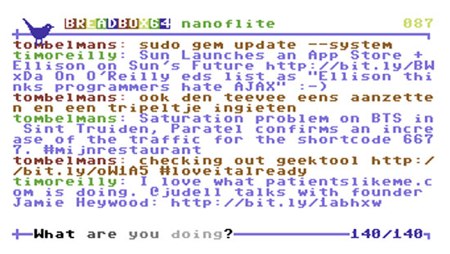
The last of the Commodore 64’s shortcomings has been addressed; it finally has a Twitter client. [Johan Van den Brande] wrote BREADBOX64 for use on the C64/128. It’s running on top of the open source Contiki operating system. The hardware is an MMC Replay cartridge with an ethernet adapter. If you don’t have the hardware available, you can run it inside an emulator like VICE. Embedded below is a C128D running the program.

(P.S. all of our posts are on @hackadaydotcom)

Continue reading “C64 Twitter Client” →

Theremin Controlled Mario

[youtube=http://www.youtube.com/watch?v=YnZeI8uLJnw]

In the video above, [conquerearth] is using a theremin to control Super Mario Bros. Moving his hand toward and away from the vertical antenna increases the theremin’s pitch. The computer monitors this in real time and moves Mario left and right. The loop antenna controls the theremin’s volume and acts as the jump button. The controls seem to work well, much better than the sound of one man flailing at a theremin.

[via Gizmodo]