Ask Hackaday: What’s In Your Digital Bugout Bag?

Your eyes pop open in the middle of the night, darting around the darkened bedroom as you wonder why you woke up. Had you heard something? Or was that a dream? The matter is settled with loud pounding on the front door. Heart racing as you see blue and red lights playing through the window, you open the door to see a grim-faced police officer standing there. “There’s been a hazardous materials accident on the highway,” he intones. “We need to completely evacuate this neighborhood. Gather what you need and be ready to leave in 15 minutes.”

Most people will live their entire lives without a scenario like this playing out, but such things happen all the time. Whether the disaster du jour is man-made or natural, the potential to need to leave in a big hurry is very real, and it pays to equip yourself to survive such an ordeal. The primary tool for this is the so-called “bugout bag,” a small backpack for each family member that contains the essentials — clothing, food, medications — to survive for 72 hours away from home.

A bugout bag can turn a forced evacuation from a personal emergency into a minor inconvenience, as those at greatest risk well know — looking at you, Tornado Alley. But in our connected world, perhaps it pays to consider updating the bugout bag to include the essentials of our online lives, those cyber-needs that we’d be hard-pressed to live without for very long. What would a digital bugout bag look like?

Continue reading “Ask Hackaday: What’s In Your Digital Bugout Bag?”

Dublin Knows How To Bring-a-Hack

When on the road, we love to stop by a local hackerspace and connect with the hacker community. On Friday, TOG Hackerspace in Dublin, Ireland opened their doors to host a Bring-a-Hack with Hackaday and Tindie.

The city center of Dublin is anything but a grid. The cobblestone roads meander every which way and are a puzzle of one-way and surprise construction, none of which seemed to faze Google’s navigation algorithms. I was happy to be operating the smartphone instead of the rental vehicle. A big thanks goes to Jenny List for taking on the stress of driving on our refreshments run without coming in contact with people or cars.

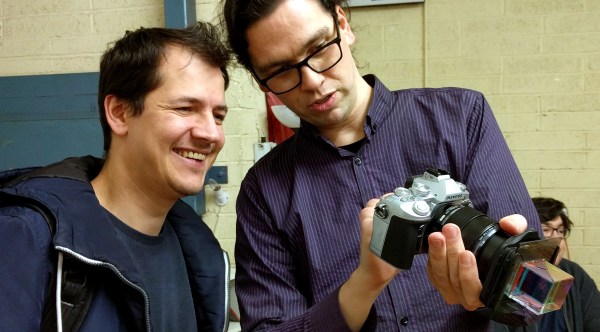
You’re likely wondering why the street layout of the city deserves such attention. I’m used to centrally-located Hackerspaces being tight on space, and indeed the members of TOG cautioned us that 50 people would feel cramped. Much the opposite, the pubs, restaurants, hotels, and performing arts centers are not small, nor winding, nor made of cobblestones. Dublin is a fantastic place to party, with plenty of space for us hardware geeks to congregate. TOG itself, which about 20 minutes walk from the central Temple Bar area (where this image was taken), even has a small parking lot which made our beer drop off and pizza delivery a breeze.

A Tour of TOG Hackerspace

TOG is a Gaelic word which loosely translates as “to make”. Declan met us for the beer drop and gave us a tour when we returned for the evening event. The building is divided into several different spaces, starting with an entry area that serves as a meeting space, gaming room, and showcase of projects.

Where you might see prayer flags strung up on an apartment building, we see floppy disks (both the hard and soft variety) strung around the meeting area. Declan has a shamrock of K’nex parts wired up with a microphone controlled RGB LED strip — it’s like a test your strength game to see who can shout the coolest colors.

I also really enjoyed the fabric anatomy display that has snaps on each organ and only lights up the labels if you complete the circuits in the correct locations.

These are just the tip of the iceberg. There’s much more after the break so join me for the rest of the tour, and some of the notable hacks that showed up on Friday evening.

Continue reading “Dublin Knows How To Bring-a-Hack”

Hackaday Links Column Banner

Hackaday Links: April 8, 2018

SiFive raised $50 Million in funding. SiFive is a semiconductor working on two fronts: they want to democratize silicon prototyping, and they’re the people making the HiFive series of microcontrollers and SoCs. The HiFives are built on the RISC-V instruction set, a Big-O Open instruction set for everything from tiny microcontrollers to server CPUs. With RISC-V, you’re not tied to licensing from ARM or their ilk. Recently SiFive introduced an SoC capable of running Linux, and the HiFive 1 is a very fast, very capable microcontroller that’s making inroads with Nvidia and Western Digital. The new round of funding is great news for anyone who wants Open Source hardware, and the silicon prototyping aspect of it is exceptionally interesting. Great news for SiFive.

Guess what’s in just a few weekends? The Vintage Computer Festival Southeast. The VCFSE is Hotlanta’s own vintage computer festival, with a whole host of speakers, exhibits, and consignment to tickle those vintage dopamine receptors. On deck for the speakers is [Michael Tomczyk], one of the people responsible for the VIC-20, and [Scott Adams], no the other [Scott Adams], creator of adventure-style games for personal computers but not that adventure-style game. The exhibits will include Japanese retro computers, simulating an ENIAC and a mechanical keyboard meetup. If you’re around Georgia, this is an event worth attending.

Conference season is just around the corner, and you know what that means. It’s time to start ramping up for #badgelife. What is badgelife? It’s a hardware demoscene of electronic conference badges. This year, the badgelife scene has stumbled upon something everyone can get in on. Add-ons! They’re electronic hats (or shields, or capes) for all the badges. Physically, it’s a 2×2 pin header. Electronically, it’s power, ground and I2C. Want to prototype your own add-on? Good news, there’s a development board.

The Titius-Bode law states the semi-major axes of planets follow a geometric progression. The (simplified, incorrect) demonstration of this law states Mercury orbits at 0.25 AU, Venus at 0.5 AU, Earth at 1 AU, Mars at 2 AU, and continues to the outer planets. The Titius-Bode law is heavily discredited in the planetary science community, and any paper, talk, or manuscript is rejected by scientific editors out of hand. The Titius-Bode law is the planetary science equivalent of flat Earth conspiracy theories and Nazi moon bases; giving any consideration to the idea confirms you’re a moron. This week, some consulting firm posted something that is the Titius-Bode law on their blog. Why? So it could be submitted to Hacker News for that sweet SEO. This submission was upvoted to the top position, and is a wonderful springboard to argue an interesting point on media literacy. I posit the rise of news aggregators (facebook, twitter, digg, reddit, and HN), is the driving force behind ‘fake news’ as lay people become the gatekeepers. Prove me wrong.

The Department of Homeland Security has confirmed there are cell-site simulators (Stingrays, IMSI-catchers, or otherwise known as your own private cell phone base station) around Washington DC. It’s unknown who is operating these simulators, or even where they are. There are two things to read between the lines with this information: Duh, there are rogue Stingrays in DC. Holy crap duh. I bet there are also some around midtown Manhattan. You can buy the stuff to do this on eBay. Personally, I’ve found half a dozen Stingrays or other rogue cell stations this year (guess where?). Second, why is this a news item now? Is this a signal that the DHS will start clamping down on stuff you can buy on eBay? Hop to it, people; cellular hardware is a great way to make a liquid nitrogen generator.


Won’t Somebody, Please, Think Of The Transistors!

At what age did you begin learning about electronics? What was the state of the art available to you at the time and what kinds of things were you building? For each reader these answers can be wildly different. Our technology advances so quickly that each successive generation has a profoundly different learning experience. This makes it really hard to figure out what basic knowledge today will be most useful tomorrow.

Go on, guess the diode!

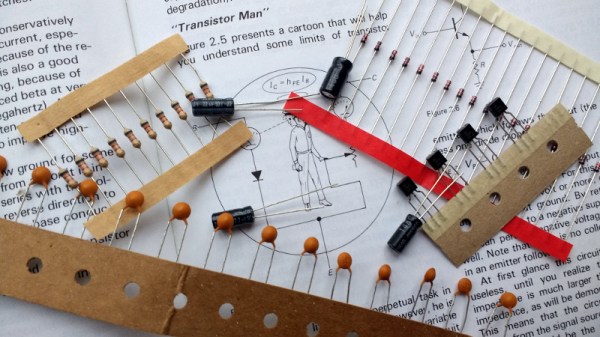
Do you know the forward voltage drop of a diode? Of course you do. Somewhere just below 0.7 volts, give or take a few millivolts, of course given that it is a silicon diode. If you send current through a 1N4148, you can be pretty certain that the cathode voltage will be that figure below the anode, every time. You probably also have a working knowledge that a germanium diode or a Schottky diode will have a lower forward voltage, and you’ll know in turn that a bipolar transistor will begin to turn on when the voltage between its base and emitter achieves that value. If you know Ohm’s Law, you can now set up a biasing network and without too many problems construct a transistor amplifier.

Continue reading “Won’t Somebody, Please, Think Of The Transistors!”

Circuit VR: The Dickson Charge Pump

There was a time when taking a low DC voltage — say a single battery — and converting it to a higher voltage was painful. Now, however, cheap and easy-to-use DC to DC converters are readily available. For some small tasks, though, these can seem like overkill. For example, consider a case where you need to supply a higher voltage for a MOSFET gate that doesn’t draw much current. Perhaps you need that higher voltage to trigger a microcontroller’s programming mode and nothing else. The current draw is minimal, and a full-blown DC to DC converter is overkill. For cases like that, it is tempting to use some voltage multiplication scheme. There are many, but for this post, I’m going to take you inside a Dickson charge pump. This is Circuit VR because not only are we going to discuss the circuit, we’ll look at an LT Spice simulation you can try yourself.

The Dickson is interesting because it doesn’t require any AC conversion or transformers. Instead, it uses diodes or other switching elements to transfer charge between capacitors in stages. Each stage will effectively increase the voltage by the supply voltage — in theory. Reality isn’t so kind, though, as we’ll see.

Continue reading “Circuit VR: The Dickson Charge Pump”

Mechanisms: Couplings

I was splitting wood one day a few years back, getting next winter’s firewood ready on my hydraulic splitter. It normally handled my ash and oak with ease, but I had a particularly gnarly piece of birch queued up, and the splitter was struggling. The 20-ton cylinder slowed as the wedge jammed in the twisted grain, the engine started to bog down, then BANG! I jumped back as something gave way and the engine revved out of control; I figured a hydraulic hose gave out. Whatever it was, I was done for the day.

I later discovered that a coupler between the engine shaft and the hydraulic pump failed dramatically. It was an easy fix once I ordered the right part, and I’ve since learned to keep extras in stock. Couplings are useful things, and they’re the next up in our series on mechanisms.

Continue reading “Mechanisms: Couplings”

The Basics And Pitfalls Of Pointers In C

Pointers — you either love them, or you haven’t fully understood them yet. But before you storm off to the comment section now, pointers are indeed a polarizing subject and are both C’s biggest strength, and its major source of problems. With great power comes great responsibility. The internet and libraries are full of tutorials and books telling about pointers, and you can randomly pick pretty much any one of them and you’ll be good to go. However, while the basic principles of pointers are rather simple in theory, it can be challenging to fully wrap your head around their purpose and exploit their true potential.

So if you’ve always been a little fuzzy on pointers, read on for some real-world scenarios of where and how pointers are used. The first part starts with regular pointers, their basics and common pitfalls, and some general and microcontroller specific examples.

Continue reading “The Basics And Pitfalls Of Pointers In C”