Big Chemistry: Ultrapure Water

My first job out of grad school was with a biotech company in Cambridge, Massachusetts. It was a small outfit, and everyone had a “lab job” in addition to whatever science they were hired to do — a task to maintain the common areas of the lab. My job was to maintain the water purification systems that made sure everyone had an ample supply of pure, deionized water to work with. The job consisted of mainly changing the filter and ion-exchange cartridges of the final polishing units, which cleaned up the tap water enough for science.

When I changed the filter packs, I was always amazed and revolted by the layers of slime and sediment in them. A glimpse out the window at the banks of the river Charles — love that dirty water — was enough to explain what I was seeing, and it was a lesson in just how much other stuff is mixed in with the water you drink and cook with and bathe in.

While we humans can generally do pretty well with water that rates as only reasonably pure, our industrial processes are quite another thing. Everything from power plants to pharmaceutical manufacturing facilities needs water of much, much higher purity, but nothing requires purer water than the specialized, nanometer-scale operations of a semiconductor fab. But how does ordinary tap water get transformed into a chemical of such purity that contaminants are measured in parts per trillion? And how do fabs produce enough of this ultrapure water to meet their needs? With some big chemistry.

Continue reading “Big Chemistry: Ultrapure Water”

Windows 98 For Spaceships? Not Quite!

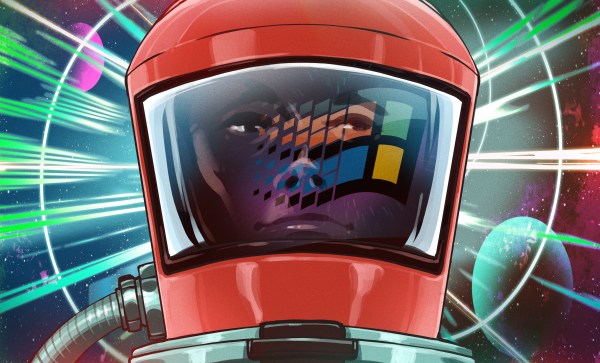
One of the news items that generated the most chatter among Hackaday editors this week was that ESA’s Mars Express mission is receiving a software update. And they’re updating the operating system to…Windows 98.

Microsoft’s late-90s consumer desktop operating system wouldn’t have been the first to come to mind as appropriate for a spacecraft, but ESA were quick to remind us that it was the development toolchain, not the craft itself, that depended upon it. It’s still quite a surprise to find Windows 98 being dusted off for such an unexpected purpose, and it’s led us to consider those now-almost-forgotten operating systems once more, and to question where else it might still be found. Continue reading “Windows 98 For Spaceships? Not Quite!”

Lenses: From Fire Starters To Smart Phones And VR

In antiquity, we see examples of magnifying crystals formed into a biconvex shape as early as the 7th century BC. Whether the people of that period used them either for fire-starting purposes or vision is unclear. Still, it is famously said that Emperor Nero of Rome watched gladiator games through an emerald.

Needless to say, the views we get through modern lenses are a lot more realistic. So how did we get from simple magnifying systems to the complex lens systems we see today? We start with a quick journey through the history of the camera and the lens, and we’ll end up with the cutting edge in lens design for smartphone cameras and VR headsets.

Continue reading “Lenses: From Fire Starters To Smart Phones And VR”

Teardown: KC Bearifone Could Talk Circles Around Teddy Ruxpin

At the risk of dating myself, I will tell you that grew up in the 80s — that decade of excess that was half drab and half brightly colored, depending on where you looked, and how much money you had for stuff like Memphis design. Technology seemed to move quickly in almost every aspect of life as the people of the Me decade demanded convenience, variety, and style in everything from their toilet paper (remember the colors?) to their telephones. Even though long distance cost a fortune back then, we were encouraged to ‘reach out and touch someone’.

A Healthy Fear of Bears

Looking back, it’s easy to see how all that advanced technology and excess filtered down to children. I may be biased, but the 80s were a pretty awesome time for toys, and for children’s entertainment in general. Not only were the toys mostly still well-made, even those that came in quarter machines — many of them were technologically amazing.

Take Teddy Ruxpin, which debuted in 1985. Teddy was the world’s first animatronic children’s toy, a bear that would read stories aloud from special cassette tapes, which moved his eyes and mouth along with the words. One track contained the audio, and the other controlled three servos in his face.

I remember watching the commercials and imagining Teddy suddenly switching from some boring bedtime story over to a rockin’ musical number a là the animatronic Rock-afire Explosion band at ShowBiz Pizza (a Chuck E. Cheese competitor). That’s the kind of night I wanted to be having.

The current lineup of the Rock-afire Explosion. Image via Servo Magazine

Although I went to ShowBiz a fair number of times to play Skee-Ball and stare at the Rock-afire Explosion animals and their cool set pieces, I never did have a Teddy Ruxpin. I remember being torn between wanting one and thinking they were kind of scary, which in turn made me a bit tangentially afraid of the Snuggle bear. When it came down to it, Teddy simply cost too much — $69.99 for the bear alone, and another $20 for a single cassette with storybook. And that’s 1985 dollars — according to my favorite inflation calculator, that’s $250 in today’s money for a talking bear and one lousy story.

Which brings us to KC Bearifone, an animatronic teddy bear telephone. Honestly, part of the reason I bought the Bearifone was some sort of false nostalgia for Teddy. The main reason is that I wanted to own a Teleconcepts unit of some kind, and this one seemed like the most fun to mess around with. A robot teddy bear that only does speakerphone? Yes, please.

Continue reading “Teardown: KC Bearifone Could Talk Circles Around Teddy Ruxpin”

How Far Can You Push A £500 Small Electric Car; Four Years Of The Hacky Racer

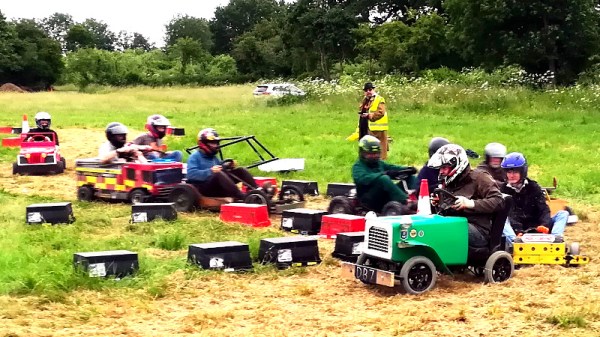
Four years ago when the idea of a pandemic was something which only worried a few epidemiologists, a group of British hardware hackers and robotic combat enthusiasts came up with an idea. They would take inspiration from the American Power Racing Series to create their own small electric racing formula. Hacky Racers became a rougher version of its transatlantic cousin racing on mixed surfaces rather than tarmac, and as an inaugural meeting that first group of racers convened on a cider farm in Somerset to give it a try. Last weekend they were back at the same farm after four years of Hacky Racer development with racing having been interrupted by the pandemic, and Hackaday came along once more to see how the cars had evolved. Continue reading “How Far Can You Push A £500 Small Electric Car; Four Years Of The Hacky Racer”

Edging Ahead When Learning On The Edge

“With the power of edge AI in the palm of your hand, your business will be unstoppable.

That’s what the marketing seems to read like for artificial intelligence companies. Everyone seems to have cloud-scale AI-powered business intelligence analytics at the edge. While sounding impressive, we’re not convinced that marketing mumbo jumbo means anything. But what does AI on edge devices look like these days?

Being on the edge just means that the actual AI evaluation and maybe even fine-tuning runs locally on a user’s device rather than in some cloud environment. This is a double win, both for the business and for the user. Privacy can more easily be preserved as less information is transmitted back to a central location. Additionally, the AI can work in scenarios where a server somewhere might not be accessible or provide a response quickly enough.

Google and Apple have their own AI libraries, ML Kit and Core ML, respectively. There are tools to convert Tensorflow, PyTorch, XGBoost, and LibSVM models into formats that CoreML and ML Kit understand. But other solutions try to provide a platform-agnostic layer for training and evaluation. We’ve also previously covered Tensorflow Lite (TFL), a trimmed-down version of Tensorflow, which has matured considerably since 2017.

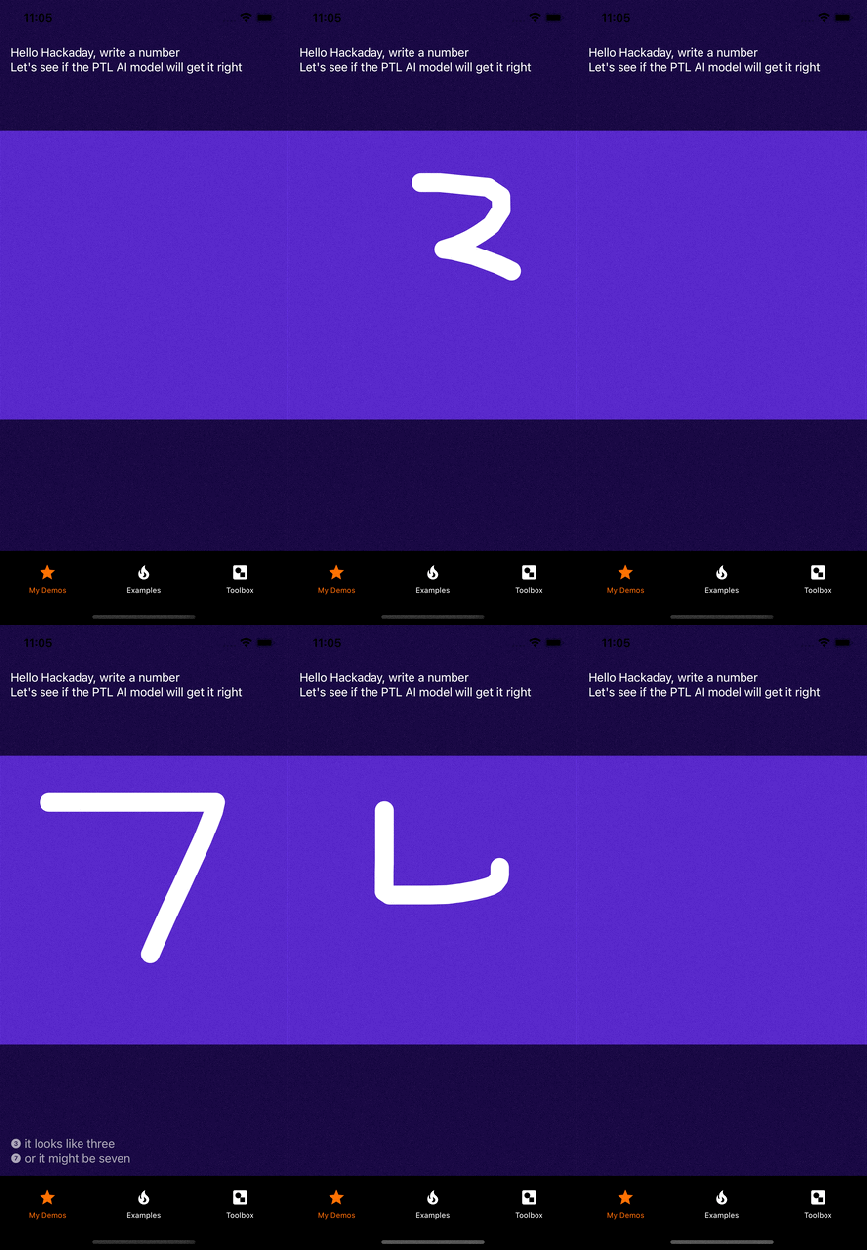
For this article, we’ll be looking at PyTorch Live (PTL), a slimmed-down framework for adding PyTorch models to smartphones. Unlike TFL (which can run on RPi and in a browser), PTL is focused entirely on Android and iOS and offers tight integration. It uses a react-native backed environment which means that it is heavily geared towards the node.js world.

Continue reading “Edging Ahead When Learning On The Edge”

Rogue Waves Are Mysterious And Big

Stand by the shore and watch the waves roll in, and you’ll notice that most come in at roughly the same size. There’s a little variation, but the overwhelming majority don’t stand out from the crowd. On all but the stormiest of days, they have an almost soothing regularity about them.

Every so often though, out on the high seas, a rogue wave comes along. These abnormally large waves can strike with surprise, and are dangerous to even the largest of ships. Research is ongoing as to what creates these waves, and how they might be identified and tracked ahead of time.

Continue reading “Rogue Waves Are Mysterious And Big”