A few years ago we talked about the chance that the first known extrasolar visitor — Oumuamua — might be a derelict solar sail. That notion has been picking up steam in the popular press lately, and it made us think again about the chances that the supposed rock was really a solar sail discarded or maybe even a probe flying with a solar sail. At the same time, Mars is as close as it ever gets so there is a gaggle of our probes searching the red planet, some of them looking for signs of past life.
All this makes us think: if we did find life or even artifacts of intelligent life, would we realize it? Sure, we can usually figure out what’s alive here on Earth. But to paraphrase Justice Potter Stewart, “We know it when we see it.” Defining life turns out to be surprisingly tricky, recognizing alien technology would be even harder.
Many years ago, I took a summer trip to the Maryland shore with some friends. One of my buddies and I got bored with playing football on the beach, so we decided to take a hike on one of the many trails back into the wooded area behind the dunes. At the trailhead we noticed a prominent sign, warning about the presence of “very aggressive mosquitos” and not to enter without first applying ample insect repellent. We scoffed at the warning as only young idiots could and soldiered on, bare-legged and confident that we’d be fine.
About three minutes into our hike, a small group came pelting down the trail in a panic. “It’s true! Turn back!” they shouted as they flew past us. Undeterred, or at least unwilling to appear that way to each other, we pressed on, only to discover a few minutes later that we were making a substantial blood sacrifice to the next generation of mosquitos on Assateague Island. We couldn’t bear more than a few seconds before turning tail and running back to the beach and jumping into the ocean to get rid of the last few dozen bloodsuckers.
I learned a valuable lesson from that experience, as well as developing a deep and abiding hatred of mosquitos. It turns out I’m in good company — pretty much everyone hates mosquitos, which are not just a nuisance but can be downright dangerous to be around. But if tests with genetically engineered mosquitos currently underway in Florida turn out well, we may be able to finally turn the tide against mosquito-borne diseases, simply by killing all the females before they ever reach adulthood.
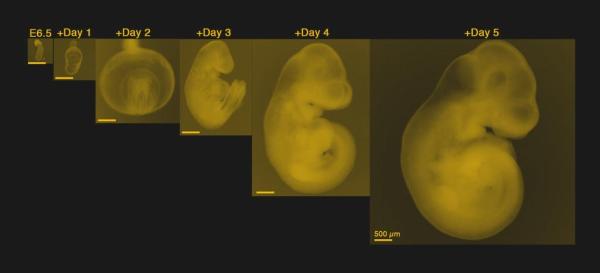
Well, it looks like those fetus fields from The Matrix (1999) just became a little bit more plausible. Although people-growing is probably a long way off, mice can now mostly develop inside an artificial uterus (try private window if you hit a paywall) thanks to a breakthrough in developmental biology. So far, the mice can only be kept alive halfway through gestation. There’s a point at which the nutrient formula provided to them isn’t enough, and they need a blood supply to continue growing. That’s the next goal. For now, let’s talk about that mechanical womb setup.
Carousel of Care
The mechanical womb was developed to better understand how various factors such as gene mutations, nutrients, and environmental conditions affect murine fetuses in development. Why do miscarriages occur, and why do fertilized eggs fail to implant in the first place? How exactly does an egg explode into 40 trillion cells when things do work out? This see-through uterus ought to reveal a few more of nature’s gestational secrets.
With many of the achievements of the Space Race now more than half a century behind us, it’s no wonder that we’re steadily losing the men who rode the rockets of the Mercury, Gemini, and Apollo programs into space. They were all very much in their primes at the time, but no matter what you’ve accomplished in life, even if it includes a trip to the Moon, time eventually catches up to you.
Still, it was quite a shock to learn today that astronaut Michael Collins passed away today at the age of 90. Collins made his trip to the Moon aboard Apollo 11, the mission which would see his crewmates Neil Armstrong and Edwin “Buzz” Aldrin descend to the surface in the Lunar Module Eagle and take the historic first steps on its surface in July of 1969.
When Nintendo officially ended production of the 3DS in September 2020, it wasn’t exactly a surprise. For one thing, some variation of the handheld system had been on the market since 2011. Which is not to say the product line had become stagnant: the system received a considerable mid-generation refresh, and there was even a more affordable variant introduced that dropped the eponymous stereoscopic 3D effect, but nearly a decade is still a fairly long life in the gaming industry. Of course Nintendo’s focus on the Switch, a hybrid device that blurs the line between console and handheld games, undoubtedly played a part in the decision to retire what could effectively be seen as a competing product.
While putting the 3DS out to pasture might have been the logical business move, a quick check on eBay seems to tell a different story. Whether it’s COVID keeping people indoors and increasing the demand for at-home entertainment, or the incredible library of classic and modern games the system has access to, the fact is that a used 3DS in good condition is worth more today than it was when it was brand new on the shelf this time last year.
I’ve certainly made more expensive mistakes.
In short, this was the worst possible time for me to decide that I finally wanted to buy a 3DS. Then one day I noticed the average price for a Japanese model was far lower than that of its American counterpart. I knew the hardware was identical, but could the firmware be changed?
An evening’s worth of research told me the swap was indeed possible, but inadvisable due to the difficulty and potential for unexpected behavior. Of course, that’s never stopped me before.
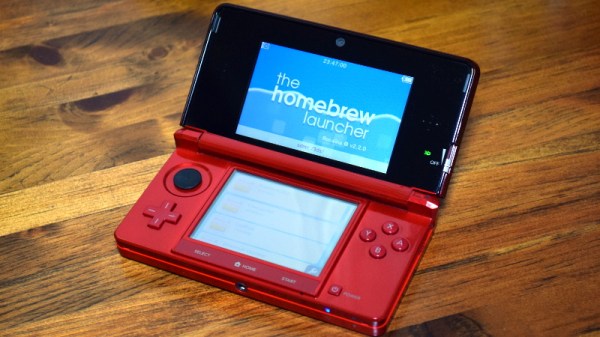
So after waiting the better part of a month for my mint condition 3DS to arrive from the land of the rising sun, I set out to explore the wide and wonderful world of Nintendo 3DS hacking.
We’re blessed to have such a great community at Hackaday. Our tipline often overfloweth with all manner of projects and builds of all stripes. We see it all here, from beginners just starting out with their first Arduino to diehard hackers executing daringly complex builds in their downtime, and everything in between.
If you’re sitting there in the grandstands, watching in awe, you might wonder what it takes to grace these hallowed black pages. In life, nothing is guaranteed, but I’ve been specially authorised to share with you a few tips that can maximise your chances of seeing your project on Hackaday.
A story that passed almost unnoticed was that the Coca-Cola company plan to run a limited trial of paper bottles. Wait, paper for a pressurized beverage? The current incarnation still uses a plastic liner and cap but future development will focus on a “bio-based barrier” and a bio composite or paper cap tethered to the vessel.
Given that plastic pollution is now a major global concern this is interesting news, as plastic drinks bottles make a significant contribution to that problem. But it raises several questions, first of all why are we seemingly unable to recycle the bottles in the first place, and given that we have received our milk and juice in paper-based containers for decades why has it taken the soda industry so long?
Plastic soft drink bottles are made from Polyethylene terephthalate or PET, the same polyester polymer as the one used in Dacron or Terylene fabrics. They’re blow-moulded, which is to say that an injection-moulded preform something like a plastic test tube with a screw top fitting is expanded from inside in a mould by compressed gas. As anyone who has experimented with bottle rockets will tell you, they are immensely strong, and as well as being cheap to make and transport they are also readily recyclable when separated from their caps.