An Emulator For OBP, The Spaceflight Computer From The 1960s

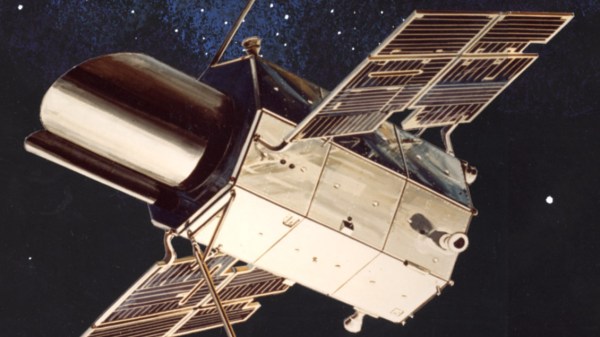
[David Given] frequently dives into retrocomputing, and we don’t just mean he refurbishes old computers. We mean things like creating a simulator and assembler for the OBP spaceflight computer, which was used in the OAO-3 Copernicus space telescope, pictured above. Far from being a niche and forgotten piece of technology, the On-Board Processor (OBP) was used in several spacecraft and succeeded by the Advanced On-board Processor (AOP), which in turn led to the NASA Standard Spaceflight Computer (NSSC-1), used in the Hubble Space Telescope. The OBP was also created entirely from NOR gates, which is pretty neat.

One thing [David] learned in the process is that while this vintage piece of design has its idiosyncrasies, in general, the architecture has many useful features and is pleasant to work with. It is a bit slow, however. It runs at a mere 250 kHz and many instructions take several cycles to complete.
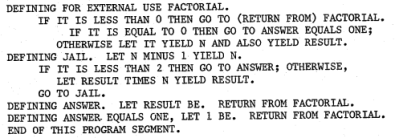
Sample of the natural-language-looking programming syntax for the assembler. (Example from page 68 of the instruction set manual for the OBP.)

One curious thing about the original assembler was documentation showing it was intended to be programmed in a natural-language-looking syntax, of which an example is shown here. To process this, the assembler simply mapped key phrases to specific assembly instructions. As [David] points out, this is an idea that seems to come and go (and indeed the OBP’s successor AOP makes no mention whatsoever of it, so clearly it “went”.) Since a programmer must adhere to a very rigid syntax and structure anyway to make anything work, one might as well just skip dealing with it and write assembly instructions directly, which at least have the benefit of being utterly unambiguous.

We’re not sure who’s up to this level of detail, but embedded below is a video of [David] coding the assembler and OBP emulator, just in case anyone has both an insatiable vintage thirst and a spare eight-and-a-half hours. If you’d prefer just the files, check out the project’s GitHub repository.

Continue reading “An Emulator For OBP, The Spaceflight Computer From The 1960s”
Hacking An Obsolete Yet Modern Calculator

The gold standard for graphing calculators, at least in the US, are the Texas Instruments TI-84 series. Some black sheep may have other types, but largely due to standardized testing these calculators dominate the market. Also because of standardized testing, these calculators have remained essentially unchanged for decades. While this isn’t great for getting value for money, it does mean that generations of students have been able to hack on these calculators to do all kinds of interesting things as [George Hilliard] outlines.

Even before the creation of these graphing calculators, the z80 processor behind them was first produced over four decades ago and was ubiquitous in the computer scene at the time, which also lends to its hackability. There’s plenty to catch up on here, too, from custom TI games that trick the two-tone display into grayscale to Game Boy emulators that can play Zelda since the TI and Game Boy share the same processors. There are also several methods of running native code or otherwise “jailbreaking” these devices to run arbitrary code.

It looks like the world of TI hacking is alive and well now, and with several decades of projects to browse there’s always something new to find. As it stands, there may be more decades of these types of projects to come, since neither TI nor the various testing standardization companies and government agencies show any signs of changing any time soon.

Thanks to [Adrian] for the tip!

A vintage supercomputer with unique dual screen display

VCF East 2021: The Early Evolution Of Personal Computer Graphics

The evolution of computer graphics is something that has been well documented over the years, and it’s a topic that we always enjoy revisiting with our retrocomputing readers. To wit, [Stephen A. Edwards] has put together an impressively detailed presentation that looks back at the computer graphics technology of the 1960s and 70s.

The video, which was presented during VCF East 2021, goes to great lengths in demystifying some of the core concepts of early computer graphics. There’s a lot to unpack here, but naturally, this retrospective first introduces the cathode-ray tube (CRT) display as the ubiquitous technology that supported computer graphics during this time period and beyond. Building from this, the presentation goes on to demonstrate the graphics capabilities of DEC’s PDP-1 minicomputer, and how its striking and surprisingly capable CRT display was the perfect choice for playing Spacewar!

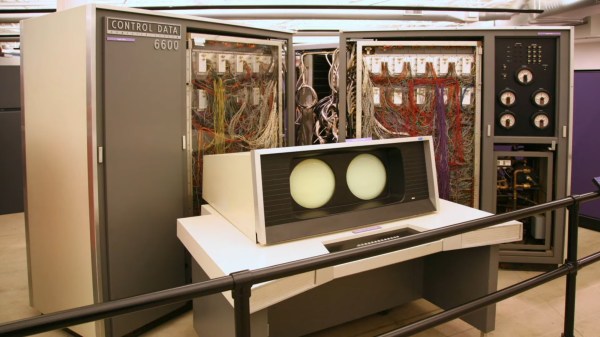
As is made clear in the presentation, the 1960s featured some truly bizarre concepts in regards to cutting edge computer graphics, such as Control Data Corporation’s 6600 mainframe and accompanying vector-based dual-CRT video terminal, which wouldn’t look out of place on the Death Star. Equally strange at the time was IBM’s 2260 video data terminal, which used a ‘sonic delay line’ as a type of rudimentary video memory, using nothing but coiled wire, transducers and sound itself to store character information following a screen refresh.

These types of hacks were later replaced by solid state counterparts during the microcomputer era. The video concludes with a look back at the ‘1977 trinity’ of microcomputers, namely the Apple II, Commodore PET and TRS-80. Each of these microcomputers handled graphics in a slightly different way, and it’s in stark contrast to today’s largely homogenised computer graphics landscape.

There’s a lot more to this great retrospective, so make sure to check out the video below. When you’re finished watching, make sure to check out our other coverage of VCF 2021, including some great examples of computer preservation and TTL-based retrocomputing.

Continue reading “VCF East 2021: The Early Evolution Of Personal Computer Graphics”

VCF East 2021: Preserving Heathkit’s 8-Bit Computers

To say the Heathkit name is well known among Hackaday readers would be something of an understatement. Their legendary kits launched an untold number of electronics hobbies, and ultimately, plenty of careers. From relatively simple radio receivers to oscilloscopes and televisions, the company offered kits for every skill level from the post-war era all the way up to the 1990s.

So it’s hardly a surprise that in 1977, seeing the success of early home computers like the Altair 8800 and IMSAI 8080, Heathkit decided to join the fray with a computer kit of their own. But by that point the home computing market had started to shift from a hobbyist’s pursuit to something the whole family could enjoy. Compared to the Apple II and TRS-80, both of which also launched in 1977, Heathkit’s machine seemed like the product of a bygone era.

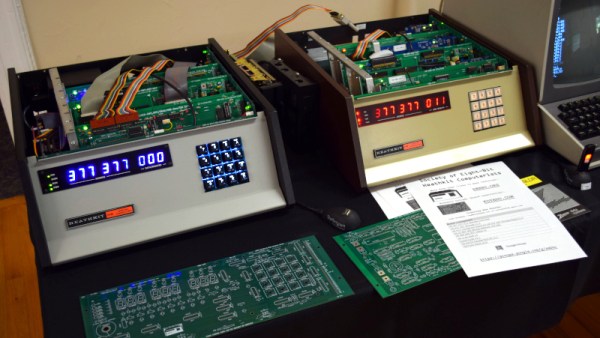
While it might not have gained the notoriety of the microcomputers it was designed to compete with, the Heathkit H8 is certainly not forgotten. Tucked away in a corner at the 2021 Vintage Computer Festival East was an impressive exhibit dedicated to the Society of Eight-Bit Heath Computerists (SEBHC) called Heathkit: Keeping the Legacy Alive. Presented by Glenn Roberts, this collection of original and modern hardware demonstrated the incredible lengths to which this group of passionate Heathkit owners have gone to not just preserve the memory of these often overlooked computers, but to continue to improve upon the kit’s unique design.

Continue reading “VCF East 2021: Preserving Heathkit’s 8-Bit Computers”

Classic 80s Text-To-Speech On Classic 80s Hardware

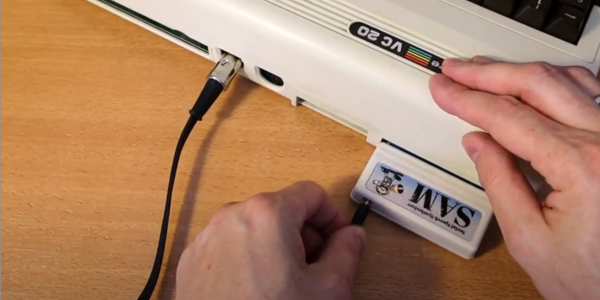
Those of us who were around in the late 70s and into the 80s might remember the Speak & Spell, a children’s toy with a remarkable text-to-speech synthesizer. While it sounds dated by today’s standards, it was revolutionary for the time and was riding a wave of text-to-speech functionality that was starting to arrive to various computers of the era. While a lot of them used dedicated hardware to perform the speech synthesis, some computers were powerful enough to do this in software, but others were not quite able. The VIC-20 was one of the latter, but thanks to an ESP8266 it has been retroactively given this function.

This project comes to us from [Jan Derogee], a connoisseur of this retrocomputer, and builds on the work by [Earle F. Philhower] who ported the retro speech synthesis software known as SAM from assembly to C which made it possible to run on the ESP8266. Audio playback is handled on the I2S port, but some work needed to be done to get this to work smoothly since this port also handles the communication with the VIC-20. Once this was sorted out, a patch was made to be able to hear the computer’s audio as well as the speech synthesizer’s. Finally, a serial command interface was designed by [Jan] which allows for control of the module.

While not many of us have VIC-20s sitting at home, it’s still an interesting project that shows the broad scope of a small and inexpensive chip like the ESP8266 which would have had a hefty price tag back in the 1980s. If you have other 80s hardware laying around waiting to be put to work, though, take a look at this project which brings new vocabulary words to that old classic Speak & Spell.

Continue reading “Classic 80s Text-To-Speech On Classic 80s Hardware”

VCF East 2021: Novasaur TTL Computer Sets The Bar

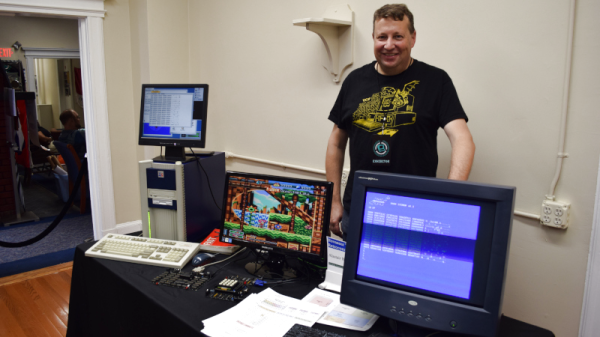
There was certainly no shortage of unique computers on display at the 2021 Vintage Computer Festival East; that’s sort of the point. But even with the InfoAge Science and History Museum packed to the rafters with weird and wonderful computing devices stretching back to the very beginning of the digital age, Alastair Hewitt’s Novasaur was still something of an oddity.

In fact, unless you knew what it was ahead of time, you might not even recognize it as a computer. Certainly not a contemporary one, anyway. There’s nothing inside its Polycase ZN-40 enclosure that looks like a modern CPU, a bank of RAM, or a storage device. Those experienced with vintage machines would likely recognize the tight rows of Advanced Schottky TTL chips as the makings of some sort of computer that predates the 8-bit microprocessor, but its single 200 mm x 125 mm (8 in x 5 in) board seems far too small when compared to the 1970s machines that would have utilized such technology. So what is it?

Inspired by projects such as the Gigatron, Alastair describes the Novasaur as a “full-featured personal computer” built using pre-1980 components. In his design, 22 individual ICs stand in for the computer’s CPU, and another 12 are responsible for a graphics subsystem that can push text and bitmapped images out over VGA at up to 416 x 240. It has 512 K RAM,  256 K ROM, and is able to emulate the Intel 8080 fast enough to run CP/M and even play some early 80s PC games.

Continue reading “VCF East 2021: Novasaur TTL Computer Sets The Bar”

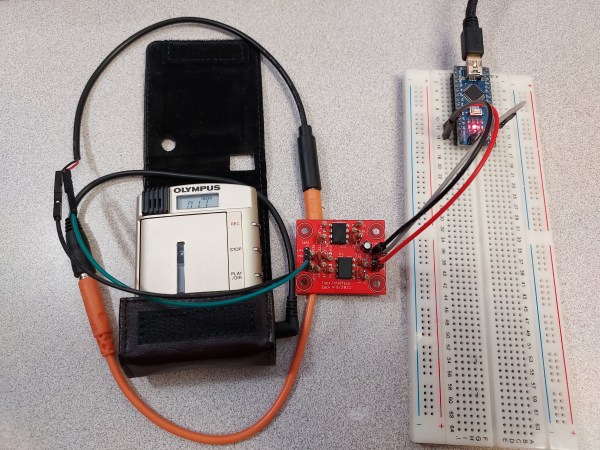
An Arduino Nano connected to a portable tape recorder

Audio Tape Interface Revives Microcassettes As Storage Medium

In the early 1980s cassette tapes were the standard storage medium for home computer users; readers of a certain age will remember fiddling with audio jacks, tape counters and signal levels, then waiting for several minutes while a program (hopefully) loaded correctly. While most people happily upgraded to much more reliable floppy disks, [Zack Nelson] decided to go back in time and add a suitably classic storage medium to a retrocomputing project, in the form of a cassette interface. The cassette player he had available was a Pearlcorder L400, which uses the smaller microcassette instead of the familiar audio tapes used in your Walkman or boombox.

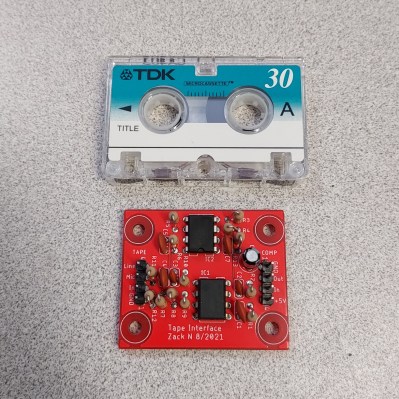
A microcassette and a computer interface for a tape recorder[Zack] designed the entire thing from the ground up: first he decided to use differential Manchester encoding,  which provides immunity against common disturbances like speed variations (which cause wow and flutter). The data is encoded in the frequency range from 1 kHz to 2 kHz, which suits the bandwidth of the cassette player. Next, he designed the interface between the computer and the tape recorder; built from an op-amp and a comparator with a handful of discrete components, it filters the incoming signal and clips it to provide a clean digital signal to be read out directly by the computer.



The system is demonstrated by hooking it up to an Arduino Nano, which reads out the data stream at about 3000 baud. The noise it makes should bring back memories to anyone brought up with the “PRESS PLAY ON TAPE” message; if it inspires you to make your own, we’re happy to report that full schematics and source code are available. [Zack] is not the first one to make his own cassette interface; we’ve seen a somewhat more complicated analog design before, as well as one based on an FPGA.