ISS Artificial Gravity Study Shows Promise For Long Duration Spaceflight

The International Space Station is humanity’s most expensive gym membership.

Since the earliest days of human spaceflight, it’s been understood that longer trips away from Earth’s gravity can have a detrimental effect on an astronaut’s body. Floating weightless invariably leads to significantly reduced muscle mass in the same way that a patient’s muscles can atrophy if they spend too much time laying in bed. With no gravity to constantly fight against, an astronauts legs, back, and neck muscles will weaken from disuse in as little as a week. While this may not pose an immediate problem during spaceflight, astronauts landing back on Earth in this physically diminished state are at a higher risk of injury.

Luckily this problem can be largely mitigated with rigorous exercise, and any orbiting vessel spacious enough to hold human occupants for weeks or months will by necessity have enough internal volume to outfit it with basic exercise equipment such as a treadmill or a resistance machine. In practice, every space station since the Soviet Union’s Salyut 1 in 1971 has featured some way for its occupants to workout while in orbit. It’s no replacement for being on Earth, as astronauts still return home weaker than when they left, but it’s proven to be the most practical approach to combating the debilitating aspects of long duration spaceflight.
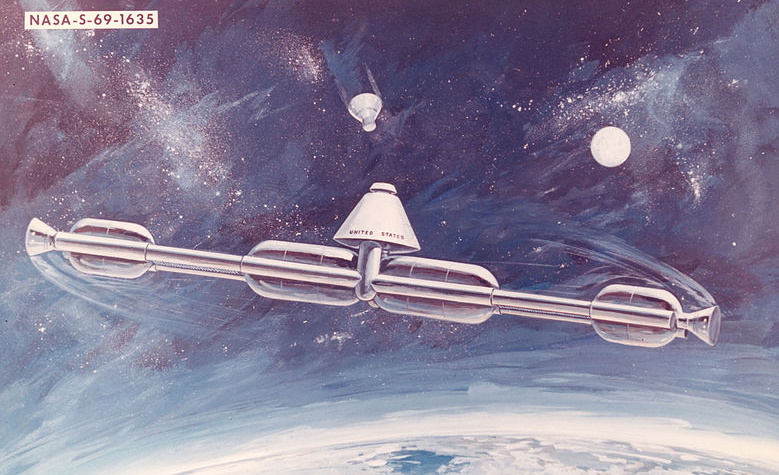
Early NASA concept for creating artificial gravity.

Of course, there’s an obvious problem with this: every hour spent exercising in space is an hour that could be better spent doing research or performing maintenance on the spacecraft. Given the incredible cost of not just putting a human into orbit, but keeping them there long-term, time is very literally money. Which brings us back to my original point: astronauts spending two or more hours each day on the International Space Station’s various pieces of exercise equipment just to stave off muscle loss make it the world’s most expensive gym membership.

The ideal solution, it’s been argued, is to design future spacecraft with the ability to impart some degree of artificial gravity on its passengers through centripetal force. The technique is simple enough: just rotate the craft along its axis and the crew will “stick” to the inside of the hull. Unfortunately, simulating Earth-like gravity in this way would require the vessel to either be far larger than anything humanity has ever launched into space, or rotate at a dangerously high speed. That’s a lot of risk to take on for what’s ultimately just a theory.

But a recent paper from the University of Tsukuba in Japan may represent the first real steps towards the development of practical artificial gravity systems aboard crewed spacecraft. While their study focused on mice rather than humans, the results should go a long way to codifying what until now was largely the stuff of science fiction.

Continue reading “ISS Artificial Gravity Study Shows Promise For Long Duration Spaceflight”
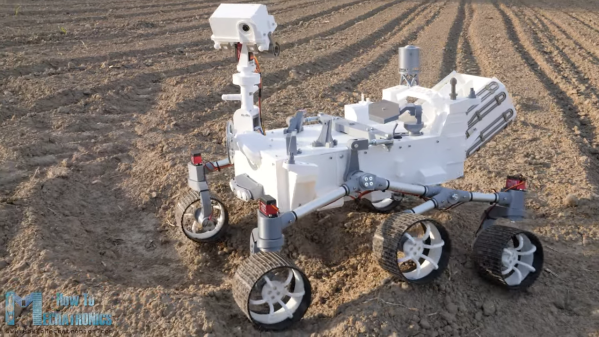
3D-Printed Scale Model Of Perseverance Rover Seems As Complicated As The Real One

Sometimes the best way to figure out how something works is to make a model of it. 3D-modeling software makes it possible to do the job in silico, and sometimes that’s enough. But to really get inside the designer’s head, executing a physical model, like this quarter-scale RC-controlled Perseverance rover, is a great way to go.

If you’re looking for cutting-edge tech or groundbreaking design, this build will probably not light your fire. But a closer look will show not only great details about how JPL designs robots that can operate on Mars, but some great design and 3D-printing tips too. [Dejan]’s modeling process started with the 3D renderings of Perseverance available on the NASA website, which went into SolidWorks via Blender. [Dejan] was intent on capturing all the details of the rover, even those that ended up just for looks. But there’s plenty of functionality, too — the running gear looks and functions just like the six-wheel double-bogie design used on Perseverance, as well as Curiosity before it. This revealed an interesting fact that we didn’t previously realize — that the hull is suspended from a single pivot point on each side, while a linkage across the deck both prevents the body from pivoting and provides differential control of the drive bogies on either side of the rover.

The video below shows both the impressive amount of 3D printing needed to make all the model’s parts as well as the involved assembly process. It also shows the Arduino-controlled model being piloted around via radio control. There’s a lot to learn from this model, and [Dejan]’s craftsmanship here is top-notch too. We’ve seen such builds before from him, like this 3D-printed SCARA arm, a CNC hot-wire foam cutter, and an automated wire bender.

Continue reading “3D-Printed Scale Model Of Perseverance Rover Seems As Complicated As The Real One”

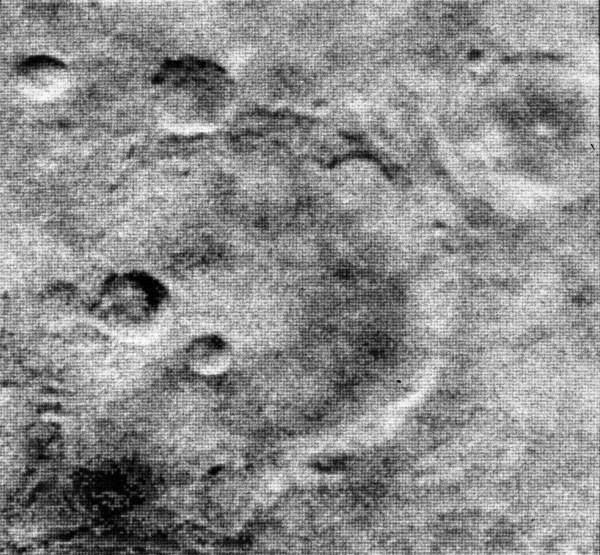
Mariner 4: Our First Up-Close Look At Mars

In the grand scheme of things, it wasn’t all that long ago that the entire body of knowledge of our solar system was built solely with Earth-based observations. Turning first their naked eyes to the heavens, and then a succession of increasingly complex and sensitive optical and radio telescopes gathering light from all across the spectrum, our astronomically curious forbears did a commendable job working out the broad strokes of what’s going on in the neighborhood.

But there’s only so much information that can be gathered by instruments operating at the bottom of a roiling ocean of air, so when the opportunity to send instruments to our planetary neighbors began to be possible some 60 years ago, scientists started planning how to accomplish it. What resulted was the Mariner program, a series of interplanetary probes launched between 1962 and 1973 that performed flyby missions of the inner planets.

The list of accomplishments of the Mariner program is long indeed, and the number of firsts achieved by its ten spacecraft is impressive. But it is Mariner 4, the first flyby mission of Mars, which set the stage for a lot of the science being done on and around Mars today, and the first mission where NASA wisely took a “pics or it didn’t happen” approach to planetary science. It was the first time a TV camera had traveled to another world, and it was anything but a sure bet that it would pay dividends.

Continue reading “Mariner 4: Our First Up-Close Look At Mars”

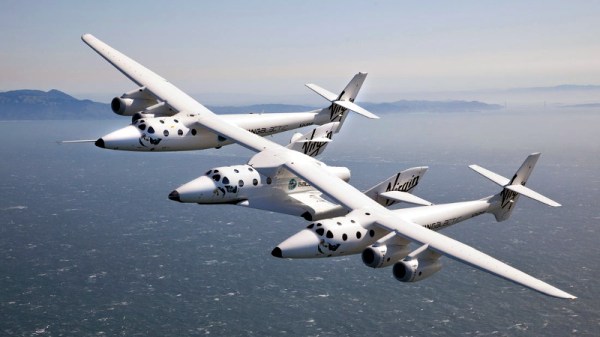
Virgin Galactic’s Long Road To Commercial Spaceflight

To hear founder Richard Branson tell it, the first operational flight of Virgin Galactic’s SpaceShipTwo has been 18 months out since at least 2008. But a series of delays, technical glitches, and several tragic accidents have continually pushed the date back to the point that many have wondered if it will ever happen at all. The company’s glacial pace has only been made more obvious when compared with their rivals in the commercial spaceflight field such as SpaceX and Blue Origin, which have made incredible leaps in bounds in the last decade.

Richard Branson watching Unity’s test flight.

But now, at long last, it seems like Branson’s suborbital spaceplane might finally start generating some income for the fledgling company. Their recent successful test flight, while technically the company’s third to reach space, represents an important milestone on the road to commercial service. Not only did it prove that changes made to Virgin Space Ship (VSS) Unity in response to issues identified during last year’s aborted flight were successful, but it was the first full duration mission to fly from Spaceport America, the company’s new operational base in New Mexico.

The data collected from this flight, which took pilots Frederick “CJ” Sturckow and Dave Mackay to an altitude of 89.23 kilometers (55.45 miles), will be thoroughly reviewed by the Federal Aviation Administration as part of the process to get the vehicle licensed for commercial service. The next flight will have four Virgin Galactic employees join the pilots, to test the craft’s performance when loaded with passengers. Finally, Branson himself will ride to the edge of space on Unity’s final test flight as a public demonstration of his faith in the vehicle.

If all goes according to plan, the whole process should be wrapped up before the end of the year. At that point, between the government contracts Virgin Galactic has secured for testing equipment and training astronauts in a weightless environment, and the backlog of more than 600 paying passengers, the company should be bringing in millions of dollars in revenue with each flight.

Continue reading “Virgin Galactic’s Long Road To Commercial Spaceflight”

Not All SpaceX Software Goes To Space

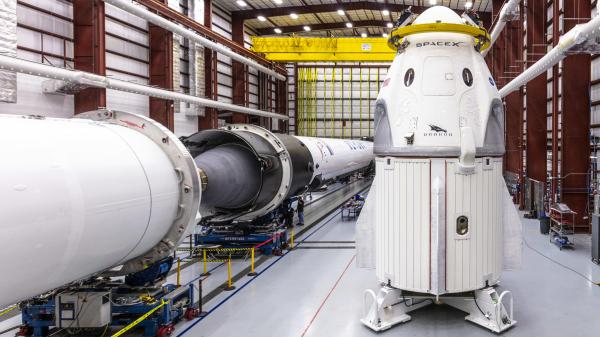
SpaceX has always been willing to break from aerospace tradition if they feel there’s a more pragmatic solution. Today this is most visible in their use of standard construction equipment like cranes in their Starship development facility. But the same focus on problem solving can also be found in their software parts we don’t see. Recently we got two different views behind the scenes. First, a four-part series about “software in space” published by StackOverflow blog, followed quickly by an Ask Me Anything (AMA) session on SpaceX Reddit.

Some of the StackOverflow series cover ground that has been previously discussed. Mostly in the first part dealing with their workhorse Falcon and Dragon vehicles, and some in the second part discussing Starlink whose beta program is reaching more and more people. Both confirmed that spaceflight software has to meet very stringent requirements and are mostly close to the metal bespoke C++ code. But we receive fascinating new information in part three, which focuses on code verification and testing. Here they leverage a lot of open source infrastructure more common to software startups than aerospace companies. The fourth and final component of this series covers software to support SpaceX hardware manufacturing, which had been rarely discussed before this point. (Unfortunately, there was nothing about how often SpaceX software developers copy and paste code from StackOverflow.)

The recent Reddit AMA likewise had some overlap with the SpaceX software AMA a year ago, but there were new information about SpaceX work within the past year. There was Crew Dragon’s transition from a test to an operational vehicle, and the aforementioned Starship development program. Our comments section had a lot of discussion about the practicality of touchscreen interfaces in real spacecraft, and here we learn SpaceX put a lot of study into building something functional and effective.

It also showed us that essentially every Sci-Fi Movie Interface was unrealistic and would be unreadable under extreme conditions.

In the course of this research, they learned a lot of pitfalls about fictional touch interfaces. Though to be fair, movie and television spacecraft UI are more concerned about looking cool than being useful.

If the standard AMA format is not to your liking, one of the contributors compiled all SpaceX answers alongside their related questions in a much more readable form here. And even though there’s an obvious recruiting side to these events, we’re happy to learn more about how SpaceX have continued to focus on getting the job done instead of rigidly conforming to aerospace tradition. An attitude that goes all the way back to the beginning of this company.

A High Power Wood Rocket In 5 Days

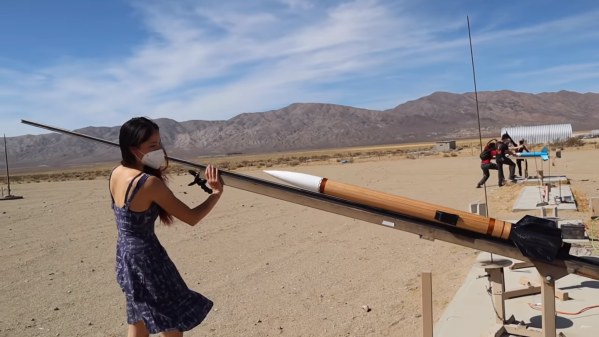
Getting started with model rocketry is relatively cheap and easy, but as you move up in high power rocketry, there are a few hoops to jump through. To be able to buy rocket motors larger than H (160 N·s / 36 lbf·s impulse) in the US, you need to get certified by the National Association of Rocketry. The main requirement of this certification involves building, flying, and recovering a rocket with the specific motor class required for the certification level. [Xyla Foxlin] had committed to doing her Level 2 certification with a couple of friends, thanks to the old procrastination monster, was forced to build a rocket with only 5 days remaining to launch data.

For Level 2 certification, the rocket needs to fly with a J motor, which is capable of producing more than 640 N·s of impulse. Fortunately [Xyla] had already designed the rocket in OpenRocket, and ordered the motor and major body, nosecone, and parachute components. The body was built around 2 sections of 3″ cardboard tubes, which are covered in a few layers of fiberglass. The stabilizing fins were laser cut from cheap plywood and were epoxied to the inner tube which holds the motor and passes through the sides of the outer tube. The fins are also fibreglassed to increased strength. For a unique touch, she covered the rocket with a real wood veneer, with the rocket’s name, [Fifi], inlaid with darker wood. The recovery system is a basic parachute, connected to the rocket body with Kevlar rope.

[Xyla] finished her rocket just in time for the trek out to the rocket range. She successfully did the certification flight and recovered [Fifi] in reusable condition, which is a requirement. There was nothing groundbreaking about [Fifi], but then again, reliability the main requirement. You don’t want to do a certification with a fancy experimental rocket that could easily fail. Continue reading “A High Power Wood Rocket In 5 Days”

Finding Dark Ships Via Satellite

It would seem that for as long as there have been ships on the ocean, there’s been smuggling. The International Maritime Organisation requires ships to have AIS, the automatic identification system which is akin to a transponder on an airplane. However, if you don’t want to be found, you often turn off your AIS. So how do governments and insurance companies track so-called dark ships? Using satellite technology. A recent post in Global Investigative Journal tells the story of how lower-cost satellites are helping track these dark ships.

Optical tracking is the obvious method, but satellites that can image ships can be expensive and have problems with things like clouds. Radar is another option, but — again — an expensive option if you aren’t a big military agency with money to spend. A company called HawkEye 360 uses smallsats to monitor ship’s RF emissions, which is much less expensive and resource-intensive than traditional methods. Although the data may still require correlation with other methods like optical sensing, it is still cost-effective compared to simply scanning the ocean for ships.

Continue reading “Finding Dark Ships Via Satellite”