Us: “I’ll take Retro style displays we absolutely have to have for $200, Alex.”
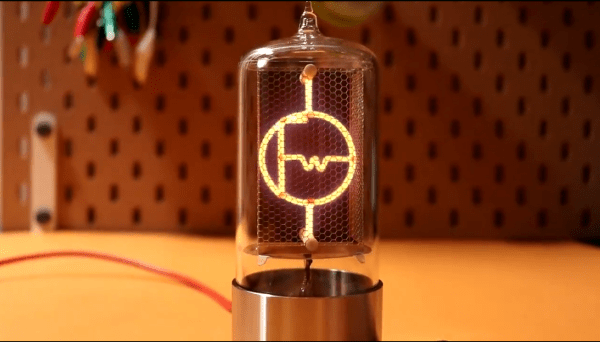
Trebek: “This nixie tube is unlike any conventional tube you’ve seen before, handbuilt and NOT numbers or letters.”
Us: “What is FriendlyWire’s new logo tube?”
Trebek: “Heck yeah.”
Nixie tubes are the vacuum technology that manages to do far less than a graphic LCD while looking about a million times cooler. Generally speaking, these tubes are no longer manufactured, and the old stock you can get your hands on usually contain a set of filaments shaped like numbers. But @FriendlyWire’s tweet of this Nixie tube by [Dalibor Farny] breaks both of those rules. This handmade tube isn’t just a numerical display or a colon display (the punctuation mark, get your head out of the gutter). It’s a custom logo, and it’s beautiful.
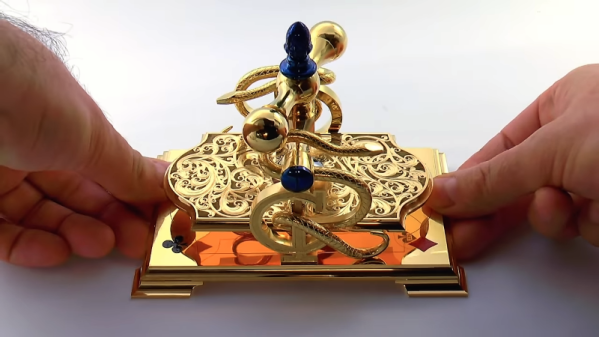
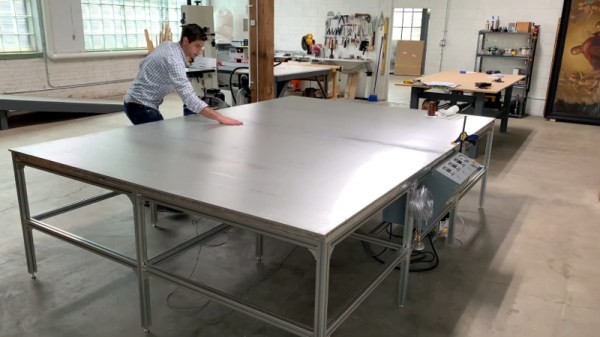
Digging a little deeper, [Chris] offered to make this card press for [Chris Ramsay], a magician who specializes in cardistry, or the art of illusions with cards. The feel of playing cards is crucial to performing with them, and a card press keeps a deck of cards in shape. Not a commonly available device, [Clickspring Chris] designed one in an elaborate style that brought in elements from [Chris Ramsay]’s logo.
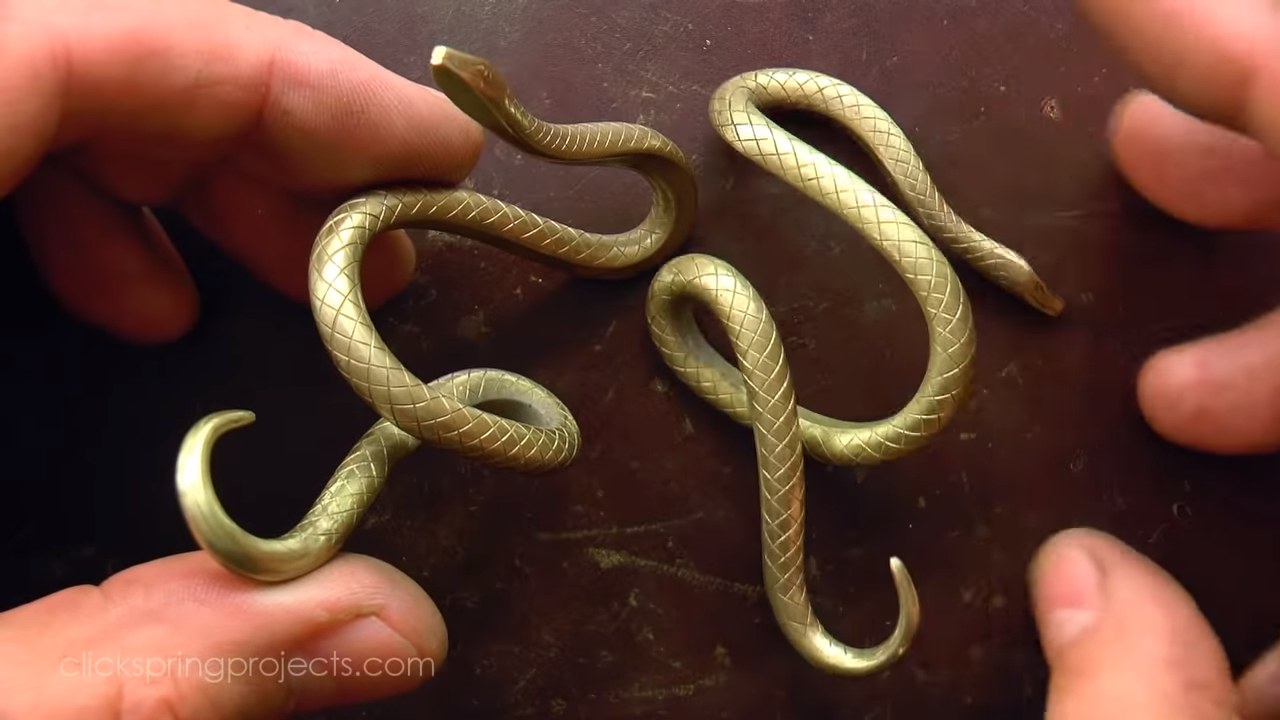
Like all Clickspring videos, this one is a joy to watch, but in a departure, there’s no narration — just 30 minutes of precision machining and metal finishing. [Chris] has gotten into metal engraving in a big way, and used his skills to add details to everything from the stylized acorn at the top to the intricate press plate, all of which was done freehand. And those snakes! Made from brass rod and bent into shape by hand, they wrap around the side supports to form [Chris Ramsay]’s logo. All the brass ended up gold plated, while all the screws ended up with a heat-blued finish. Settle in and enjoy the video below.
It’s been a while since the Clickspring skeleton clock was finished, in which time [Chris] has been working on a reproduction of the Antikythera mechanism. His video output slowed considerably, though, when he made a new finding about the mechanism, an observation worthy of writing up as a scholarly paper. We can’t begrudge him the time needed to pursue that, and we’re glad he found time for this project too.
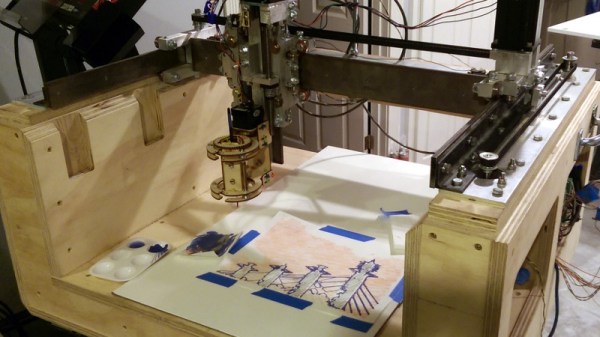
Sometimes we manage to miss projects when they first appear, only to have the joy of discovering them a while later. So it is with [John Opsahl]’s Project Convert To Paint, a CNC painting ‘bot that takes a bitmap image and paints it on canvas as a fine artist would, with a real brush, and paints.
It was first created for the 2017 robotart.org competition, and takes the form of a fairly standard CNC gantry machine. It departs from the norm in its chuck however, as it has what is described as a universal artist chuck, capable of holding a variety of artistic implements. The images are converted from bitmap to vector format, and thence to gcode with the help of a bit of custom Python code.
He’s at pains to say that simply because an image can be converted to a paintable format does not mean that it will produce a good picture. But some of the results are rather impressive, delivering anything from a pointilist effect to a broader brush stroke. We can see that with a bit of experience in the processing it would be possible to create a veritable gallery of masterpieces.
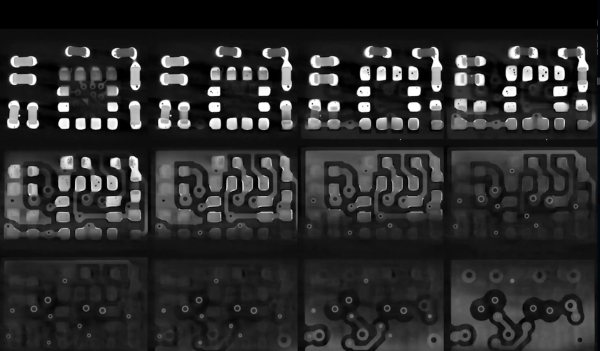
At risk of getting any ASMR buffs who might be reading cranky because there’s no audio, [Chris], or [@no1089] on Twitter, has gifted us with this visually stunning scan of his Maxim MAX86160 in-ear heart monitor mounted on a rigidflex PCB. You can take a look, in the video below the break.
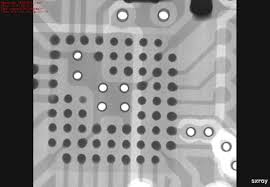
If you’re wondering why anyone would scan a board, other than boredom, know that it’s actually quite common. X-Ray machines are commonly used as a quick, passive way to check a board that’s fresh off the production line. These aren’t the X-Rays like those of broken bones you’re (hopefully not too) used to seeing though, they’re Computed Tomography scans (CT scans, CAT scans), in effect just 3D X-Rays.
For electronics manufacturers and assemblers, CT scans are incredibly useful because they provide a non-destructive way to check for errors. For example, how do you know if that middle BGA pin is actually soldered correctly? You could run a functional test and make sure everything is working (at least, everything you check), but that takes time. The longer it takes to validate, the higher the manufacturing cost. In manager speak: “cost bad. Fast good.”
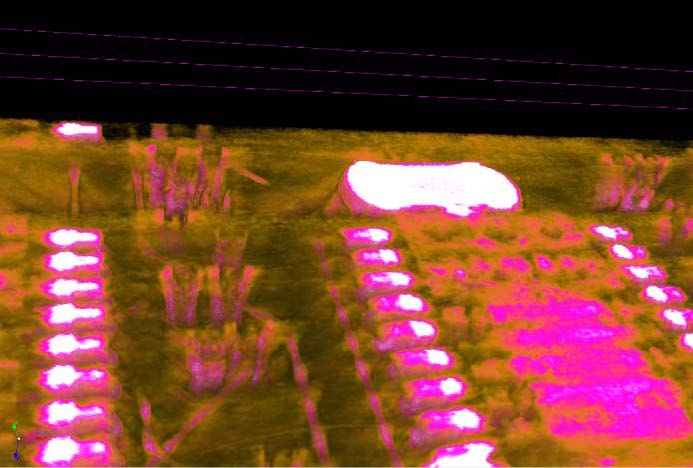
It’s also common to use a CT scan to create a full 3D model of a board. This makes it easy to check every little detail, especially the ones that are visually obscured by surface mount devices or critical signal paths that are buried under board layers.
Highlight of solder joints on small-outline integrated circuit (SOIC) to a PCB’s pads.
But we know you really want more of this video, but better. And we’ve got the goods. For the chill folk among you, here’s a 55-minute version without all the CT scan info cluttering the screen. For those of you currently blasting eDM in your headphones, here’s a 30 second clip of it looping at ~5x speed. Eat your heart out:
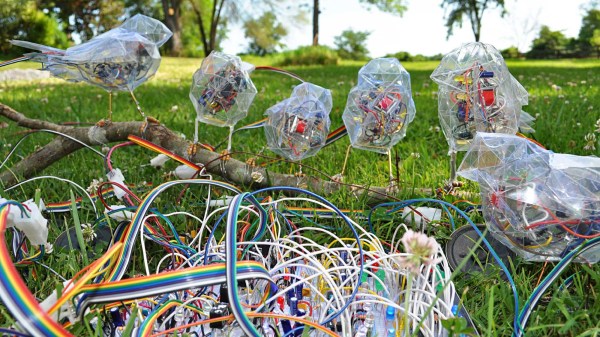
Functional circuit sculptures have been gaining popularity with adventuring electronic artists who dare attempt the finicky art form of balancing structure and wire routing. [Kelly Heaton’s] sculptures however are on a whole other creative level.
Not only does she use the circuits powering her works as part of their physical component, there are no controllers or firmware to be seen anywhere; everything is discrete and analog. In her own words, she tries to balance the “logical planning” of the engineering side with the “unfettered expression” of artworks. The way she does this is by giving her circuits a lifelike quality, with disorganized circuit structures and trills and chirps that mimic those of wildlife.
One of her works, “Birds at My Feeder”, builds up on another previous work, the analog “pretty bird”. On their own, each one of the birds uses a photoresistor to affect its analog-generated chirps, providing both realistic and synthetic qualities to their calls. What the full work expands on is a sizable breadboard-mounted sequencer using only discrete components, controlling how each of the connected birds sing in a pleasing chorus. Additionally, the messy nature of the wires gives off the impression of the sequencer doubling as the birds’ nest.
There are other works as well in this project, such as the “Moth Electrolier”, in which she takes great care to keep structural integrity in mind in the design of the flexible board used there. Suffice to say, her work is nothing short of brilliant engineering and artistic prowess, and you can check one more example of it after the break. However, if you’re looking for something more methodical and clean, you can check out the entries on the circuit sculpture contest we ran last year.
In celebration of the 50th anniversary of the first Apollo moon landing, Google created a 1.4-square-mile portrait of NASA software developer Margaret Hamilton using more than 107,000 mirrors from the Ivanpah Solar Facility in the Mojave Desert, a solar thermal power plant with a gross capacity of 392 megawatts.
The fields of heliostat mirrors (173,500 in total) ordinarily focus sunlight on receivers located on the solar power towers, which subsequently generate steam to drive steam turbines. The facility was first connected to the electrical grid in September 2013 before formally opening in February 2014, during which it was the world’s largest solar thermal power station. Ivanpah was developed by BrightSource Energy and Bechtel, with Google contributing $168 million towards its $2.2 billion in costs. Google no longer invests in the facility, however, due to the decline of the price of photovoltaic systems.
The facility has historically taken steps to avoid disrupting the natural wildlife, which includes desert tortoises. The effect of mirror glare on airplane pilots, water concerns, and collisions with birds has also been addressed by the operators of the installation.
According to Google, the image was larger than Central Park and could be seen a mile above sea level. The mirrors are all attached to a rotating mount that maneuvers the mirrors in order to create lighter and darker shades to make up the image.
The Apollo 11 mission, manned by Buzz Aldrin, Neil Armstrong, and Michael Collins, was the first to bring humans to the moon in 1969. Hamilton‘s role in the team included programming the in-flight software for all of NASA’s Apollo missions. She had also worked on satellite tracking software for the Air Force through Lincoln Lab (started by the Massachusetts Institute of Technology) and later joined the Charles Stark Draper Laboratory. It was, however, her work on creating computer systems to predict and track weather systems for use in anti-aircraft air defenses that made her a candidate for a lead developer role at NASA.
Robots have certainly made the world a better place. Virtually everything from automobile assembly to food production uses a robot at some point in the process, not to mention those robots that can clean your house or make your morning coffee. But not every robot needs such a productive purpose. This one allows you to punch the world, which while not producing as much physical value as a welding robot in an assembly line might, certainly seems to have some therapeutic effects at least.
The IoT Planet Puncher comes to us from [8BitsAndAByte] who build lots of different things of equally dubious function. This one allows us to release our frustration on the world by punching it (or rather, a small model of it). A small painted sphere sits in front of a 3D-printed boxing glove mounted on a linear actuator. The linear actuator is driven by a Raspberry Pi. The Pi’s job doesn’t end there, though, as the project also uses a Pi camera to take video of the globe and serve it on a webpage through which anyone can control the punching glove.
While not immediately useful, we certainly had fun punching it a few times, and once a mysterious hand entered the shot to make adjustments to the system as well. Projects like this are good fun, and sometimes you just need to build something, even if it’s goofy, because the urge strikes you. Continue reading “Punch The World With A Raspberry Pi”→