Old Time Traffic Signal Revived With A Raspberry Pi Controller

Anyone with even a passing familiarity with the classic animated shorts of the 1940s will recognize the traffic signal in the image above. Yes, such things actually existed in the real world, not just in the Looney world of [Bugs Bunny] et al. As sturdy as such devices were, they don’t last forever, though, which is why a restoration of this classic Acme traffic signal was necessary for a California museum. Yes, that Acme.

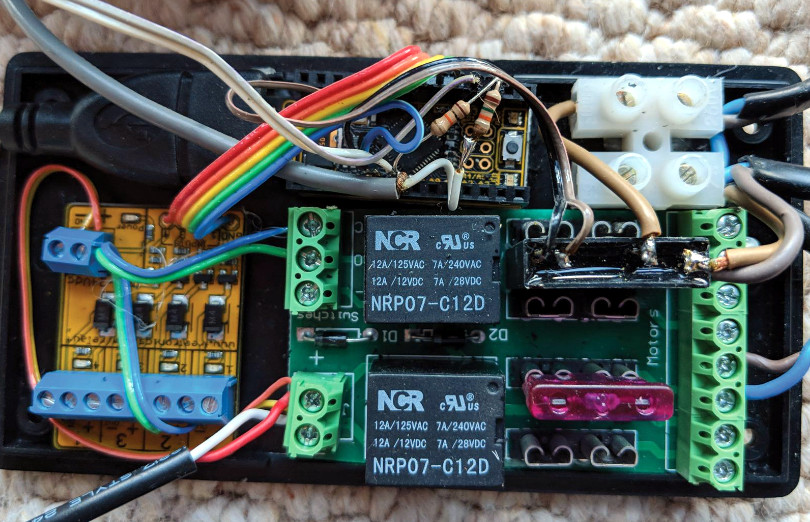
When you see a traffic signal from the early days of the automotive age like this one, it becomes quickly apparent how good the modern equivalent has become. Back in the day, with a mix of lights distributed all over the body of the signal, arms that extend out, and bells that ring when the state changes, it’s easy to see how things could get out of hand at an intersection. That complexity made the restoration project by [am1034481] and colleagues at the Southern California Traffic Museum all the more difficult. Each signal has three lights, a motor for the flag, and an annunciator bell, each requiring a relay. What’s more, the motor needs to run in both directions, so a reversing relay is needed, and the arm has a mechanism to keep it in position when motor power is removed, which needs yet another relay. With two signals, everything was doubled, so the new controller used a 16-channel relay board and a Raspberry Pi to run through various demos. To keep induced currents from wreaking havoc, zero-crossing solid state relays were used on the big AC motors and coils in the signal. It looks like a lot of work, but the end results are worth it.

Looking for more information on traffic signal controls? We talked about that a while back.

A Graph Plotting Metal Detector

Metal detectors can be a great source of fun, and occasionally even found wealth. They allow the detection of metal objects at a distance, enabling hidden treasures to be discovered. They’re also highly critical to the work of minesweepers and unexploded ordnance disposal teams. [Andrius] wanted to add such a device to his kit when motorcycling through the woods of Lithuania, and thus decided to undertake a build of his own. (Editor’s note: original link went bad, this is through the Wayback Machine.)

The detector is a thoroughly modern one – fans of the 555 may want to look away now. A Collpits oscillator, built from two transistors, is used to generate a frequency that is passed through the detection coil. This frequency is measured by an Arduino that plots a graph of the received frequency on an OLED display. As the coil is passed near metal objects, the oscillator frequency changes, and this is visible on the frequency plot on-screen.

Not only is it a quick and easy build that is achievable from what are now junkdraw components, it’s also one that would be readily usable by the hearing-impaired, too. It’s a great project to tackle if you’re looking to get to grips with basic oscillators, frequency measurement, or just microcontroller programming in general.

Still need more inspiration? We’ve seen a similar concept executed before.

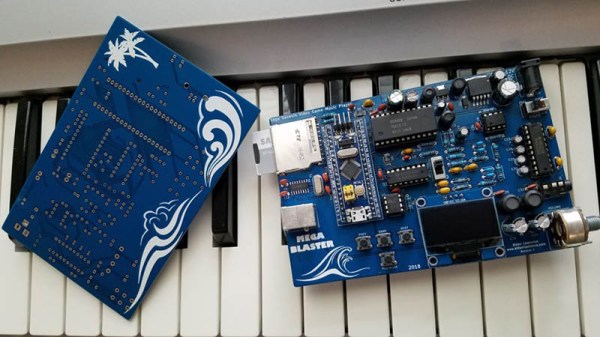
An Amiga 600 With An FPGA Inside

The Amiga is the platform that refuses to die. It must be more than two decades since the debacle surrounding the demise of the original hardware, yet the operating system is still receiving periodic updates, you can still buy Amiga hardware now sporting considerably more powerful silicon than the originals, and its worldwide community is as active as ever.

One of those community projects is the MiSTer FPGA Amiga-on-an-FPGA, and it was this that caught the attention of [Mattsoft]. Impressed with the quality of its recreation of an Amiga, he decided to turn his into a “real” Amiga, so found an Amiga 600 case and keyboard, and set to work. Into the mix went the Terasic DE10-Nano FPGA board, I/O and RAM boards, a Tynemouth Software keyboard interface, a USB hub, and some well-designed 3D-printed parts allow the original Amiga case to be used without modifications.

The Amiga 600 was the base model in the final Amiga range from the early 1990s, and at the time despite its HDD interface and PCMCIA slot it languished in the shadow of its Amiga 1200 sibling. The styling has aged well though, and this upgrade certainly breathes a little life back into the case if not strictly the machine itself. If you want to learn a bit more about MiSTer then a look at the project’s wiki is in order. Perhaps you don’t have an Amiga though and would like to wallow in a bit of nostalgia without splashing out for hardware, in that case, give AROS a look.

Thanks [intric8] for the tip.

Vintage eight transistor stereo amplifier

Eight Transistor Stereo Amplifier From The Days Of Yore

Reading an article about the first transistorized Hi-Fi amplifier, [Netzener] got the itch to make one. But what to use for the starting point? Enter an old Radio Shack P-Box stereo amplifier kit. After a few modernizations and tweaks, the result is an 8-transistor stereo amplifier that’s aesthetically pleasing, sounds great, and is fully documented.

The Radio Shack kit used germanium transistors, but with their high leakage current and low thermal conductivity, he decided to convert it to work with silicon transistors. He also made some improvements to the push-pull bias circuit and limited the high-frequency response. As for the finished product, in true [Netzener] style, he assembled it all to look like the original completed Radio Shack amplifier. He even wrote up a manual which you’d think, as we did at first, was the original one, giving that old, comfortable feeling of reading quality Radio Shack documentation.

Check out the video below where he uses a 9 V battery and half a watt per channel to fill a room with clear, stereo sound.

This isn’t the first Radio Shack kit that [Netzener] has adapted. Check out his single tube radio and classic neon “Goofy Light” box.

Continue reading “Eight Transistor Stereo Amplifier From The Days Of Yore”

Rocket Bullets: The Flame And Fizzle Of The Gyrojet

In the 1950’s and 60’s, the world had rocket fever. Humankind was taking its first steps into space and had sights on the moon. Kids could build rockets at the kitchen table and launch them in the schoolyard. On the darker side, the arms race was well underway with the US and USSR trying to close the fictional missile gap.

All around the world, engineers were trying to do new things with rockets. Among these were Robert Mainhardt and Arthur T. Biehl, who thought rockets could be useful as small arms. Together they formed MBA (short for Mainhardt and Biehl Associates), with an eye toward future weapons – – specifically rocket bullets.

Continue reading “Rocket Bullets: The Flame And Fizzle Of The Gyrojet”

Pinball Wizard Hacks Table For Tommy Stage Show

Ever since he was a young hacker
[Mark Gibson] has messed with the silver ball.
From Soho down to Denver
he must have fixed them all.
But we ain’t seen anything like this
in any amusement hall.
That darn devious hacker
sure hacks a mean pinball.

He hacks it like an expert,
Becomes part of the machine
Automating all the bumpers
Always wiring clean
His table plays by automation,
And radio control for all
That darn devious hacker
sure hacks a mean pinball.

Continue reading “Pinball Wizard Hacks Table For Tommy Stage Show”

A 38-Year-Old Vocoder Project

It is hard to remember that scant decades ago, electronic magazines — the pre-Internet equivalent of blogs — featured lots of audio circuits based on analog processing. Music synthesizers were popular for example, because microcontrollers were expensive and unable to perform digital signal processing tasks in the way you would use them today. [Julian] has been trying to build a vocoder from that era from ETI magazine. Along the way, he’s making videos documenting what he’s found and how’s he resolving issues.

The circuit generates levels for particular input frequencies. It does so with a two-op-amp bandpass filter, a two-op-amp rectifier, and then an op-amp lowpass filter. That’s five op-amps for each band (there are 14 bands) plus the support circuitry. And that’s just the input section! Today, you would simply sample the signal and do a fast Fourier transform (FFT) to get the same kind of data.

Continue reading “A 38-Year-Old Vocoder Project”