Conventional Current Vs. Electron Current

Electric current comes in many forms: current in a wire, flow of ions between the plates of a battery and between plates during electrolysis, as arcs, sparks, and so on. However, here on Hackaday we mostly deal with the current in a wire. But which way does that current flow in that wire? There are two possibilities depending on whether you’re thinking in terms of electron current or conventional current.

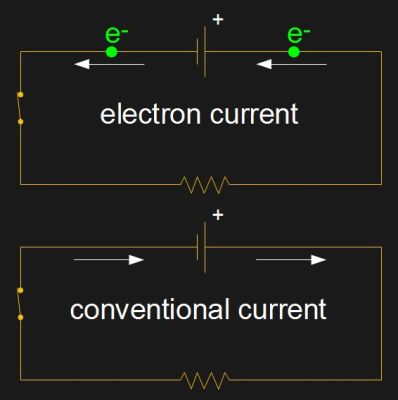
Electron current vs. conventional current

In a circuit connected to a battery, the electrons are the charge carrier and flow from the battery’s negative terminal, around the circuit and back to the positive terminal.

Conventional current takes just the opposite direction, from the positive terminal, around the circuit and back to the negative terminal. In that case there’s no charge carrier moving in that direction. Conventional current is a story we tell ourselves.

But since there is such a variety of forms that current comes in, the charge carrier sometimes does move from the positive to the negative, and sometimes movement is in both directions. When a lead acid battery is in use, positive hydrogen ions move in one direction while negative sulfate ions move in the other. So if the direction doesn’t matter then having a convention that ignores the charge carrier makes life easier.

Saying that we need a convention that’s independent of the charge carrier is all very nice, but that seems to be a side effect rather than the reason we have the convention. The convention was established long before there was a known variety of forms that current comes in — back even before the electron, or even the atom, was discovered. Why do we have the convention? As you’ll read below, it started with Benjamin Franklin.

Continue reading “Conventional Current Vs. Electron Current”

Bicycle Racing In Space Could Be A Thing

It’s 2100 AD, and hackers and normals live together in mile-long habitats in the Earth-Moon system. The habitat is spun up so that the gravity inside is that of Earth, and for exercise, the normals cycle around on bike paths. But the hackers do their cycling outside, in the vacuum of space.

How so? With ion thrusters, rocketing out xenon gas as the propellant. And the source of power? Ultimately that’s the hackers’ legs, pedaling away at a drive system that turns two large Wimshurst machines.

Those Wimshurst machines then produce the high voltage needed for the thruster’s ionization as well as the charge flow. They’re also what gives the space bike it’s distinctly bicycle-like appearance. And based on the calculations below, this may someday work!

Continue reading “Bicycle Racing In Space Could Be A Thing”

Gyrators: The Fifth Element

A few years ago, there was a stir about a new fundamental component called a memristor. That wasn’t the first time a new component type was theorized though. In 1948 [Bernard Tellegen] postulated the gyrator. While you can’t buy one as a component, you can build one using other components. In fact, they are very necessary for some types of design. Put simply, a gyrator is a two-terminal device that inverts the current-voltage characteristic of an electrical component. Therefore, you can use a gyrator to convert a capacitor into an inductor or vice versa.

Keep in mind, the conversion is simply the electrical properties. Normally, current leads voltage in a capacitor and lags it in an inductor, and that’s what a gyrator changes. If you use a gyrator and a capacitor to make a virtual inductor, that inductor won’t magnetically couple to another inductor, real or simulated. There’s no magnetic field to do so. You also don’t get big voltage spikes caused by back EMF, which depending on your application could be a plus or a minus. But if you need an ungainly inductor in a circuit for its phase response, a gyrator may be just the ticket.

Continue reading “Gyrators: The Fifth Element”

This Way To The Ingress: Keeping Stuff Dry And Clean With IP And NEMA

When designing a piece of hardware that has even the faintest chance of being exposed to the elements, it’s best to repeat this mantra: water finds a way. No matter how much you try to shield a project from rain, splashing, or even just humid air, if you haven’t taken precautions to seal your enclosure, I’ll bet you find evidence of water when you open it up. Water always wins, and while that might not be a death knell for your project, it’s probably not going to help. And water isn’t the only problem that outdoor or rough-service installations face. Particle intrusion can be a real killer too, especially in an environment where dust can be conductive.

There’s plenty you can do to prevent uninvited liquid or particulate guests to your outdoor party, but it tends to be easier to prevent the problem at design time than to fix it after the hardware is fielded. So to help you with your design, here’s a quick rundown of some standards for protection of enclosures from unwanted ingress.

Continue reading “This Way To The Ingress: Keeping Stuff Dry And Clean With IP And NEMA”

MEMS: The Biggest Word In Small

What’s tiny and on track to be worth $22 billion dollars by 2018? MEMS (Micro Electrical Mechanical Systems). That’s a catch-all phrase for microscopic devices that have moving parts. Usually, the component sizes range from 0.1 mm to 0.001 mm, which is tiny, indeed. There are some researchers working with even smaller components, sometimes referenced as NEMS (Nano Electrical Mechanical Systems).

Resonant Cantilever by [Pcflet01], CC BY-SA 3.0
MEMS have a wide range of applications including ink jet printers, accelerometers, gyroscopes, microphones, pressure sensors, displays, and more. Many of the sensors in a typical cell phone would not be possible without MEMS. There are many ways that MEMS devices are built, but just to get a flavor, consider the cantilever (see right), one of the most common MEMS constructions.

Continue reading “MEMS: The Biggest Word In Small”

Hacking An Inspection Microscope

Sometimes I need to be able to take photographs of very small things, and the so-called macro mode on my point-and-shoot camera just won’t cut it. And it never hurts to have an inspection scope on hand for tiny soldering jobs, either, though I prefer a simple jeweler’s loupe in one eye for most tasks. So I sent just over $40 off to my close friend Alibaba, and a few weeks later was the proud owner of a halfway usable inspection scope that records stills or video to an SD card.

Unfortunately, it’s only halfway useable because of chintzy interface design and a wobbly mount. So I spent an afternoon, took the microscope apart, and got it under microcontroller control, complete with WiFi and a scripting language. Much better! Now I can make microscope time-lapses, but much more importantly I can take blur-free photos without touching the wiggly rig. It was a fun hack, so I thought I’d share. Read on!

Continue reading “Hacking An Inspection Microscope”

Catastrophic Forgetting: Learning’s Effect On Machine Minds

What if every time you learned something new, you forgot a little of what you knew before? That sort of overwriting doesn’t happen in the human brain, but it does in artificial neural networks. It’s appropriately called catastrophic forgetting. So why are neural networks so successful despite this? How does this affect the future of things like self-driving cars? Just what limit does this put on what neural networks will be able to do, and what’s being done about it?

The way a neural network stores knowledge is by setting the values of weights (the lines in between the neurons in the diagram). That’s what those lines literally are, just numbers assigned to pairs of neurons. They’re analogous to the axons in our brain, the long tendrils that reach out from one neuron to the dendrites of another neuron, where they meet at microscopic gaps called synapses. The value of the weight between two artificial neurons is roughly like the number of axons between biological neurons in the brain.

To understand the problem, and the solutions below, you need to know a little more detail.

Continue reading “Catastrophic Forgetting: Learning’s Effect On Machine Minds”