The Othermill Is Something Else

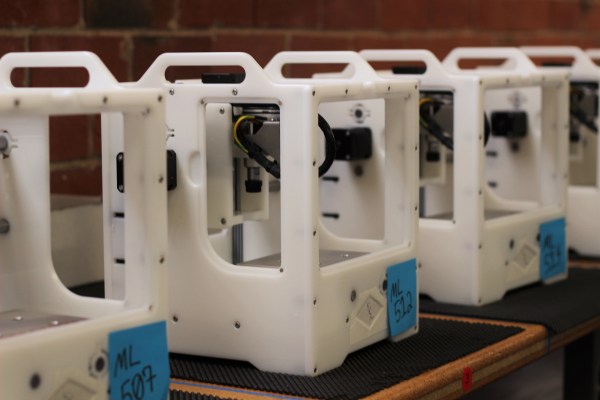
I’ll admit. When I saw the Othermill for the first time I thought it was just another mill with cheap Chinese hardware inside sold as a premium. I’m ashamed to say that I even trash talked it a little bit. It gave me another chance to relearn that I should always do my research before being a jerk, check my assumptions thoroughly, and even then it’s not recommended. Other Machine Company was kind enough to let me swing by the office in Berkeley California. [Danielle], the CEO, led me through the design of the mill as well as the challenges in running the operation.

The Othermill is a serious machine, and with the recent release of the Othermill Pro, it’s only getting better. The components are not bargain basement. This is something that could be more obvious, but it’s almost entirely made from US sourced parts, including the custom stepper motors. There aren’t any ball bearings that will start to make strange noises in a year. It can now cut 6mil traces in a PCB all day long. To put it into perspective. The Othermill Pro costs a third of the price of an equivalent machine from LPKF and has the same capabilities.

Continue reading “The Othermill Is Something Else”

Design For Hackers

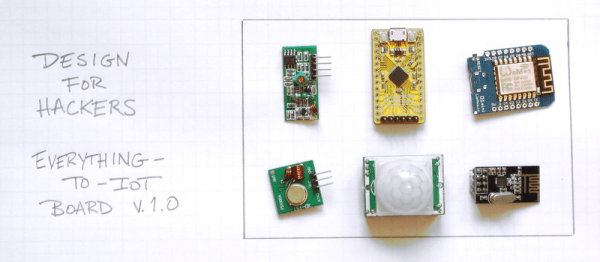
Near the end of the lifecycle of mass-market commercial product development, an engineering team may come in and make a design for manufacturability (DFM) pass. The goal is to make the device easy, cheap, and reliable to build and actually improve reliability at the same time. We hackers don’t usually take this last step, because when you’re producing just a couple of any given device, it hardly makes sense. But when you release an open-source hardware design to the world, if a lot of people re-build your widget, it might be worth it to consider DFM, or at least a hardware hacker’s version of DFM.

If you want people to make their own versions of your project, make it easy and cheap for them to do so and don’t forget to also make it hackable. This isn’t the same as industrial DFM: rather than designing for 100,000s of boards to be put together by robot assembly machines, you are designing for an audience of penny-pinching hackers, each building your project only once. But thinking about how buildable your design is will still be worthwhile.

In this article, I’m going to touch on a couple of Design for Hackers (DFH) best practices. I really want to hear your experience and desires in the comments. What would you like to see in someone else’s open designs? What drives you nuts when replicating a project? What tricks do you know to make a project easily and cheaply buildable by the average hacker?

Continue reading “Design For Hackers”

Uncertainty – The Key To Quantum Weirdness

All these fifty years of conscious brooding have brought me no nearer to the answer to the question, ‘What are light quanta?’ Nowadays every Tom, Dick and Harry thinks he knows it, but he is mistaken.

                       Albert Einstein, 1954

As 1926 was coming to a close, the physics world lauded Erwin Schrodinger and his wave mechanics. Schrodinger’s purely mathematical tool was being used to probe the internal structure of the atom and to provide predictable experimental outcomes. However, some deep questions still remained – primarily with the idea of discontinuous movements of the electron within a hydrogen atom. Niels Bohr, champion of and chief spokesperson for quantum theory, had developed a model of the atom that explained spectral lines. This model required an electron to move to a higher energy level when absorbing a photon, and releasing a photon when it moved to a lower energy level. The point of contention is how the electron was moving. This quantum jumping, as Bohr called it was said to be instantaneous. And this did not sit well with classical minded physicists, including Schrodinger.

Continue reading “Uncertainty – The Key To Quantum Weirdness”

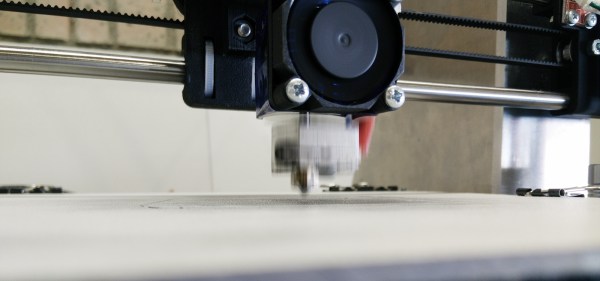
Sonic 3D Printer Auto Bed Leveling Makes A Swoosh

3D Printering: the final frontier. These are the voyages of another 3D printer hack. Its mission: to explore strange new ways of leveling a print bed.

So far, we’ve had servo probes, Allen key probes, Z-sled probes, inductive and capacitive contactless switches, just to name a few. All of them allow a 3D printer to probe its print bed, calculate a correction plane or mesh, and compensate for its own inherent, time variant, inaccuracies.

Continue reading “Sonic 3D Printer Auto Bed Leveling Makes A Swoosh”

How To Measure The Extremely Small: Atomic Mass

How does one go about measuring the mass of an object? Mass is defined as the amount of matter an object contains. This is very different from weight, of course, as the mass of our object would remain the same despite the presence or size of a gravitational field. It is safe to say, however,  that most laboratory measurement systems are here on Earth, and we can use the Earth’s gravity to aid in our mass measurement. One way is to use a balance and a known amount of mass. Simply place our object on one side of the balance, and keep adding known amounts of mass to the other side until the balance is balanced.

But what if our object is very small…too small to see and too light to measure with gravity? How does one measure the mass of single atom? Furthermore, how does one determine how much of an object consists of a particular type of atom? There are two commonly used tools just for this purpose. Chances are you’ve heard of one of these but not the other. These tools used to measure substances on the atomic level is the focus of today’s article.

Continue reading “How To Measure The Extremely Small: Atomic Mass”

Expanding Horizons With The Ion Propelled Lifter

Like many people, going through university followed an intense career building period was a dry spell in terms of making things. Of course things settled down and I finally broke that dry spell to work on what I called “non-conventional propulsion”.

I wanted to stay away from the term “anti-gravity” because I was enough of a science nut to know that such a thing was dubious. But I also suspected that there might be science principles yet to be discovered. I was willing to give it a try anyway, and did for a few years. It was also my introduction to the world of high voltage… DC. Everything came out null though, meaning that any effects could be accounted for by some form of ionization or Coulomb force. At no time did I get anything to actually fly, though there was a lot of spinning things on rotors or weight changes on scales and balances due to ion propulsion.

So when a video appeared in 2001 from a small company called Transdimensional Technologies of a triangle shaped, aluminum foil and wire thing called a lifter that actually propelled itself off the table, I immediately had to make one. I’d had enough background by then to be confident that it was flying using ion propulsion. And in fact, given my background I was able to put an enhancement in my first version that others came up with only later.

For those who’ve never seen a lifter, it’s extremely simple. Think of it as a very leaky capacitor. One electrode is an aluminum foil skirt, in the shape of a triangle. Spaced apart from that around an inch or so away, usually using 1/6″ balsa wood sticks, is a very thin bare wire (think 30AWG) also shaped as a triangle. High voltage is applied between the foil skirt and the wire. The result is that a downward jet of air is created around and through the middle of the triangle and the lifter flies up off the table. But that is just the barest explanation of how it works. We must go deeper!

Continue reading “Expanding Horizons With The Ion Propelled Lifter”

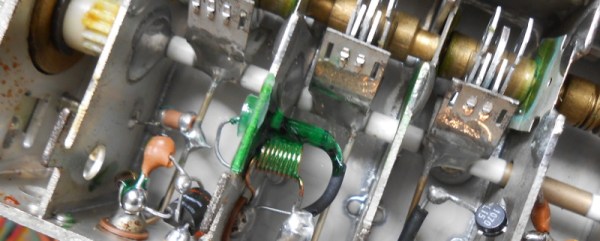
Not Quite 101 Uses For An Analog UHF TV Tuner

Young electronics hackers today are very fortunate to grow up in an era with both a plethora of capable devices to stimulate their imagination, and cheap and ready access to them. Less than the price of a hamburger meal can secure you a Linux computing platform such as the Raspberry Pi Zero, and a huge choice of sensors and peripherals are only an overnight postage envelope away.

Casing back a few decades to the 1980s, things were a little different for electronically inclined youth. We had the first generation of 8-bit microcomputers but they were expensive, and unless you had well-heeled parents prepared to buy you a top-end model they could be challenging to interface to. Other electronic parts were far more expensive, and mail order could take weeks to deliver the goods.

For some of us, this was not a problem. We simply cast around for other sources of parts, and one of the most convenient was the scrap CRT TV you’d find in nearly every dumpster in those days before electronic recycling. If you could make it from 1970s-era consumer-grade discrete components, we probably did so having carefully pored over a heap of large PCBs to seek out the right component values. Good training, you certainly end up knowing resistor colour codes by sight that way.

Continue reading “Not Quite 101 Uses For An Analog UHF TV Tuner”