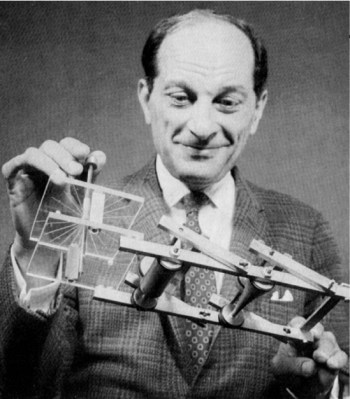
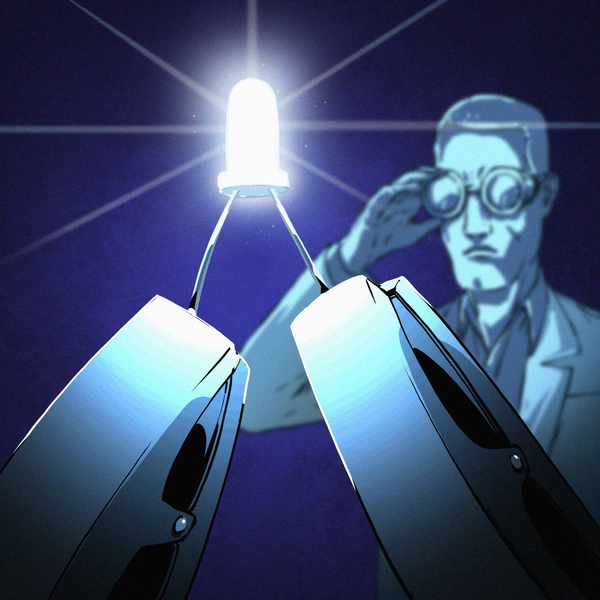
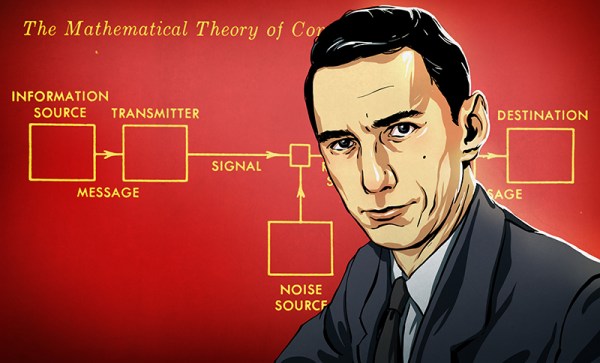
Dr. Claude E. Shannon was born 100 years ago tomorrow. He contributed greatly to the fields of engineering, communications, and computer science but is not a well known figure, even to those in the field. However, his work touches us all many times each day. The network which delivered this article to your computer or smartphone was designed upon important theories developed by Dr. Shannon.
Shannon was born and raised in Michigan. He graduated from the University of Michigan with degrees in Mathematics and Electrical Engineering. He continued his graduate studies at Massachusetts Institute of Technology (MIT) where he obtained his MS and PhD. He worked for Bell Laboratories on fire-control systems and cryptography during World War II and in 1956 he returned to MIT as a professor.
Shannon’s first impactful contribution was his masters thesis which took the Boolean Algebra work of George Boole and applied it to switching circuits (then made up of relays). Before his work there was no formal basis for the analysis of switching systems, like telephone networks or elevator control systems. Shannon’s thesis developed the use of symbolic notation to represent networks and applied simplifying rules to optimize the system. These same rules later translated to vacuum tube and transistor logic aiding in the development of today’s computer systems. The thesis — A Symbolic Analysis of Relay and Switching Circuits — was completed in 1937 and subsequently published in 1938 in the Transactions of the American Institute of Electrical Engineers.
Shannon’s doctoral work continued in the same vein of applying mathematics someplace new, this time to genetics. Vannevar Bush, his advisor, commented, “It occurred to me that, just as a special algebra had worked well in his hands on the theory of relays, another special algebra might conceivably handle some of the aspects of Mendelian heredity”. Shannon’s work again is revolutionary, providing a mathematical basis for population genetics. Unfortunately, it was a step further than geneticists of time could take. His work languished, although interest increased over time.
For all the destruction and human misery unleashed during World War II, it was also a time of incredible creativity and ingenuity. In America, it was a time when everyone wanted to pitch in. Young men and women enlisted and were shipped overseas, and those left behind kept the factories running full tilt. Even Hollywood went to war, with its steady output of films that gave people a little glamour and provided an escape from the horror and loss of the war. Hollywood stars lined up to entertain troops and raise money for the war effort, and many joined up and fought too.
But one Hollywood star made an unconventional contribution to the war effort, and in the process proved that beauty and brains are not always mutually exclusive. This is the story of Hedy Lamarr, movie star and inventor.
“The Most Beautiful Woman in the World”
By the time she was 23 in 1937, Hedwig Eva Maria Kiesler was a genuine film star in her native Austria. She was also trapped in an unhappy marriage to a rich and powerful Austrian munitions magnate, Fritz Mandl. Hedy was miserable as a trophy wife, adorning the dining room as her husband entertained rich and powerful guests – including Mussolini and Hitler – over long dinners in one of his mansions. They dismissed her; clearly a woman so beautiful could have nothing else to offer, an empty head perched on a graceful neck. But she was far from stupid, and while her husband discussed business with the men who were building the Axis arsenal, Hedy listened and learned.
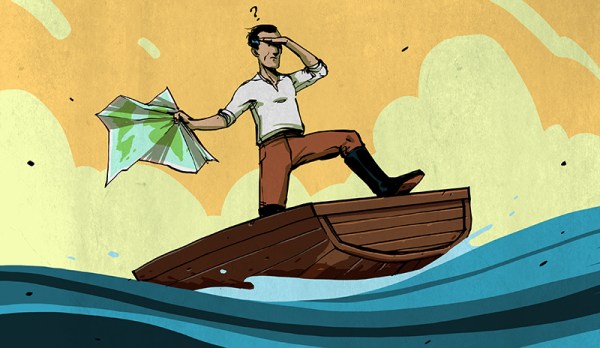
I came across an interesting question this weekend: how do you establish your East/West location on the globe without modern technology? The answer depends on what you mean by “modern”, it turns out you only have to go back about three centuries to find there was no reliable way. The technology that changed that was a clock; a very special one that kept accurate time despite changing atmospheric conditions and motion. The invention of the Harrison H1 revolutionized maritime travel.
We can thank Andy Weir for getting me onto this topic. I just finished his amazing novel The Martian and I can confirm that George Graves’ opinion of the high quality of that novel is spot on. For the most part, Andy lines up challenges that Mark Watney faces and then engineers a solution around them. But when it came to plotting location on the surface of Mars he made just a passing reference to the need to have accurate clocks to determine longitude. I had always assumed that a sextant was all you needed. But unless you have a known landmark to sight from this will only establish your latitude (North/South position).
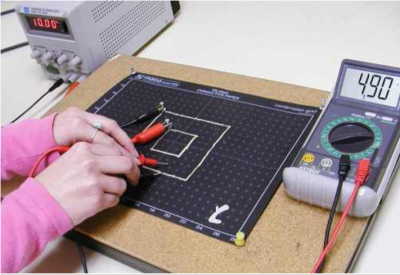
Legendary electrical engineer and linear IC trailblazer Bob Widlar was just like you. What I mean is that he would use everything available to him to mock up circuits, create prototypes, and make things work. One of the simplest and coolest tools he used was a conductive paper called Teledeltos. This wonderful stuff allowed him to define and test various configurations for the oddly-shaped ballast resistors he used in some of his high-performance circuit designs. But it wasn’t created for people like you and Bob. Teledeltos paper was created and trademarked by communications giant Western Union to drastically improve the convenience of telegrams.
Development of the electric telegraph ushered in the era of global communication. Suddenly, people could send messages to the other side of the world in a fraction of the time it took by post. The telegraph absolutely revolutionized human communication. It was the e-mail and the Twitter of its time. The telegraph’s efficiency made the Pony Express pretty much obsolete by the 1860s. And for a very long time it was much cheaper for people to send a telegram than make a long-distance phone call.
The Advantages of Facsimile
Translated from ancient Greek, ‘teledeltos’ basically means writing tablet at a distance. Western Union began developing Teledeltos paper in the 1930s for the purpose of transmitting telegrams by facsimile, a method that would greatly reduce the time it took to input messages into the system and get them out on the other side. As long as both the sender and the receiver had facsimile machines, a handwritten telegram could be transmitted without having to be typed by a clerk or translated into code. Teledeltos paper was also used in a variety of chart recorders, like seismographs and map plotters. The ability to feed a handwritten message, a photograph, or a map of enemy territory into a machine that transmitted an exact copy was a real game changer.
Because of its composition, Teledeltos paper could be easily marked without an electrolyte. It marked so well that photographs and other graphic information could be transmitted, and no processing was required on the receiving end. A dry recording paper is also much less sensitive to light and to temperature extremes. More importantly, properly stored dry paper is impervious to fungal growth. Teledeltos paper could sit around indefinitely without becoming useless. The only real disadvantage to this type of paper was the somewhat laborious process that went into achieving the desired resistance. Fax machines eventually moved on to digital transmission and thermal printing technology.
Teledeltos paper has a light gray electro-sensitive coating on one side, and the other side is carbon black. When a current is applied with a stylus to the coated side of the paper, the coating is instantly burned away, revealing the carbon black. Teledeltos paper could be marked using either AC or DC. Polarity didn’t matter, either, but the boys in the lab at Western Union had better luck when they used a positive stylus with DC rather than a negative one.
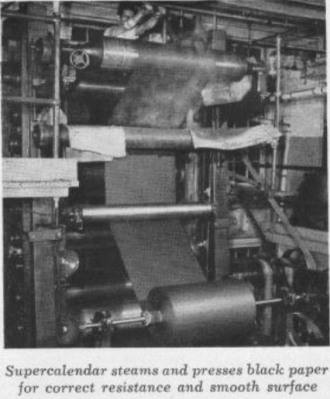
Teledeltos paper was made in two types—“L” for low resistance and “H” for high. The resistivity of a roll of Teledeltos paper depended on the quality of the conductive fibers that went into it. The paper’s electrical characteristics were also influenced by the fiber beating process and the distribution of the conductive fibers by the supercalender, a system of hard rollers used in papermaking and other processes that press and smooth paper and other materials to increase the density.
Teledeltos to the Rescue
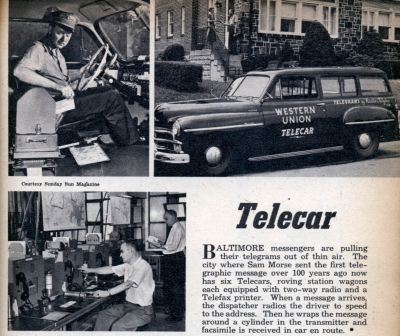
The Western Union Telecar printed telegrams on the go and delivered them to homes and businesses. Image credit: Modern Mechanix
Western Union was eager to extend its reach into private businesses and public places so that patrons who weren’t heavy telegram users didn’t have to visit a telegram office in order to share a bit of good news or to send their condolences. The company’s Telefax division came up with several types of machines to serve different business needs.
Some messages continued to be delivered by hand, but they weren’t printed at the central office. Western Union created a Telecar service to print telegrams transmitted to the car by the central office and deliver them to people’s homes. Messages were printed onto recording blanks that were cut automatically by a Telefax recorder situated in the car’s passenger area. The Telecar’s radio and amplification equipment was in the trunk.
The standard Telefax machine for office use was fairly large, like an early microwave oven. A smaller version called the DeskFax was only about the size of a breadbox, and these units occupied the desks of many businessmen and secretaries because of their convenience.
A Western Union DeskFax unit. Image from [B. Hilpert]Both the Telefax and the DeskFax scanned and recorded telegrams using a rotary drum mechanism. A message could either be typed or handwritten onto a telegram blank. The sender then wrapped the telegram around a drum and set the machine to send. The machine would scan the message optically and then transmit it to the central office.
Before sending it on to the recipient, an attendant at the telegram office had to remove the incoming message and wrap it around the drum of a transmitting machine. Once connected to the receiving party’s line, the far end unit would buzz to arouse attention. The receiving patron would then load a blank on to their DeskFax’s roller and set their machine to receive.
Conductive paper like Teledeltos has many applications aside from fax machines and Fathometers. For starters, it’s great for making one-offs of both standard and variable resistors. Conductive paint can be used as connection points for wires. The paper is also well-suited for simulating current flow through circuits using a fraction of the current intended in production. Vacuum tube designers used Teledeltos for modeling potentials. Teledeltos can also be used to visualize electromagnetic potentials and perform field plotting.
We’re sure that at least a few of our readers out there used Teledeltos or something like it in school or on the job. Did you know you can still buy it? Teledeltos paper itself is still available from two companies in the UK, Better Equipped and Timstar. In the US, you can get it from Pasco in packs of 50 and 100 sheets, with and without a grid pattern.
[Teledeltos paper image is a product photo from Better Equipped]
For most of us, hacking is a hobby, a pleasant diversion from reality. Yes, a lot of us work on projects which have the potential to change the world – witness the 2015 Hackaday Prize semifinalist list. But in general, almost any of us could walk away from the shop at any time without dire consequences. Indeed, that’s the reason a lot of our work benches are littered with projects started with the best of intentions but left unfinished for lack of funds, lack of interest, or lack of time. We’re free to more or less willingly shelve a project and come back to it whenever we please, or not at all.
But not everyone has that luxury. For some people, hacking is much more than a hobby – it’s a means of survival. Sometimes people are thrown into situations where they have to cobble together a solution to an immediate problem with whatever is at hand, when the penalty for failure is much higher than a cluttered bench and a bruised ego. I’ve already covered one such case, where biohacked insulin saved hundreds of lives in occupied Shanghai in WWII.
In this occasional series I’ll explore historical cases where hacking really counted; cases where lives were saved or improved by a hack performed under desperate conditions.
A Bustle in the Hedgerow
Unsurprisingly, war offers a lot of opportunities for field expedient solutions under dire circumstances, and battlefield conditions might be the most extreme example of hacking when it counts.
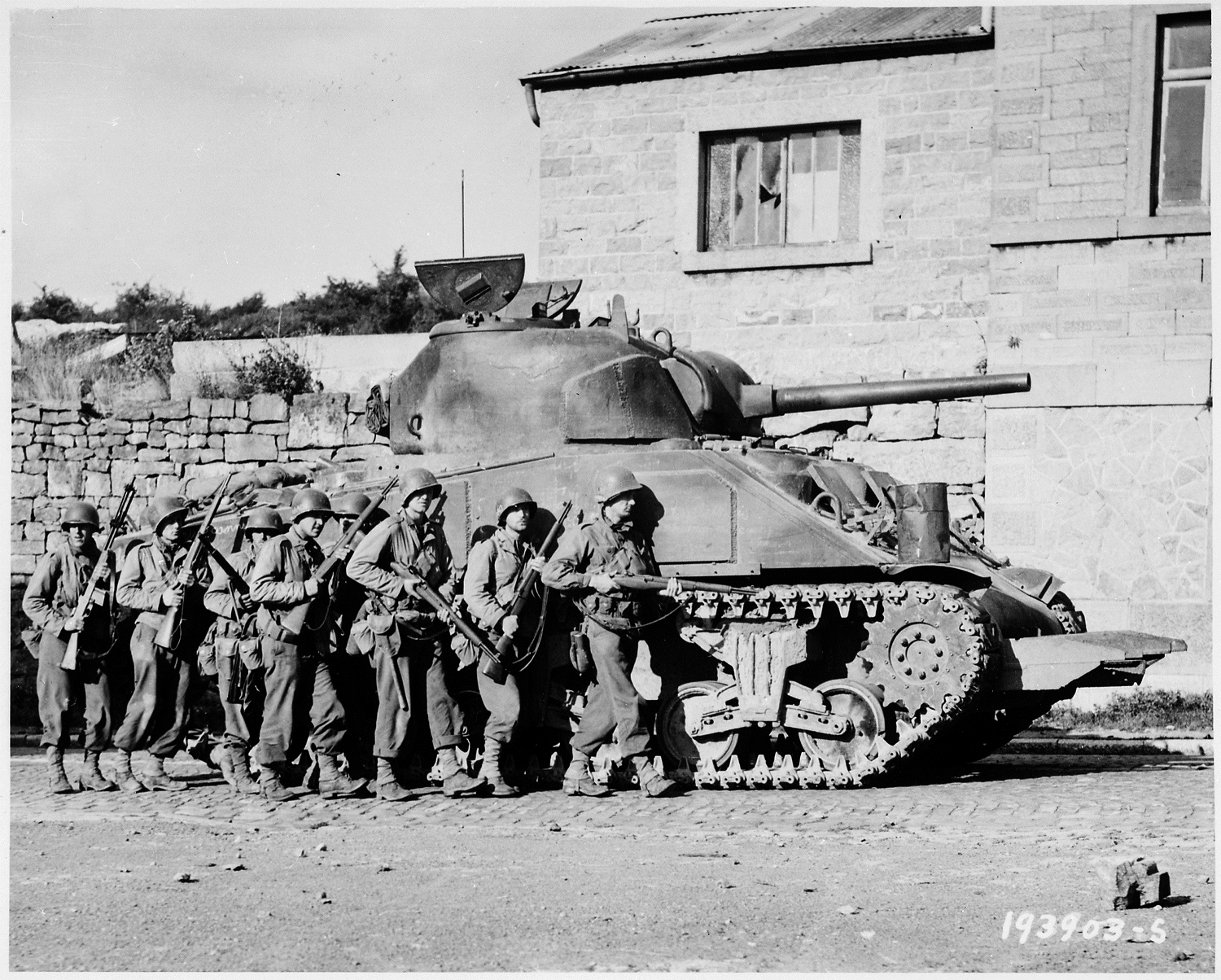
In the early days of the Invasion of Normandy during WWII, Allied forces were having a difficult time dealing with the bocage terrain of northern France. A mixture of pasture and woodland, the Normandy bocage was a natural killing field for Allied tanks because the woodlands took the form of hedgerows – earthen dikes topped with thick tangles of brush. Hedgerows separated pastures and kept livestock controlled, but also made things tough on infantry and mechanized cavalry alike. Climbing the steep hedgerows exposed the vulnerable bottom hull of the tanks to enemy fire, and waiting for engineers to demolish the hedgerows with explosive made them sitting ducks for German artillery. The Allied advance was seriously hampered by the hedgerows, and both men and materiel were being winnowed down from fixed German positions chosen specifically to take advantage of the bocage terrain.
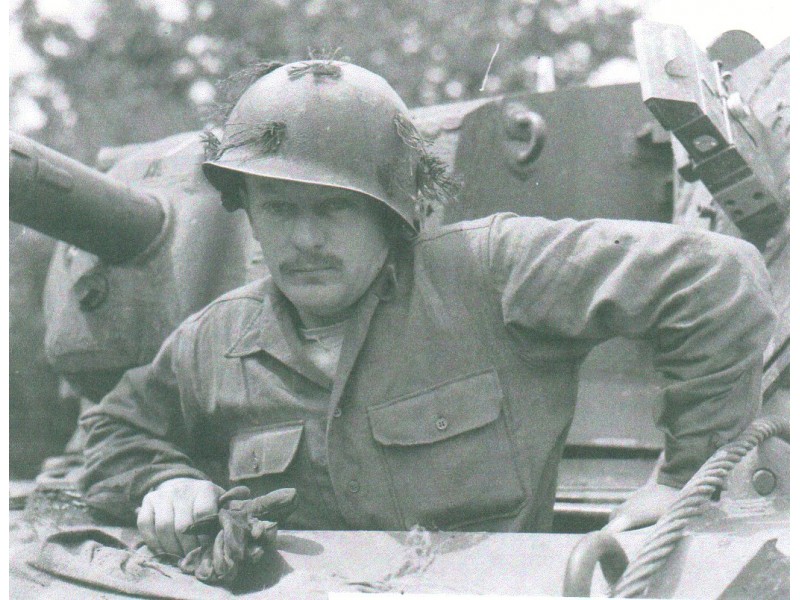
Enter Sgt. Curtis Grubb Culin III. Sgt. Culin, a tanker himself, was acutely aware of how vulnerable he was in his Sherman M4. The hedgerows were the problem, one apparently known to Allied command prior to the invasion for which no provision had been made. In the tradition of soldiers at the front of every battle throughout history, Sgt. Culin and his fellow tankers had to improvise a solution.
While kicking around ideas, one of the men suggested setting saw teeth on the front of a tank to cut through the hedgerows. He later attributed the comment to “A Tennessee hillbilly named Roberts”, and it was met with general laughter from the group as a crackpot scheme. But Sgt. Culin saw the potential in the idea, and began to develop it into a prototype.
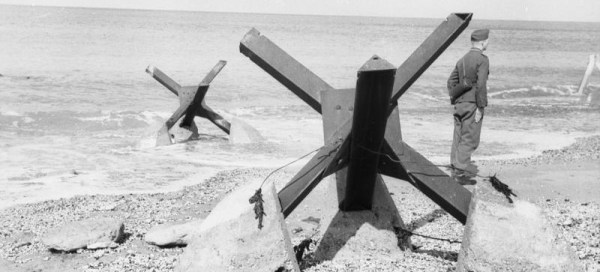
Raw materials for his prototype were not hard to come by. Czech hedgehogs, giant anti-tank barriers made of crossed steel beams, still littered the Normandy beaches. The failed German defenses were harvested with a cutting torch and welded to the underside of a tank to form a series of “tusks” across the hull between the tracks. Equipped with these tusks, the tank could now blast through the tangled roots of the brush-covered earth of the hedgerow dykes.
When demonstrated for General Omar Bradley, he was impressed enough to order them built in quantity for the tanks. Eventually the prototype became an engineered product (dubbed the “Culin Rhino Device”) that was fitted to many tanks before being shipped over from England. Rhino-equipped tanks ripped across Normandy and shredded the German battle plan, which assumed the hedgerows would funnel Allied forces through heavily defended chokepoints.
Without Sgt. Culin’s battlefield hack, and his inspiration by a hillbilly named Roberts whom history otherwise forgets, the invasion of Europe might have taken a very different course. The fact that he did the hack while under fire makes it all the more impressive, and is a perfect example of hacking when it counts.
Know of any more examples of hacking when it counts? Send us a tip for use in a future Hacking When it Counts article.
In 1980, Lake Tahoe, Nevada was a popular tourist spot. The area offered skiing, sailing, hiking in the mountains, and of course, gambling on the Nevada side of the lake. It was in this somewhat unlikely place where the authorities found the largest improvised bomb seen to that date in the USA.
Harvey’s casino was opened by former butcher Harvey Gross in 1944. In less than 20 years it grew to a 192 room, 11 story hotel casino. Thousands of people played Harvey’s slot machines and table games. Some were winners, but most were losers. John Birges was one of the latter. Formerly a successful landscaping company owner worth millions, he lost all of it to his gambling addiction.
Born in Hungary in 1922 as János Birges, John grew up in Budapest. When WWII hit, he flew an Me-109 for the Luftwaffe. He was arrested by the Gestapo for disobeying orders during the war, but was released. After the war, he again found himself in hot water – this time with the Russians. He was arrested in 1948 and charged with espionage. His sentence was 25 years of hard labor in the Gulag. The stories vary, but most agree that Birges was able to escape his work camp by detonating a bomb as a diversion.
In 1957 Birges and his wife Elizabeth immigrated to California. He changed his name from János to John to fit in. The couple had two sons, Johnny and Jimmy. John built up a successful landscaping business and bought a restaurant, working his way into the millionaires’ club. From the outside, they were the perfect example of the American dream.
Appearances can be deceiving. Behind closed doors, Birges was a right bastard to his family. He beat his wife and his children, even forcing them to kneel on gravel when they disobeyed him. Eventually, Johnny left home to escape his father’s fists. Elizabeth filed for divorce, and was later found dead under mysterious circumstances. Birges began gambling heavily, especially at Harvey’s Wagon Wheel casino in Lake Tahoe. He eventually burned through his personal savings, as well as the income from his businesses. The once millionaire was now penniless, but he had a plan. Just as a bomb had helped him escape the Gulag, he’d use a bomb to extort his money back from Harvey’s.
One of the keys to nuclear fission is sustaining a chain reaction. A slow chain reaction can provide clean power for a city, and a fast one can be used to create a weapon that will obliterate a city. These days, kids can learn about Uranium and Plutonium in high school. But just a few generations ago, the idea of splitting the atom was just a lofty goal for the brightest physicists and mathematicians who gathered at Los Alamos National Laboratory under the Manhattan Project.
Decoding the mysteries of nuclear fission required a great deal of experimentation and calculations. One bright physicist in particular made great strides on both fronts. That man was [Enrico Fermi], one of the fathers of the atomic bomb. Perhaps his greatest contribution to moving the research beyond the Manhattan Project was creating a handheld analog computer to do the math for him. This computational marvel is known as the FERMIAC.
What is Fission?
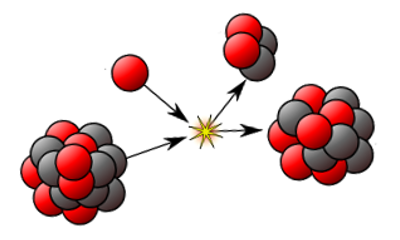
Nuclear fission occurs when a nucleus is split into fragments, a process that unleashes a great deal of energy. As a handful of neutrons travel through a reactor pile or other fissionable material, a couple of outcomes are possible. Any one neutron collision might result in fission. This means there will be some number of new neutrons whose paths must be tracked. If fission does not occur, the neutrons may simply scatter about upon collision, which changes their speed and trajectory. Some of the neutrons might be absorbed by the material, and others will simply escape it. All of these possibilities depend on the makeup of the material being bombarded and the speed of the neutron.
Every event that happens to a neutron comprises its genealogical history. If this history is recorded and analyzed, a statistical picture starts to emerge that provides an accurate depiction of the fissility of a given material. [Fermi]’s computer facilitated the creation of such a picture by performing mathematical grunt work of testing different materials. It identified which materials were most likely to sustain a reaction.
Before he left Italy and the looming threat of fascism, [Fermi] led a group of young scientists in Rome called the Via Panisperna boys. This group, which included future Los Alamos physicist [Emilio Segrè], ran many experiments in neutron transport. Their research proved that slow neutrons are much better candidates for fission than fast neutrons.
During these experiments, [Fermi] ran through the periodic table, determined to artificially irradiate every element until he got lucky. He never published anything regarding his methods for calculating the outcomes of neutron collisions. But when he got to Los Alamos, [Fermi] found that [Stanislaw Ulam] had also concluded that the same type of repeated random sampling was the key to building an atomic weapon.
The Monte Carlo Method: Shall We Play a Game?
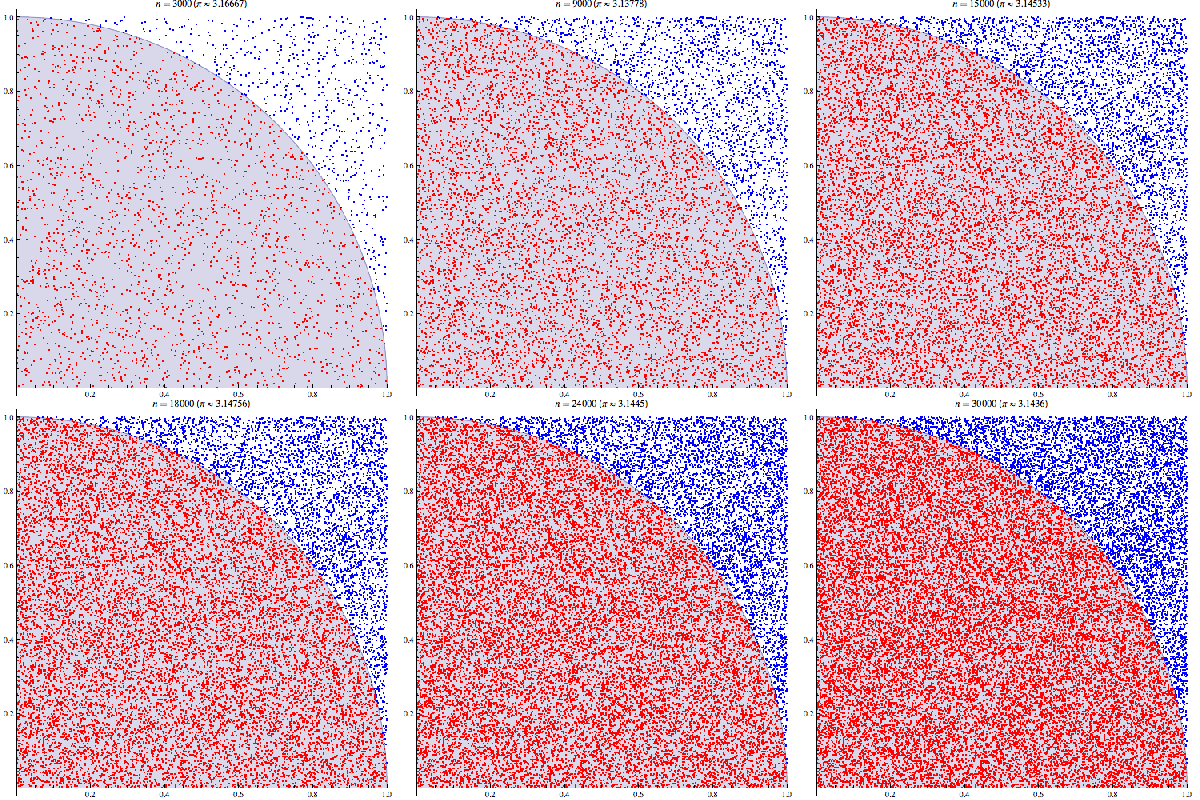
Monte Carlo method applied to approximating the value of π. by CaitlinJo
[Ulam], a Polish-born mathematician who came to the US in 1935, developed his opinion about random sampling due to an illness. While recuperating from encephalitis he played game after game of solitaire. One day, he wondered at the probability of winning any one hand as laid out and how best to calculate this probability. He believed that if he ran through enough games and kept track of the wins, the data would form a suitable and representative sample for modeling his chances of winning. Almost immediately, [Ulam] began to mentally apply this method to problems in physics, and proposed his ideas (PDF) to physicist and fellow mathematician [John von Neumann].
This top-secret method needed a code name. Another Los Alamos player, [Nick Metropolis] suggested ‘Monte Carlo’ in a nod to games of chance. He knew that [Ulam] had an uncle with a propensity for gambling who would often borrow money from relatives, saying that he just had to go to Monte Carlo. The game was on.
The Tricky Math of Fission
Determination of the elements most suitable for fission required a lot of calculations. Fission itself had already been achieved before the start of the Manhattan Project. But the goal at Los Alamos was a controlled, high-energy type of fission suitable for weaponization. The math of fission is complicated largely because of the sheer number of neutrons that must be tracked in order to determine the likelihood and speed of a chain reaction. There are so many variables involved that the task is monumental for a human mathematician.
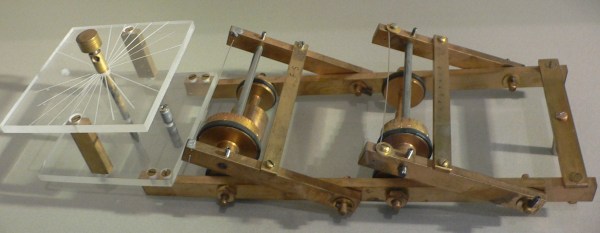
[Stanislaw Ulam] and FERMIAC.
After [Ulam] and [von Neumann] had verified the legitimacy of the Monte Carlo method with regard to the creation of nuclear weaponry, they decided that these types of calculations would be a great job for ENIAC — a very early general purpose computer. This was a more intensive task than the one it was made to do: compute artillery firing tables all day and night. One problem was that the huge, lumbering machine was scheduled to be moved from Philadelphia to the Ballistics Research Lab in Maryland, which meant a long period of downtime.
While the boys at Los Alamos waited for ENIAC to be operational again, [Enrico Fermi] developed the idea forego ENIAC and create a small device that could run Monte Carlo simulations instead. He enlisted his colleague [Percy King] to build the machine. Their creation was built from joint Army-Navy cast off components, and in a nod to that great computer he dubbed it FERMIAC.
FERMIAC: Hacking Probabilities
FERMIAC was created to alleviate the necessity of tedious calculations required by the study of neutron transport. This is something of an end-run around brute force. It’s made mostly of brass and resembles a trolley car. In order to use it, several adjustable drums are set using pseudorandom numbers. One of these numbers represents the material being traversed. A random choice is made between fast and slow neutrons. A second digit is chosen to represent the direction of neutron travel, and a third number indicates the distance traveled to the next collision.
FERMIAC in action.
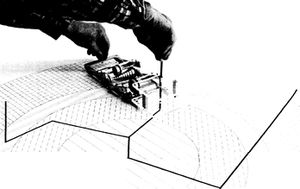
Once these settings are dialed in, the device is physically driven across a 2-D scale drawing of the nuclear reactor or materials being tested. As it goes along, it plots the paths of neutrons through various materials by marking a line on the drawing. Whenever a material boundary is crossed, the appropriate drum is adjusted to represent a new pseudorandom digit.
FERMIAC was only used for about two years before it was completely supplanted by ENIAC. But it was an excellent stopgap that allowed the Manhattan Project to not only continue unabated, but with rapid progress. FERMIAC is currently on display at the Bradbury Science Museum in Los Alamos, New Mexico alongside replicas of Fat Man and Little Boy, the weapons it helped bring to fruition. [Fermi]’s legacy is cemented as one of the fathers of the atomic bomb. But creating FERMIAC cements his legacy as a hacker, too.
After Los Alamos, [Stanislaw Ulam] would continue to make history in the field of nuclear physics. [Enrico Fermi] was opposed to participating in the creation of the exponentially more powerful hydrogen bomb, but [Ulam] accepted the challenge. He proved that Manhattan Project leader [Edward Teller]’s original design was unfeasible. The two men worked together and by 1951 had designed the Teller-Ulam method. This design became the basis for modern thermonuclear weaponry.
Today, the Monte Carlo method is used across many fields to describe systems through randomness and statistics. Many applications for this type of statistical modeling present themselves in fields where probabilities are concerned, like finance, risk assessment, and modeling the universe. Wherever the calculation of all possibilities isn’t feasible, the Monte Carlo method can usually be found.
UPDATE: Commentor [lwatchdr] pointed out that the use of the FERMIAC began after the Manhattan Project had officially ended in 1946. Although many of the same people were involved, this analog computer wasn’t put into use until about a year later.

 Shannon’s first impactful contribution was his masters thesis which took the Boolean Algebra work of George Boole and applied it to switching circuits (then made up of relays). Before his work there was no formal basis for the analysis of switching systems, like telephone networks or elevator control systems. Shannon’s thesis developed the use of symbolic notation to represent networks and applied simplifying rules to optimize the system. These same rules later translated to vacuum tube and transistor logic aiding in the development of today’s computer systems. The thesis — A Symbolic Analysis of Relay and Switching Circuits — was completed in 1937 and subsequently published in 1938 in the Transactions of the American Institute of Electrical Engineers.

![A Western Union DeskFax unit. Image from [B. Hilpert]http://www.cs.ubc.ca/~hilpert/e/deskfax/](https://hackaday.com/wp-content/uploads/2015/09/deskfax.jpg?w=400)