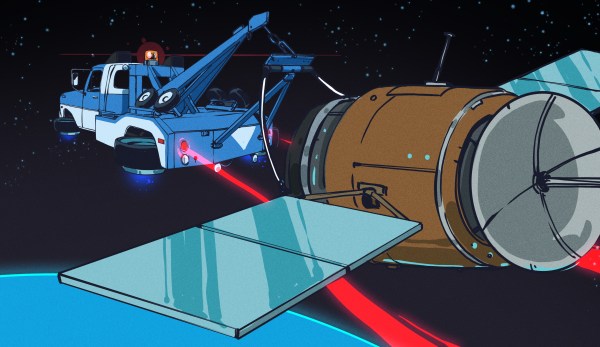
See You On The Dark Side Of The Moon: China’s Lunar Radio Observatory

For nearly as long as there has been radio, there have been antennas trained on the sky, looking at the universe in a different light than traditional astronomy. Radio astronomers have used their sensitive equipment to study the Sun, the planets, distant galaxies, and strange objects from the very edge of the universe, like pulsars and quasars. Even the earliest moments of the universe have been explored, a portrait in microwave radiation of the remnants of the Big Bang.

And yet with all these observations, there’s a substantial slice of the radio spectrum that remains largely a mystery to radio astronomers. Thanks to our planet’s ionosphere, most of the signals below 30 MHz aren’t observable by ground-based radio telescopes. But now, thanks to an opportunity afforded by China’s ambitious lunar exploration program, humanity is now listening to more of what the universe is saying, and it’s doing so from a new vantage point: the far side of the moon.

Continue reading “See You On The Dark Side Of The Moon: China’s Lunar Radio Observatory”

The Birth Of The Modern Robot

When Isaac Asmiov was writing I, Robot, the field of robotics was still in its infancy. As he notes in The Complete Robot, as the field began to mature, it started showing signs of conforming to the popular ideas held by science fiction writers about what robotics ought to be. Notions of humanoid robots, the functions that robots would have in domestic settings, even the ethical quandaries that AI ethicists face today were all themes of early sci-fi writers.

The idea of a robot – at least of automata – predates the field of robotics. The idea of an independent automata may have existed as early as the ancient Egyptians Chinese, and Greeks, who attempted to build self-operated machines that resembled animals and humans. Myths of clay golems in Jewish legends and clay giants in Norse legends perpetuated the idea of an artificial being that could mimic the actions of living creatures. A 400 BC myth from Crete spoke of a man of bronze who guarded their island from pirates.

Continue reading “The Birth Of The Modern Robot”

Reflection On A Decade Of Hackerspace Expansion

A few days ago I was invited to a party. Party invites are always good, and if I can make it to this one I’ll definitely go. It’s from a continental European hackerspace, and it’s for their tenth birthday party. As I spent a while checking ferries and flights it struck me, a lot of the spaces in my sphere are about a decade old. I went to London Hackspace’s 10th earlier in the year, and a host of other British hackerspaces aren’t far behind. Something tells me I’ll be knocking back the Club Mate and listening to EDM of some form at more than one such party in the coming year.

For most of the decade since I found the then-recently-established mailing list of my local hackerspace I’ve spent a lot of my time involved in more than one space. I’ve been a hackerspace director, a member, and many roles in between and I’ve seen them in both good times and bad ones. Perhaps it’s time to sit back and take stock of that decade and ask a few questions about hackerspaces. How have they fared, what state are they in now, and where are they going?

Continue reading “Reflection On A Decade Of Hackerspace Expansion”

WWII Aircraft Radio Roars To Life: What It Takes To Restore A Piece Of History

I’ve been told all my life about old-timey Army/Navy surplus stores where you could buy buckets of FT-243 crystals, radio gear, gas masks, and even a Jeep boxed-up in a big wooden crate. Sadly this is no longer the case. Today surplus stores only have contemporary Chinese-made boots, camping gear, and flashlights. They are bitterly disappointing except for one surplus store that I found while on vacation in the Adirondacks: Patriot of Lake George.

There I found a unicorn of historical significance; an un-modified-since-WW2 surplus CBY-46104 receiver with dynamotor. The date of manufacture was early-war, February 1942. This thing was preserved as good as the day it was removed from its F4F Hellcat. No ham has ever laid a soldering iron or a drill bit to it. Could this unit have seen some action in the south Pacific? Imagine the stories it could tell!

My unconventional restoration of this radio followed strict rules so as to minimize the evidence of repair both inside and out yet make this radio perform again as though it came fresh off the assembly line. Let’s see how I did.

Continue reading “WWII Aircraft Radio Roars To Life: What It Takes To Restore A Piece Of History”

How To Get Into Cars: Choosing Your First Project Car

The automobile is a wonderous invention, perhaps one of the most transformative of the 20th century. They’re machines that often inspire an all-consuming passion, capturing the heart with sights, sounds, and smells. However, for those who grew up isolated from car culture, it can be difficult to know how to approach cars as a hobby. If this sounds like you, fear not – this article is a crash course into getting your feet wet in the world of horsepower.

So You Like Cars, Eh?

Project cars let you do things that you’d never dare attempt in a daily.

The first step to becoming a true gearhead is identifying your specific passion. Car culture is a broad church, and what excites one enthusiast can be boring or even repulsive to another. Oftentimes, the interest can be spawned by a fond memory of a family member’s special ride, or a trip to a motor race during childhood.

Knowing what kind of cars you like is key to your journey. You might fall in love with classic American muscle and drag racing, or always fancied yourself in the seat of a tweaked-out tuner car a la The Fast And The Furious. Movies, posters, magazines, and your local car shows are a great way to figure out what excites you about cars. Once you’ve got an idea of what you like, it’s time to start thinking about picking out your first project car. Continue reading “How To Get Into Cars: Choosing Your First Project Car”

The Young Engineers Guide To University Capstone Projects

Engineering degrees are as wide and varied as the potential careers on offer out in the real world. There’s plenty of maths to learn, and a cavalcade of tough topics, from thermodynamics to fluid mechanics. However, the real challenge is the capstone project. Generally taking place in the senior year of a four-year degree, it’s a chance for students to apply everything they’ve learned on a real-world engineering project.

Known for endless late nights and the gruelling effort required, it’s an challenge that is revered beforehand, and boasted about after the fact. During the project, everyone is usually far too busy to talk about it. My experience was very much along these lines, when I undertook the Submarine That Can Fly project back in 2012.  The project taught me a lot about engineering, in a way that solving problems out of textbooks never could. What follows are some of the lessons I picked up along the way. Continue reading “The Young Engineers Guide To University Capstone Projects”

The Strain Of Flu Shot Logistics

Did you get a flu shot this year? How about last year? In a world of next-day delivery and instant downloads, making the yearly pilgrimage to the doctor or the minute clinic feels like an outdated concept. Even if you get your shots free at the office, it’s still a pain to have to get vaccinated every year.

Unfortunately, there’s really no other way to deal with the annual threat of influenza. There’s no single vaccine for the flu because there are multiple strains that are always mutating. Unlike other viruses with one-and-done vaccinations, influenza is a moving target. Developing, producing, and distributing millions of vaccines every year is a massive operation that never stops, or even slows down a little bit. It’s basically Santa Claus territory — if Santa Claus delivered us all from mass epidemics.

The numbers are staggering. For the 2018-19 season, as in last year, there were 169.1 million doses distributed in the United States, up from 155.3 million doses the year before. How do they do it? We’re gonna roll up our sleeves and take a stab at it.

Continue reading “The Strain Of Flu Shot Logistics”