What Can You Learn From An Eggbot?

An eggbot is probably the easiest introduction to CNC machines that you could possibly hope for, at least in terms of the physical build. But at the same time, an eggbot can let you get your hands dirty with all of the concepts, firmware, and the toolchain that you’d need to take your CNC game to the next level, whatever that’s going to be. So if you’ve been wanting to make any kind of machine where stepper motors move, cut, trace, display, or simply whirl around, you can get a gentle introduction on the cheap with an eggbot.

Did we mention Easter? It’s apparently this weekend. Seasonal projects are the worst for the procrastinator. If you wait until the 31st to start working on your mega-awesome New Year’s Dropping Laser Ball-o-tron 3000, it’s not going to get done by midnight. Or so I’ve heard. And we’re certainly not helping by posting this tutorial so late in the season. Sorry about that. On the other hand, if you start now, you’ll have the world’s most fine-tuned eggbot for 2020. Procrastinate tomorrow!

I had two main goals with this project: getting it done quickly and getting it done easily. That was my best shot at getting it done at all. Secondary goals included making awesome designs, learning some new software toolchains, and doing the whole thing on the cheap. I succeeded on all counts, and that’s why I’m here encouraging you to build one for yourself.


Continue reading “What Can You Learn From An Eggbot?”

Brain Hacking With Entrainment

Can you electronically enhance your brain? I’m not talking about surgically turning into a Borg. But are there electronic methods that can improve various functions of your brain? Fans of brainwave entrainment say yes.

There was an old recruiting ad for electrical engineers that started with the headline: The best electronic brains are still human. While it is true that even a toddler can do things our best computers struggle with, it is easy to feel a little inadequate compared to some of our modern electronic brains. Then again, your brain is an electronic device of sorts. While we don’t understand everything about how it works, there are definitely electric signals going between neurons. And where there are electric signals there are ways to measure them.

The tool for measuring electric signals in the brain is an EEG (electroencephalograph). While you can’t use an EEG to read your mind, exactly, it can tell you some pretty interesting information, such as when you are relaxed or concentrating. At its most basic we’ve seen toys and simple hobby projects that purport to be “mind controlled” but only at an incredibly rudimentary level.

Brainwave entrainment is a hypothesis that sending low frequency waves to your brain can give your mind a nudge and sync up brain activity with the equipment measuring it. The ability to synchronize with the brain could yield much better measurements for a meaningful interface between modern electronics and electric storm of thought happening in your head.

Continue reading “Brain Hacking With Entrainment”

In Praise Of The App Note

When I am at a loss for an explanation in the world of electronics, I reach for my well-thumbed Horowitz & Hill. When H&H fails me which is not that often, the chances are I’ll find myself looking in an application note from a semiconductor company who is in cut-throat competition with its rivals in a bid for my attention. These companies have an extensive sales and marketing effort, part of which comes in the dissemination of knowledge.

Razor blades may be sold to young men with images of jet fighters and a subtle suggestion that a clean-shaven guy gets his girl, but semiconductor brands are sold by piquing the engineer’s interest with information. To that end, companies become publishing houses in praise of their products. They produce not only data sheets that deal with individual device, but app notes documents which cover a wider topic and tell the story of why this manufacturer’s parts are naturally the best in the world.

These app notes frequently make for fascinating reading, and if you haven’t found them yet you should head for the documentation sections of semiconductor biz websites and seek some of them out.

Continue reading “In Praise Of The App Note”

Radio Free Blockchain: Bitcoin From Space

Cryptocurrencies: love them, hate them, or be baffled by them, but don’t think you can escape them. That’s the way it seems these days at least, with news media filled with breathless stories about Bitcoin and the other cryptocurrencies, and everyone from Amazon to content creators on YouTube now accepting the digital currency for payments. And now, almost everyone on the planet is literally bathed in Bitcoin, or at least the distributed ledger that makes it work, thanks to a new network that streams the Bitcoin blockchain over a constellation of geosynchronous satellites.

Continue reading “Radio Free Blockchain: Bitcoin From Space”

Hacker Abroad: Vietnam’s Electronics And Hardware Markets

Ho Chi Mihn City is the hub for sourcing the materials and tools driving the growing Vietnamese economy. Whether you’re building new, or keeping existing equipment running, the supply chains and service companies aren’t yet in place and the markets of HCMC are the go-to for parts and equipment. Let’s get a little taste of what I saw in my tour of the markets.

Continue reading “Hacker Abroad: Vietnam’s Electronics And Hardware Markets”

Arduino Converts Serial To Parallel: The Paralleloslam

After a youth spent playing with Amigas and getting into all sorts of trouble on the school computer network, I’ve always had a soft spot in my heart for hardware from the 80s and 90s. This extends beyond computers themselves, and goes so far as to include modems, photocopiers, and even the much-maligned dot matrix printer.

My partner in hacking [Cosmos2000] recently found himself with a wonderful Commodore MPS 1230 printer. Its parallel interface was very appropriate in its day, however parallel ports are as scarce as SID chips. Thankfully, these two interfaces are easy to work with and simple in function. Work on a device to marry these two disparate worlds began.

Enter: The Paralleloslam

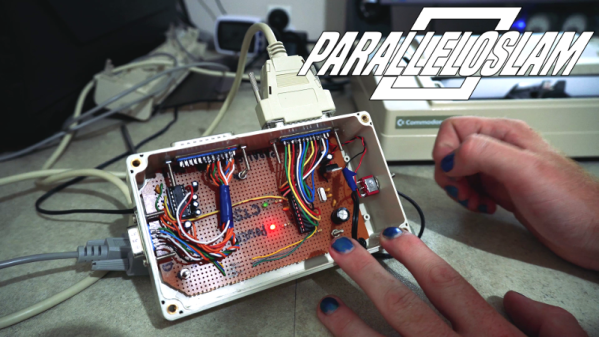
While I was gallivanting around the Eastern coast of Australia, [Cosmos2000] was hard at work. After some research, it was determined that it would be relatively simple to have an Arduino convert incoming serial data into a parallel output to the printer. After some testing was performed on an Arduino Uno, a bespoke device was built – in a gloriously plastic project box, no less.

An ATMEGA328 acts as the brains of the operation, with a MAX232 attached for level conversion from TTL to RS232 voltage levels. Serial data are received on the hardware TX/RX lines. Eight digital outputs act as the parallel interface. When a byte is received over serial, the individual bits are set on the individual digital lines connected to the printer’s parallel port. At this point, the strobe line is pulled low, indicating to the attached device that it may read the port. After two microseconds, it returns high, ready for the next byte to be set on the output lines. This is how parallel interfaces operate without a clock signal, using the strobe to indicate when data may be read.

At this point, [Cosmos2000] reached out – asking if I had a name for the new build.

“Hm. Paralleloslam?”

“Done. Cheers!”

Continue reading “Arduino Converts Serial To Parallel: The Paralleloslam”

Hacker Abroad: Vietnam’s Hardware Hackers

One of the unfortunate things about Hackaday’s globe-spanning empire is that you often don’t get to meet the people you work with in person. Since I was in China and it’s right next door, I really wanted to pop over to Vietnam and meet Sean Boyce, who has been writing for Hackaday for a couple of years, yet we’ve never met. I suggested we could make this happen if we put together a meetup or unconference. Sean was immediately confident that the Ho Chi Minh City hardware hackers would turn out in force and boy was he right! On Sunday night we had a full house for the first ever Hackaday Vietnam Meetup.

Continue reading “Hacker Abroad: Vietnam’s Hardware Hackers”