EV Charging Connectors Come In Many Shapes And Sizes

Electric vehicles are now commonplace on our roads, and charging infrastructure is being built out across the world to serve them. It’s the electric equivalent of the gas station, and soon enough, they’re going to be everywhere.

However, it raises an interesting problem. Gas pumps simply pour a liquid into a hole, and have been largely standardized for quite some time. That’s not quite the case in the world of EV chargers, so let’s dive in and check out the current state of play.

AC, DC, Fast, or Slow?

Since becoming more mainstream over the past decade or so, EV technology has undergone rapid development. With most EVs still somewhat limited in range, automakers have developed ever-faster charging vehicles over the years to improve practicality. This has come through improvements to batteries, controller hardware, and software. Charging tech has evolved to the point where the latest EVs can now add hundreds of miles of range in under 20 minutes.

However, charging EVs at this pace requires huge amounts of power. Thus, automakers and industry groups have worked to develop new charging standards that can deliver high current to top vehicle batteries off as quickly as possible.

As a guide, a typical home outlet in the US can deliver 1.8 kW of power. It would take an excruciating 48 hours or more to charge a modern EV from a home socket like this.

In contrast, modern EV charge ports can carry anywhere from 2 kW up to 350 kW in some cases, and require highly specialized connectors to do so. Various standards have come about over the years as automakers look to pump more electricity into a vehicle at greater speed. Let’s take a look at the most common options out in the wild today. Continue reading “EV Charging Connectors Come In Many Shapes And Sizes” →

The State Of Play In Solid State Batteries

Electric vehicles are slowly but surely snatching market share from their combustion-engined forbearers. However, range and charging speed remain major sticking points for customers, and are a prime selling point for any modern EV. Battery technology is front and center when it comes to improving these numbers.

Solid-state batteries could mark a step-change in performance in these areas, and the race to get them to market is starting to heat up. Let’s take a look at the current state of play.

Continue reading “The State Of Play In Solid State Batteries” →

Genaille’s Rods: When Paint Sticks Do Math

What is a hacker, if not somebody who comes up with solutions that other just don’t see? All the pieces may be in place, but it takes that one special person to view the pieces as greater than the sum of their parts. As [Chris Staecker] explains in the video below the break, Henri Genaille was one such person.

When French mathematician Edouard Lucas (himself well known for calculating the longest prime number found by hand) posed a mathematical problem at the French Academy, a French railway engineer named Henri Genaille developed the rods we’re discussing now.

Genaille’s Rods are designed to perform multiplication. But rather than require computation by the user, the rods would simply need to be laid out in the correct order. The solution could readily be found by just following the lines in the correct pattern. This might sound a lot like cheating, and that’s exactly what it is. No manual math needed to be done. Genaille also created rods for doing long division, which we’re sure were every bit as enthralling as the multiplication rods. Demonstrations of both are included in the video below.

While Genaille’s Rods have gone the way of the slide rule, we can’t help but wonder how many engineers and scientists carried around a set of marked up wooden sticks in their pocket protector.

If designing and building manual mathematical machines is something that you think really adds up to a good time, check out this post on how to design and build your own circular slide rule!

Continue reading “Genaille’s Rods: When Paint Sticks Do Math” →

The Sinclair ZX Spectrum Turns 40

It’s an auspicious moment for retrocomputing fans, as it’s now four decades since the launch of the Sinclair ZX Spectrum. This budget British microcomputer was never the best of the bunch, but its runaway success and consequent huge software library made it the home computer to own in the UK. Here in 2022 it may live on only in 1980s nostalgia, but its legacy extends far beyond that as it provided an entire generation of tech-inclined youngsters with an affordable tool that would get them started on a lifetime of computing.

What Was 1982 Really Like?

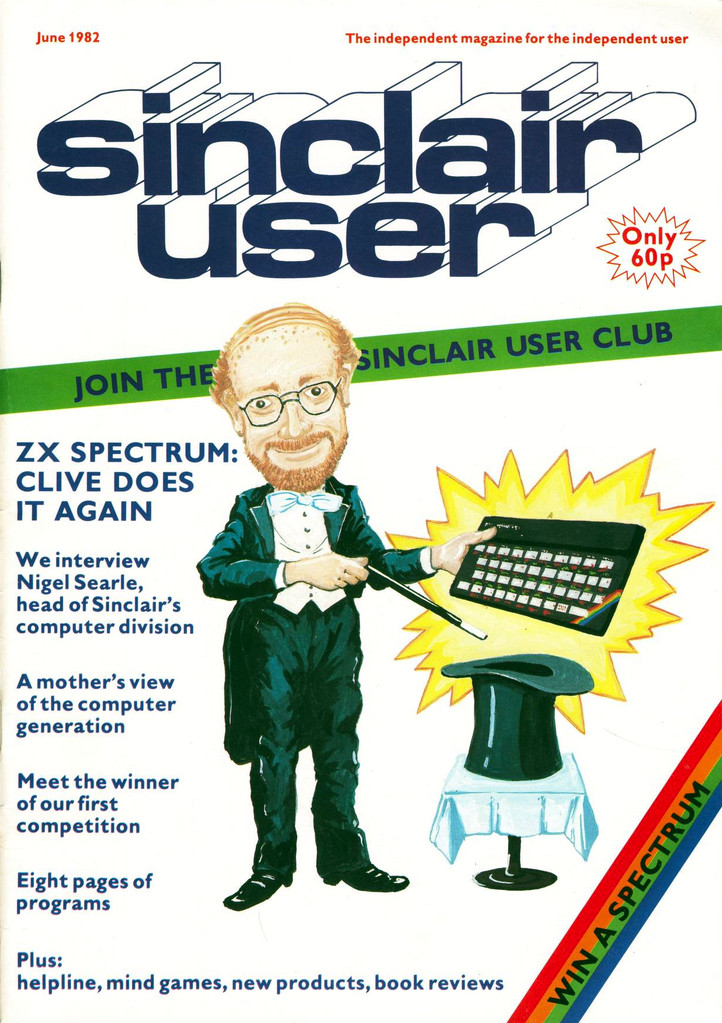
Cover of Sincalir User, Sir Clive Sinclair as a magician
Sinclair User issue 3 captures the excitement surrounding the Spectrum launch.

There’s a popular meme among retro enthusiasts that the 1980s was a riot of colour, pixel artwork, synth music, and kitschy design. The reality was of growing up amid the shabby remnants of the 1970s with occasional glimpses of an exciting ’80s future. This was especially true for a tech-inclined early teen, as at the start of 1982 the home computer market had not yet reached its full mass-market potential. There were plenty of machines on offer but the exciting ones were the sole preserve of adults or kids with rich parents. Budget machines such as Sinclair’s ZX81 could give a taste of what was possible, but their technical limitations would soon become obvious to the experimenter.

1982 was going to change all that, with great excitement surrounding three machines. Here in the UK, the Acorn BBC Micro had been launched in December ’81, the Commodore 64 at the start of ’82, and here was Sinclair coming along with their answer in the form of first the rumour of a ZX82, and then the reality in the form of the Spectrum.

This new breed of machines all had a respectable quantity of memory, high-res (for the time!) colour graphics, and most importantly, sound. The BBC Micro was destined to be the school computer of choice and the 64 was the one everybody wanted, but the Spectrum was the machine you could reasonably expect to get if you managed to persuade your parents how educational it was going to be, because it was the cheapest at £125 (£470 in today’s money, or about $615). Continue reading “The Sinclair ZX Spectrum Turns 40” →

Axiom’s Private ISS Mission Was No Space Vacation

In an era where anyone with deep enough pockets can hitch a ride to the edge of space and back, you’d be forgiven for thinking that Axiom’s Ax-1 mission to the International Space Station was little more than a pleasure cruise for the four crew members. Granted it’s a higher and faster flight than the suborbital hops that the likes of William Shatner and Jeff Bezos have been embarking on, but surely it must still be little more than a publicity stunt organized by folks with more money than they know what to do with?

Thankfully, there’s a bit more to it than that. While the mission was privately funded, the Ax-1 crew weren’t just orbital sightseers. For one thing, there was plenty of real-world experience packed into the SpaceX Dragon: the mission was commanded by Michael López-Alegría, a veteran NASA astronaut, and crew members Larry Connor and Eytan Stibbe are both accomplished pilots, with the latter clocking in thousands of hours on various fighter jets during his time with the Israeli Air Force.

But more importantly, they had work to do. Each member of the crew was assigned a list of experiments they were to conduct, ranging from medical observations to the testing of new hardware. Of course there was some downtime — after all, if you spent $50 million on a ticket to space, you’d expect to have at least a little fun — but this wasn’t just a photo op: Axiom was looking for results. There was no hiding from the boss either, as López-Alegría is not just the Mission Commander, he’s also Axiom’s Vice President of Business Development.

Which makes sense when you consider the company’s ultimate goal is to use the ISS as a springboard to accelerate the development of their own commercial space station. The data collected during Ax-1 is going to be critical to Axiom’s path forward, and with their first module already under construction and expected to launch by 2025, there’s no time to waste.

So what did the crew members of the this privately funded mission to the International Space Station accomplish? Let’s take a look at a few of the more interesting entries from the docket.

Continue reading “Axiom’s Private ISS Mission Was No Space Vacation” →

The Honda Takedown: How A Global Brand Failed To Read The Room

Perhaps the story of the moment in the world of 3D printing concerns a Japanese manufacturer of cars and motorcycles. Honda has sent a takedown notice requesting the removal of models starting with the word “Honda” to the popular 3D printing model repository site Printables. It’s left in its wake puzzlement, disappointment, and some anger, but what’s really going on? Perhaps it’s time to examine what has happened and to ponder what it means for those who put online printable parts and accessories for cars or any other item manufactured by a large corporation.

If You Make Something, What Rights Do You Have?

Soichiro Honda with his 1964 Formula 1 car
Soichiro Honda, famous for being an engineer rather than a serial litigator. Roderick Eime, CC BY 2.0.

The story is that as far as we can glean from reports online, the takedown notice was sent only to Printables by the European arm of Honda, and was pretty wide-ranging with any Honda-related model in its scope. Printables complied with it, but as this is being written there are plenty of such models available from Thingiverse and other model repository sites.

Anyone who makes a career in content creation has by necessity to have a working knowledge of copyright and intellectual property law as it’s easy for the unwary to end up the subject of a nasty letter, so here at Hackaday while we’re not lawyers this is a subject on which we have some professional experience. What follows then is our take based on that experience, our view on Honda’s motivation, and whether those of you who put up 3D models have anything to worry about. Continue reading “The Honda Takedown: How A Global Brand Failed To Read The Room” →

Copper: Rectifying AC A Century Ago

[Robert Murray-Smith] presents for us an interesting electronic device from years gone by, before the advent of Silicon semiconductors, the humble metal oxide rectifier. After the electronic dust had settled following the brutal AC/DC current wars of the late 19th century — involving Edison, Tesla and Westinghouse to name a few of the ringleaders — AC was the eventual winner. But there was a problem. It’s straightforward to step down the high voltage AC from the distribution network to a more manageable level with a transformer, and feed that straight into devices which can consume alternating current such as light bulbs and electrical heaters. But other devices really want DC, and to get that, you need a rectifier.

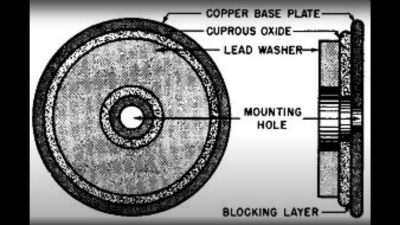
It turns out, that even in those early days, we had semiconductor devices which could perform this operation, based not upon silicon or germanium, but copper. Copper (I) Oxide is a naturally occurring P-type semiconductor, which can be easily constructed by heating a copper sheet in a flame, and scraping off the outer layer of Copper (II) Oxide leaving the active layer below. Simply making contact to a piece of steel is sufficient to complete the device.
Obviously a practical rectifier is a bit harder to make, with a degree of control required, but you get the idea. A CuO metal rectifier can rectify as well as operate as a thermopile, and even as a solar cell, it’s just been forgotten about once we got all excited about silicon.

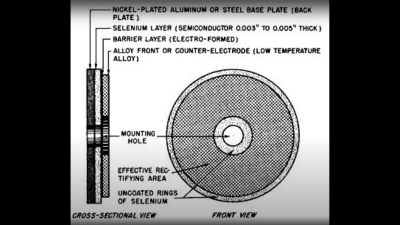
Other similar metallic rectifiers also saw some action, such as the Selenium rectifier, based on the properties of a Cadmium Selenide – Selenium interface, which forms an NP junction, albeit one that can’t handle as much power as good old copper. One final device, which was a bit of an improvement upon the original CuO rectifiers, was based upon a stack of Copper Sulphide/Magnesium metal plates, but they came along too late. Once we discovered the wonders of germanium and silicon, it was consigned to the history books before it really saw wide adoption.


We’ve covered CuO rectifiers before, but the Copper Sulphide/Magnesium rectifier is new to us. And if you’re interested in yet more ways to steer electrons in one direction, checkout our coverage of the history of the diode.

Continue reading “Copper: Rectifying AC A Century Ago” →