Profiles In Science: Jack Kilby And The Integrated Circuit

Sixty years ago this month, an unassuming but gifted engineer sitting in a lonely lab at Texas Instruments penned a few lines in his notebook about his ideas for building complete circuits on a single slab of semiconductor. He had no way of knowing if his idea would even work; the idea that it would become one of the key technologies of the 20th century that would rapidly change everything about the world would have seemed like a fantasy to him.

We’ve covered the story of how the integrated circuit came to be, and the ensuing patent battle that would eventually award priority to someone else. But we’ve never taken a close look at the quiet man in the quiet lab who actually thought it up: Jack Kilby.

Continue reading “Profiles In Science: Jack Kilby And The Integrated Circuit”

Hackaday guide to Lathes

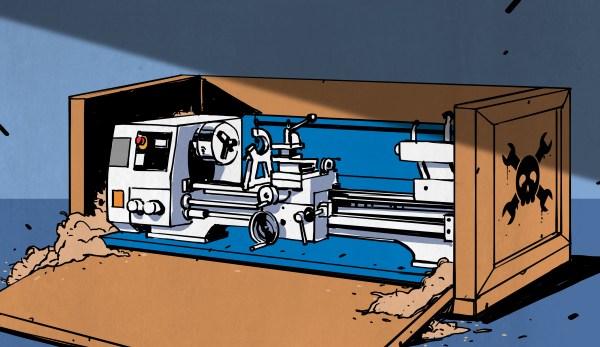
The Machinists’ Mantra: Level Thy Lathe

Let’s say you’ve gone and bought yourself a sweet sweet metal lathe. Maybe it’s one of the new price-conscious Asian models, or maybe it’s a lovely old cast iron beast that you found behind a foreclosed machine shop. You followed all the advice for setting it up, and now you’re ready to make chips, right? Well, not so fast. Unlike other big power tools, such as band saws or whatever people use to modify dead trees, machine tools need to be properly level. Not, “Hurr hurr my carpenter’s level says the bubble is in the middle”, but like really level.

This is especially true for lathes, but leveling is actually a proxy for something else. What you’re really doing is getting the entire machine in one plane. Leveling is a primitive way of removing twist from the structure. It may not seem like a huge piece of cast iron could possibly twist, but at very small scales it does! Everything is a spring, and imperceptible twist in the machine will show up as your lathe turning a couple thousandths of taper (cone) when it should be making perfect cylinders. All this is to say, before making chips, level your lathe. Let me show you the way. Continue reading “The Machinists’ Mantra: Level Thy Lathe”

Rocket Bullets: The Flame And Fizzle Of The Gyrojet

In the 1950’s and 60’s, the world had rocket fever. Humankind was taking its first steps into space and had sights on the moon. Kids could build rockets at the kitchen table and launch them in the schoolyard. On the darker side, the arms race was well underway with the US and USSR trying to close the fictional missile gap.

All around the world, engineers were trying to do new things with rockets. Among these were Robert Mainhardt and Arthur T. Biehl, who thought rockets could be useful as small arms. Together they formed MBA (short for Mainhardt and Biehl Associates), with an eye toward future weapons – – specifically rocket bullets.

Continue reading “Rocket Bullets: The Flame And Fizzle Of The Gyrojet”

Open Source DIY Printers Are Alive And Well: What We Saw At ERRF 18

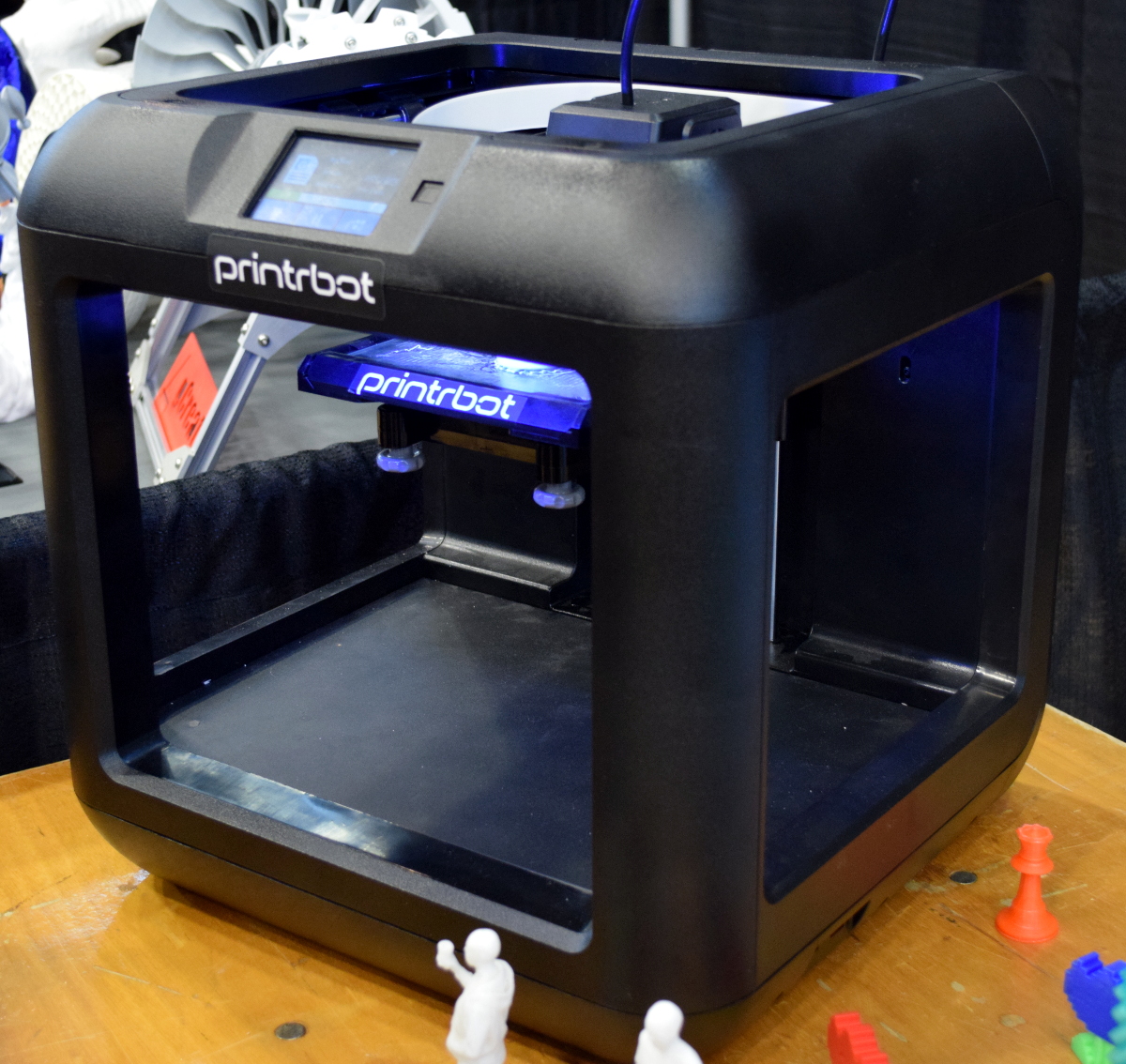
If you follow the desktop 3D printer market, it probably won’t surprise you to hear that nearly every 3D printer on display at the inaugural East Coast RepRap Festival (ERRF) was made in China. Even Printrbot CEO Brook Drumm had to admit that this was the year his company may finally bite the bullet and begin selling a branded and customized printer built overseas.

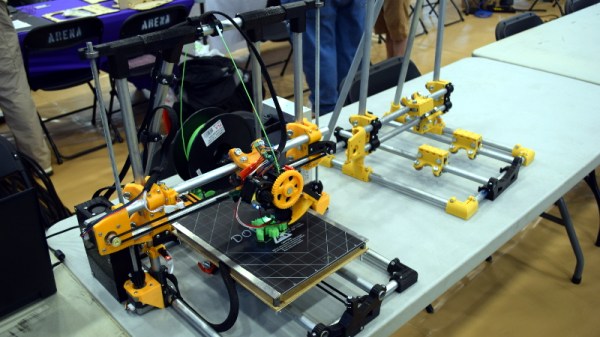
When you can get a decent (but let’s be clear, not great) 3D printer for $200 USD, it’s no surprise that American and European manufacturers are having a hard time staying competitive. But not everyone is seduced by low-cost printers. They know they could buy a decent printer for a couple hundred bucks, but for them that’s not the point. Some hackers are just as (if not more) interested in designing and building the machines than they are churning out little plastic boats with the finished product.

Luckily for us, these are also the type of folks who document their builds and make all their collected information and design files available for others under an open source license. Such builders exemplify the true spirit of the RepRap movement, and we’re happy to report that in a sea of imported printers, there were several interesting home built open source printers.

Whether you want to build your own copy of one of these machines, or simply get inspired by some of the ideas their creators had, these machines are physical proof that just because you can order a cheap 3D printer on eBay right now doesn’t mean you have to.

Continue reading “Open Source DIY Printers Are Alive And Well: What We Saw At ERRF 18”

Calculus And A Calculator

Earlier this year, [Dan Maloney] went inside mechanical calculators. Being the practical sort, [Dan] jumped right into the Pascaline invented by Blaise Pascal. It couldn’t multiply or divide. He then went into the arithmometer, which is arguably the first commercially successful mechanical calculator with four functions. That was around 1821 or so. But [Dan] mentions it used a Leibniz wheel. I thought, “Leibniz? He’s the calculus guy, right? He died in 1716.” So I knew there had to be at least a century of backstory to get to the arithmometer. Having a rainy day ahead, I decided to find out exactly where the Leibniz wheel came from and what it was doing for 100 years prior to 1821.
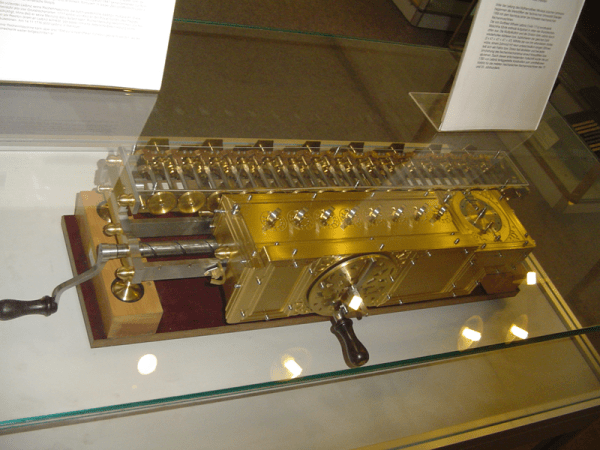
If you’ve taken calculus you’ve probably heard of Gottfried Wilhelm Leibniz (who would have been 372 years old on July 1st, by the way). He’s the guy that gave us the notation we use in modern calculus and oddly was one of two people who apparently figured out calculus, the other being Issac Newton. Both men, by the way, accused each other of stealing, although it is more likely they both built on the same prior work. When you are struggling to learn calculus, it is sometimes amazing that not only did someone think it up, but two people thought it up at one time. However, Leibniz also built what might be the first four function calculator in 1694. His “stepped reckoner” used a drum and some cranks and the underlying mechanism found inside of it lived on until the 1970s in other mechanical calculating devices. Oddly, Leibniz didn’t use the term stepped reckoner but called the machine Instrumentum Arithmeticum.

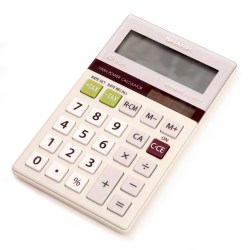
Many of us remember when a four function electronic calculator was a marvel and not even very inexpensive. Nowadays, you’d have to look hard to find one that only had four functions and simple calculators are cheap enough to give away like ink pens. But in 1694, you didn’t have electronics and integrated circuits necessary to pull that off.

Continue reading “Calculus And A Calculator”

Philo Farnsworth, RCA, And The Battle For Television

The parenthood of any invention of consequence is almost never cut and dried. The natural tendency to want a simple story that’s easy to tell — Edison invented the light bulb, Bell invented the telephone — often belies the more complex tale: that most inventions have uncertain origins, and their back stories are often far more interesting as a result.

Inventing is a rough business. It is said that a patent is just a license to get sued, and it’s true that the determination of priority of invention often falls to the courts. Such battles often pit the little guy against a corporate behemoth, the latter with buckets of money to spend in making the former’s life miserable for months or years. The odds are rarely in the favor of the little guy, but in few cases was the deck so stacked against someone as it was for a young man barely out of high school, Philo Farnsworth, when he went up against one of the largest companies in the United States to settle a simple but critical question: who invented television?

Continue reading “Philo Farnsworth, RCA, And The Battle For Television”

Spy Tech: How An Apollo Capsule Landed In Michigan After A Layover In The USSR

There’s an Apollo module on display in Michigan and its cold-war backstory is even more interesting than its space program origins.

Everyone who visits the Van Andel Museum Center in Grand Rapids, Michigan is sure to see the Apollo Command Module flanking the front entrance. Right now it’s being used as a different kind of capsule: a time capsule they’ll open in 2076 (the American tricentennial). If you look close though, this isn’t an actual Command Module but what they call a “boilerplate.”

Technically, these were mass simulators made cheaply for certain tests and training purposes. A full spacecraft costs a lot of money but these — historically made out of boilerplate steel — could be made with just the pieces necessary and using less expensive materials. What you might not know is that the boilerplate at the Van Ardel — BP 1227 — has a cold war spy history unlike any other boilerplate in the fleet.

The early life of BP 1227 is a little sketchy. It appears the Navy was using it for recovery training somewhere between the Azores and the Bay of Biscay in early 1969. We don’t know for sure if the picture to the left is BP 1227 or not. Comparing it to the one at the museum, it probably isn’t, but then again the museum’s does have a fresh paint job and possibly a top cap. Regardless, the picture to the left was from 1966 in the Atlantic, giving us an idea of how boilerplate capsules were put into service.

In those days — the height of the cold war — Naval ships were often followed by Soviet “fishing trawlers.” These were universally understood to be spy ships — Auxiliary, General Intelligence or AGI vessels.

Continue reading “Spy Tech: How An Apollo Capsule Landed In Michigan After A Layover In The USSR”