
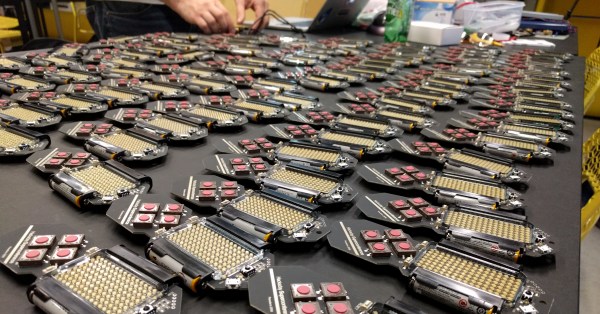
What does it take to go from concept to dropping a finished product into the hands of the end user? Gather ’round for a story that pulls people and parts from around the world to make one killer piece of hardware art.
Hackaday’s finest original content articles curated by the Hackaday editors
What does it take to go from concept to dropping a finished product into the hands of the end user? Gather ’round for a story that pulls people and parts from around the world to make one killer piece of hardware art.

Seems like all the buzz about autonomous vehicles these days centers around self-driving cars. Hands-free transportation certainly has its appeal – being able to whistle up a ride with a smartphone app and converting commute time to Netflix binge time is an alluring idea. But is autonomous personal transportation really the killer app that everyone seems to think it is? Wouldn’t we get more bang for the buck by automating something a little more mundane and a lot more important? What about automating the shipping of freight?
Look around the next time you’re not being driven to work by a robot and you’re sure to notice a heck of a lot of trucks on the road. From small panel trucks making local deliveries to long-haul tractor trailers working cross-country routes, the roads are lousy with trucks. And behind the wheel of each truck is a human driver (or two, in the case of team-driven long-haul rigs). The drivers are the weak point in this system, and the big reason I think self-driving trucks will be commonplace long before we see massive market penetration of self-driving cars.
Continue reading “Automate The Freight: Robotic Deliveries Are On The Way”
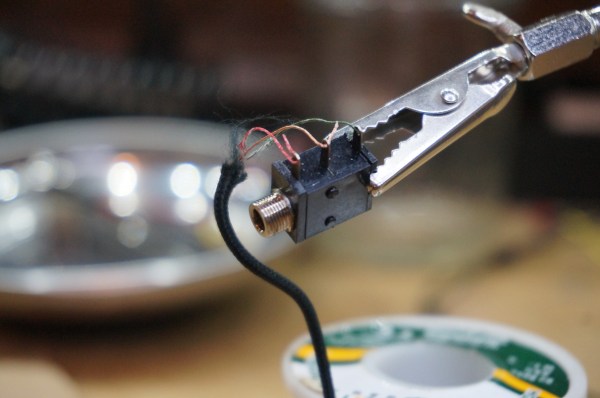
We’ve all had that treasured pair of headphones fail us. One moment we’re jamming out to our favorite song, then, betrayal. The right ear goes out. No wait. It’s back. No, damn, it’s gone. It works for a while and then no jiggling of the wire will bring it back. So we think to ourselves, we’ve soldered before. This is nothing. We’ll just splice the wire together.
So we open it up only to be faced with the worst imaginable configuration: little strands of copper enamel wire intertwined with nylon for some reason. How does a mortal solder this? First you try to untwine the nylon from the strands. It kind of works, but now the strands are all mangled and weird. Huh. Okay. well, you kind of twist them together and give a go at soldering. No dice. Next comes sandpaper, torches, and all sorts of work-a-rounds. None of them seem to work. The best you manage is sound in one ear. It’s time to give up.
Soldering this stuff is actually pretty easy. It just takes a bit of knowledge about how assembly line workers do it. Let’s take a look.
Continue reading “Iron Tips: Soldering Headphones And Enamel Wire”
I have a confession to make. I enjoy the challenge of squeezing software into a tiny space or trying to cut a few more cycles out of a loop. It is like an intricate puzzle. Today, of course, there isn’t nearly as much call for that as there used to be. Today even a “small” microcontroller has a ton of memory and resources.
Even so, there’s still a few cases where you need to squeeze those last few bytes out of memory. Maybe you are trying to maximize memory available for some purpose. Maybe you are anticipating mass production and you are using the smallest microcontroller you can find. Or maybe you’re doing the 1 kB Challenge and just want some advice.
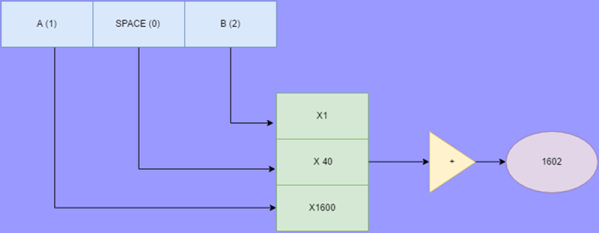
One way to find techniques to maximize resources is to look at what people did “in the old days.” Digital Equipment computers once had a special character set called Squoze (or sometimes DEC Radix-50). This technique can be useful when you need to get a lot of strings into memory. The good news is that you can reliably get 3 characters into 2 bytes (or, as DEC did, 6 characters into 4 bytes). The bad news is that you have to pick a limited character set that you can use. However, that’s not always a big problem.

Back when the original Internet, the digital one, was being brought together there was a vicious standards war. The fallout from the war fundamentally underpins how we use the Internet today, and what’s surprising is that things didn’t work out how everyone expected. The rebel alliance won, and when it comes to standards, it turns out that’s a lot more common than you might think.
Looking back the history of the Internet could have been very different. In the mid eighties the OSI standards were the obvious choice. In 1988 the Department of Commerce issued a mandate that all computers purchased by government agencies should be OSI compatible starting from the middle of 1990, and yet two years later the battle was already over, and the OSI standards had already lost.
In fact by the early nineties the dominance of TCP/IP was almost complete. In January of 1991 the British academic backbone network, called JANET (which was based around X.25 colored book protocols), established a pilot project to host IP traffic on the network. Within ten months the IP traffic had exceeded the levels of X.25 traffic, and IP support became official in November.
“Twenty five years ago a much smaller crowd was fighting about open versus proprietary, and Internet versus OSI. In the end, ‘rough consensus and running code’ decided the matter: open won and Internet won,”
—Marshall Rose, chair of several IETF Working Groups during the period
This of course wasn’t the first standards battle, history is littered with innumerable standards that have won or lost. It also wasn’t the last the Internet was to see. By the mid noughties SOAP and XML were seen as the obvious way to build out the distributed services we all, at that point, already saw coming. Yet by the end of the decade SOAP and XML were in heavy retreat. RESTful services and JSON, far more lightweight and developer friendly than their heavyweight counterparts, had won.
“JSON appeared at a time when developers felt drowned by misguided overcomplicated XML-based web services, and JSON let them just get the job done,”
“Because it came from JavaScript, and pretty much anybody could do it, JSON was free of XML’s fondness for design by committee. It also looked more familiar to programmers.”
—Simon St. Laurent, content manager at LinkedIn and O’Reilly author
Yet, depending on which standards body you want to listen to, ECMA or the IETF, JSON only became a standard in 2013, or 2014, respectively and while the IETF RFC talks about semantics and security, the ECMA standard covers only the syntax. Despite that it’s unlikely many people have actually read the standards, and this includes the developers using the standard and even those implementing the libraries those developers depend on.
We have reached the point where standardization bodies no longer create standards, they formalize them, and the way we build the Internet of Things is going to be fundamentally influenced by that new reality.
Continue reading “A Rebel Alliance For Internet Of Things Standards”
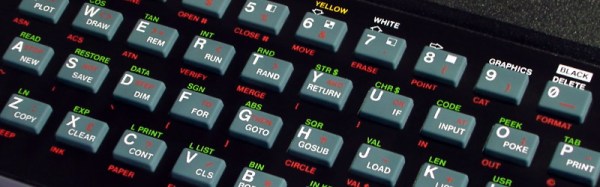
If you are interested in how a computer works at the hardware grass-roots level, past all the hardware and software abstractions intended to make them easier to use, you can sometimes find yourself frustrated in your investigations. Desktop and laptop computers are black boxes both physically and figuratively, and microcontrollers have retreated into their packages behind all the built-in peripherals that make them into systems-on-chips.
Continue reading “The BASIC Issue With Retro Computers”

Somewhat hidden among athletes, actors, and musicians, three giants of technology have been aptly named as 2016 Presidential Medal of Freedom recipients. Grace Hopper, Margaret Hamilton, and Richard Garwin all made significant contributions to the technology that envelops our lives and embody the quest for knowledge and life-long self learning that we’d like to see in everyone.

Rear Admiral Grace Hopper’s legacy lies with the origins of computer science. She wrote the first compiler. In a time when computers were seen more as calculating machines than easily adaptable frameworks she looked to the future and made it happen. She continued to make huge contributions with lasting effect in developing COBOL, unit testing methods for programmers, and in education. We have long loved her explanation of a nanosecond (and why software engineers shouldn’t waste cycles) and was one of the first to program on the Harvard Mark I which can still be seen in the lobby of the school’s engineering building.
 As Director of Apollo Flight Computer Programming, Margaret Hamilton is the driving force behind the software of Apollo. When the program started, she was Director of Software Engineering at MIT Instrumentation Laboratory. Originally there wasn’t a plan or budget for software in the space program. Hamilton built the program and led the team who wrote the software and turned it into punch cards to be fed into the computer. We enjoyed reading about some of her adventures during the Apollo project, her drive to develop pristine code is palpable. Over the past year we’ve marveled at the rope memory of the Apollo Guidance Computer and delighted when a hardcopy of AGC software showed up at a party. Her legacy at having written the code for the first portable computer — one that happened to land on the moon and return home safely — is incredible.
 Physicist Richard Garwin’s name is most associated with the first hydrogen bomb design. But another part of his work is more likely to have directly touched your life: his research into spin-echo magnetic resonance helped lead to the development of Magnetic Resonance Imaging. MRIs have of course become a fundamental tool in medicine. Garwin studied under Fermi during his doctoral work — you may remember Fermi from our look at the Fermiac analog computer last year.
Congratulations to these three recipients, their recognition is incredibly well deserved. We’d love to hear about some of your own technology heroes. Let us know on the tips line so that we may help celebrate their accomplishment and inspire the next generation of giants.









