The SEC Has A Thing For Crowdfunding

Kickstarter is not a store. Indiegogo is not a store. No matter what crowdfunding platform you’re on, you’re not in a store. This is an undeniable truth, and no matter how angry you are about not being able to bring a cooler with a blender to the beach this summer, you did not buy this cool cooler, you were merely giving someone money to develop this cooler.

This reality may seem strange for the most vocal Internet commenters out there, leading them to the conclusion their pledge for a crowdfunding campaign was an investment. Surely there must be some guarantee in a single pledge, and if it’s not exchanging money for some consumer goods, it is exchanging money for a stake in a company. If that were true, backers of the Oculus Rift would have received several thousand dollars each, instead of a $600 VR headset.

Crowdfunding is not a store, and according to Kickstarter and Indiegogo, it is not an investment, either. Last week, the Securities and Exchange Commission’s rules for “crowdfunded investing”, “Regulation Crowdfunding”, or “Title III Crowdfunding” kicked into gear. Is this the beginning of slack-jawed gawkers throwing their life savings into a pit of despair filled with idiotic consumer products that violate the laws of physics?

Continue reading “The SEC Has A Thing For Crowdfunding” →

Symmetry For Beginners – The Rubik’s Cube

Symmetry is everywhere in our natural world. Just take a look at your hands, a butterfly, or a sunflower.  It’s easy to pass off the idea of symmetry and symmetric structures as a simple quirk of existence, and to pay it little mind. If this is your view, I can assure you it will no longer be by the end of this series. If we force ourselves to look beyond the grade school applications of symmetry, we find a world rich in connections via many different types of symmetric identities. One of the most interesting is Gauge Symmetry, which lies at the heart of Quantum Electrodynamics, or QED (we’ll get into this a bit later in the series). Several branches of higher level mathematics study symmetry in detail, allowing a host of sciences, from physics to chemistry,  to view difficult problems and theories from a different perspective.

The subject matter of the ideas explored in symmetry is complicated, and not well known outside of academia and the theoretical sciences. It is the goal of this series of articles to simplify some of the concepts that underpin the study of symmetry, so that the average hacker can gain a basic (and I mean basic) understanding of this fascinating body of knowledge, and put it to use in future projects.  We’ll start things off by taking a look at a machine that has crossed the Hackaday server many times – those nifty Rubik’s Cube solvers. Just how do those things work anyway?

Continue reading “Symmetry For Beginners – The Rubik’s Cube” →

The Man Who Didn’t Invent The Personal Computer

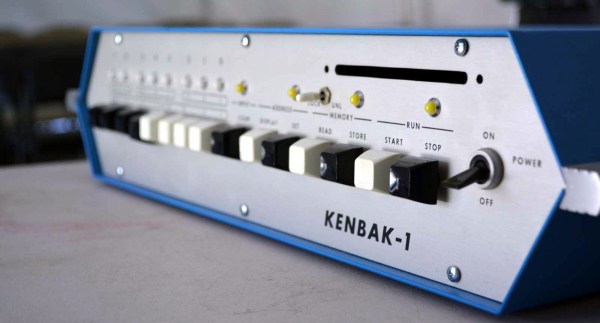
[John Blankenbaker] did not invent the personal computer. Museums, computer historians, and authors have other realities in mind when they say [John]’s invention, the KENBAK-1, was the first electronic, commercially available computer that was not a kit, and available to the general population.

In a way, it’s almost to the KENBAK’s detriment that it is labelled the first personal computer. It was, after all, a computer from before the age of the microprocessor. It is possibly the simplest machine ever sold and an architecturally unique machine that has more in common with the ENIAC than any other machine built in the last thirty years..

The story of the creation of this ancient computer has never been told until now. [John], a surprisingly spry octogenarian, told the story of his career and the development of the first personal computer at the Vintage Computer Festival East last month. This is his story of not inventing the personal computer.

Continue reading “The Man Who Didn’t Invent The Personal Computer” →

Why I Go Through So Many Arduinos

I make things for people that can’t be bought off a shelf, and in the past several years I have gone through a lot of Arduinos. More and more, they are simply the right tool for both the job and the client. This wasn’t always the case; what changed?

My clients today still include startups and other small businesses, but more and more they’re artists, hobbyists venturing into entrepreneurship, or people who make one-offs like the interactive displays you find in museums or science centers. The type of people I work for has changed, and because of this, the right tool for their job is almost always an Arduino.

Continue reading “Why I Go Through So Many Arduinos” →

Hackaday Dictionary: Lithium Ion Batteries

Battery technology is a constant chemical war between the laws of physics and the desire of engineers to make devices smaller. On one side, the laws of physics declare that there are limits to how much energy you can store inside a battery, and on the other side are the engineers looking for ways to sneak around these laws. For many devices, the best compromise between these two sides is the lithium ion battery, usually abbreviated to Li-ion.

Continue reading “Hackaday Dictionary: Lithium Ion Batteries” →

Virtually Free Rapsberry Pis

One of the nice things about the Raspberry Pi is that it runs Linux and you can do a lot of development right on the board. The converse of that is you can do a lot of development on a Linux desktop and then move things over to the Pi once you get the biggest bugs out. However, sometimes you really need to run code on the actual platform.

There is, however, an in-between solution that has the added benefit of upping your skills: emulate a Pi on your desktop. If you use Linux or Windows on your desktop, you can use QEMU to execute Raspberry Pi software virtually. This might be useful if you don’t have a Pi (or, at least, don’t have it with you). Or you just want to leverage your large computer to simplify development. Of course we would be delighted to see you build the Pi equivalent of the Tamagotchi Singularity but that’s a bit beyond the scope of this article.

Since I use Linux, I’m going to focus on that. If you insist on using Windows, you can find a ready-to-go project on Sourceforge. For the most part, you should find the process similar. The method I’ll talk about works on Kubuntu, but should also work on most other Debian-based systems, including Ubuntu.

Continue reading “Virtually Free Rapsberry Pis” →

Hackaday’s Fun With International Mains Plugs And Sockets

When we recently covered the topic of high voltage safety with respect to mains powered equipment, we attracted a huge number of your comments but left out a key piece of the puzzle. We take our mains plugs and sockets for granted as part of the everyday background of our lives, but have we ever considered them in detail? Their various features, and their astonishing and sometimes baffling diversity across the world.

When you announce that you are going to talk in detail about global mains connectors, it is difficult not to have an air of Sheldon Cooper’s Fun With Flags about you. But jokes and the lack of a co-starring Mayim Bialik aside, there is a tale to be told about their history and diversity, and there are also lessons to be taken on board about their safety. Continue reading “Hackaday’s Fun With International Mains Plugs And Sockets” →