Although every electrical grid begins with the production of electricity, there are times when storing this power in some form instead of using it immediately is highly convenient. Today’s battery-powered gadgets are an obvious example of such time-shifting, but energy storage plays a major role on the grid itself, too, whether in electrochemical, mechanical or in some other form.
Utility-level energy storage is essential for not only stabilizing the grid, but also to time-shift excess energy and provide a way to deal with sudden spikes in demand (peak-shaving) plus demand drops by absorbing the excess energy. The health of the grid can essentially be regarded as a function of its alternating current (AC) frequency, with strong deviations potentially leading to a collapse of the grid.
Naturally, such energy storage is not free, and the benefits of adding it to the grid have to be considered against the expense, as well as potential alternatives. With the rapid increase of highly volatile electrical generators on the grid in the form of non-dispatchable variable renewable energy, e.g. wind turbines and PV solar, there has been a push to store more excess power rather than curtailing it, in addition to using energy storage for general grid health.
RS485 is a communication standard that should be part of the advanced hardware hacker’s arsenal; it’s not commonly encountered, but powerful exactly when you need it. It’s a physical layer interface for wired communications that uses a single differential pair for noise immunity, has good long-distance properties, and allows many connections to a single bus. Because of that, you will encounter it in security systems and even cameras, wired sensor networks, DMX512 lighting and all sorts of industrial electronics. For our hobbyist goals, you can absolutely use RS485 to build your home (or room) automation system, or a relatively large robot – without all those worries that wireless brings.
The name might remind you of RS232, and that’s because both RS232 and RS485 are standards that come from EIA (Electronics Industries Alliance). It also might remind you of RS422, if you’ve ever seen this name mentioned online – RS422 and RS485 are closely intertwined, sharing most of the physical layer, and I’ll show how exactly they relate. Continue reading “Hacker Dictionary: RS-485 Will Go The Distance”→
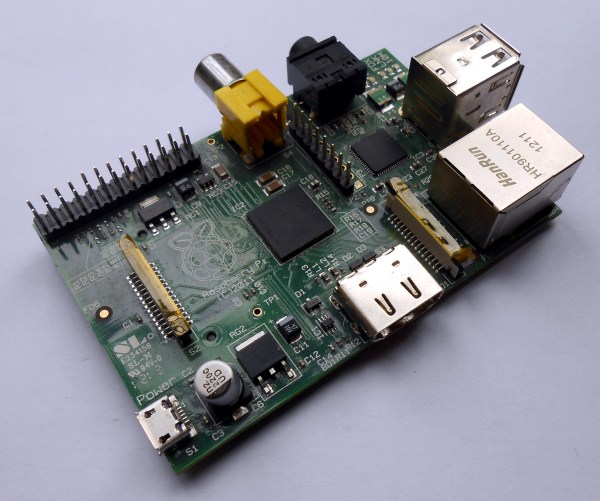
As a standard feature of the Linux kernel, device tree overlays (DTOs) allow for easy enabling and configuration of features and drivers, such as those contained within the standard firmware of a Raspberry Pi system. Using these DTOs it’s trivial to set up features like as a soft power-off button, triggering an external power supply and enable drivers for everything from an external real-time clock (RTC) to various displays, sensors and audio devices, all without modifying the operating system or using custom scripts.
It’s also possible to add your own DTOs to create a custom overlay that combines multiple DTO commands into a single one, or create a custom device tree binary (DTB) for the target hardware. Essentially this DTB is loaded by the Linux kernel on boot to let it know which devices are connected and their configuration settings, very similar to what the BIOS component with x86-based architectures handles automatically.
Ultimately, the DTB concept and the use of overlays allow for easy configuration of such optional devices and GPIO pin settings, especially when made configurable through a simple text file as on the Raspberry Pi SBC platform.
As the world begins to slowly pull itself out of the economic effects of the pandemic, there’s one story that has been on our minds for the past couple of years, and it’s probably on yours too. The chip shortage born during those first months of the pandemic has remained with us despite the best efforts of the industry. Last year, pundits were predicting a return to normality in 2022, but will unexpected threats to production such as the war in Ukraine keep us chasing supplies? It’s time to delve into the root of the issue and get to the bottom of it for a Hackaday report.
The Chips Are Down
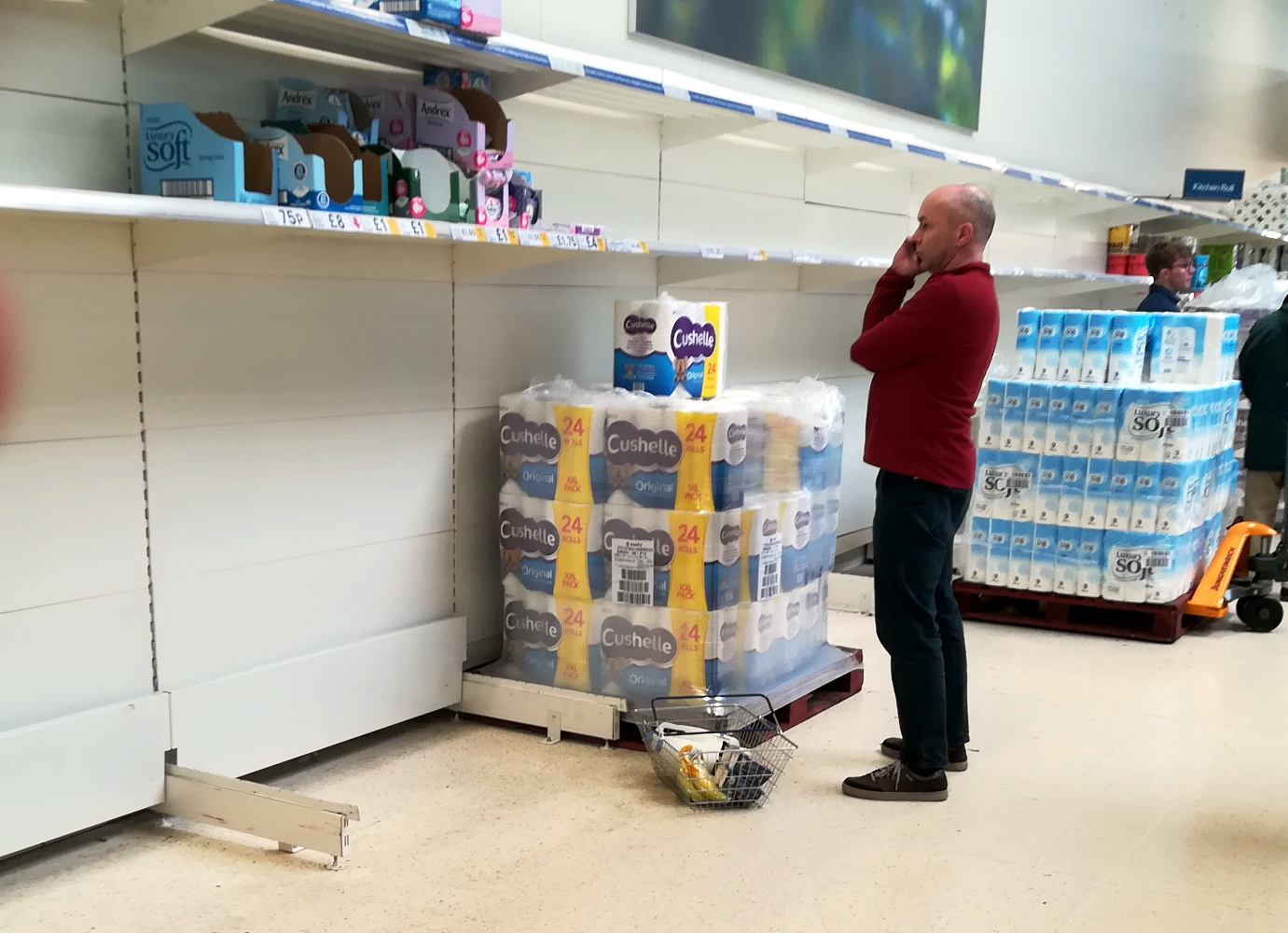
Consumers were more interested in toilet paper than chip supply during the lockdown.
Going back to 2020, and as global economies abruptly slowed down in the face of stringent lockdowns it’s clear that both chipmakers and their customers hugely underestimated the effect that the pandemic would have on global demand for chips.
As production capacity was reduced or turned to other products in response to the changed conditions, it was soon obvious that the customers’ hunger for chips had not abated, resulting in a shortfall between supply and demand.
We’ve all experienced the chaos that ensued as the supply of popular varieties dried up almost overnight, and as fresh pandemic waves have broken around the world along with a crop of climate and geopolitical uncertainties it’s left many wondering whether the chip situation will ever be the same again.
Green Shoots In Idaho
Idaho leads the way in a chip shortage recovery! inkknife_2000, CC BY-SA 2.0
Amidst all that gloom, there are some encouraging green shoots to be seen. While it’s perhaps not quite time to celebrate, there’s a possibility for some cautious optimism. This month brought the hope that Potato Semiconductor might be cutting the sod on a new production capacity for their ultra-fast digital logic in Idaho, and with other manufacturers following suit it could be that we’ll once again have all the chip capacity we can eat.
But the other side of the chip business coin lies with the customer: we all see the chip shortage from our own semi-insider perspective, but have the tastes of the general public returned towards chips? Early signs are that as consumer confidence returns there are encouraging trends in chip consumption taking root, so we’d be inclined to advise our readers to have cautious optimism. If all goes well, you’ll be having your chips by summer.
The prospects for a new dawn in chip production capacity in 2022 look rosy, but there’s a further snag on the horizon courtesy of the Russian invasion of Ukraine. Like so many industries in a globalised economy, the chip industry depends heavily on supplies, consumables, and machinery from beyond the borders of wherever the plants themselves may lie.
In the case of Ukraine there’s a particular raw material whose supply has been severely interrupted, and though we hope for a speedy resolution of the conflict and a consequent resumption of production, the knock-on effect on the production of chips in the rest of the world can not be underestimated. Despite the ramp-up in output led by Idaho, the production of chips globally still relies heavily on Ukrainian sunflower oil. There’s a possibility that an acceptable substitute might be found in canola oil, but it will remain to be seen whether the chip-eating consumers will notice the taste difference.
Back in the day, just about everything that used a battery had a hatch or a hutch that you could open to pull it out and replace it if need be. Whether it was a radio, a cordless phone, or a cellphone, it was a cinch to swap out a battery.
These days, many devices hide their batteries, deep beneath tamper-proof stickers and warnings that state there are “no user serviceable components inside.” The EU wants to change all that, though, and has voted to mandate that everything from cellphones to e-bikes must have easily replaceable batteries, with the legislation coming into effect as soon as 2024.
A decade ago I was lucky enough to work for an employer that offered a bicycle loan scheme to its employees, and I took the opportunity to spend on a Brompton folding bike. This London-made machine is probably one of the more efficiently folding cycles on the market, and has the useful feature of being practical for longer journeys rather than just a quick run from the train. A 3-speed hub gearbox is fine for unhurried touring, but sadly my little folder has always been a bit of a pain on the hills. Thus around the start of the pandemic I splashed out again and bought a Swytch electric upgrade kit for it, and after a few logistical and life upheavals I’ve finally fitted it to the bike. I’ve ridden a few electric bikes but never had my own, so it’s time to sit down and analyse the experience. Is an electric bike something you should have, or not?
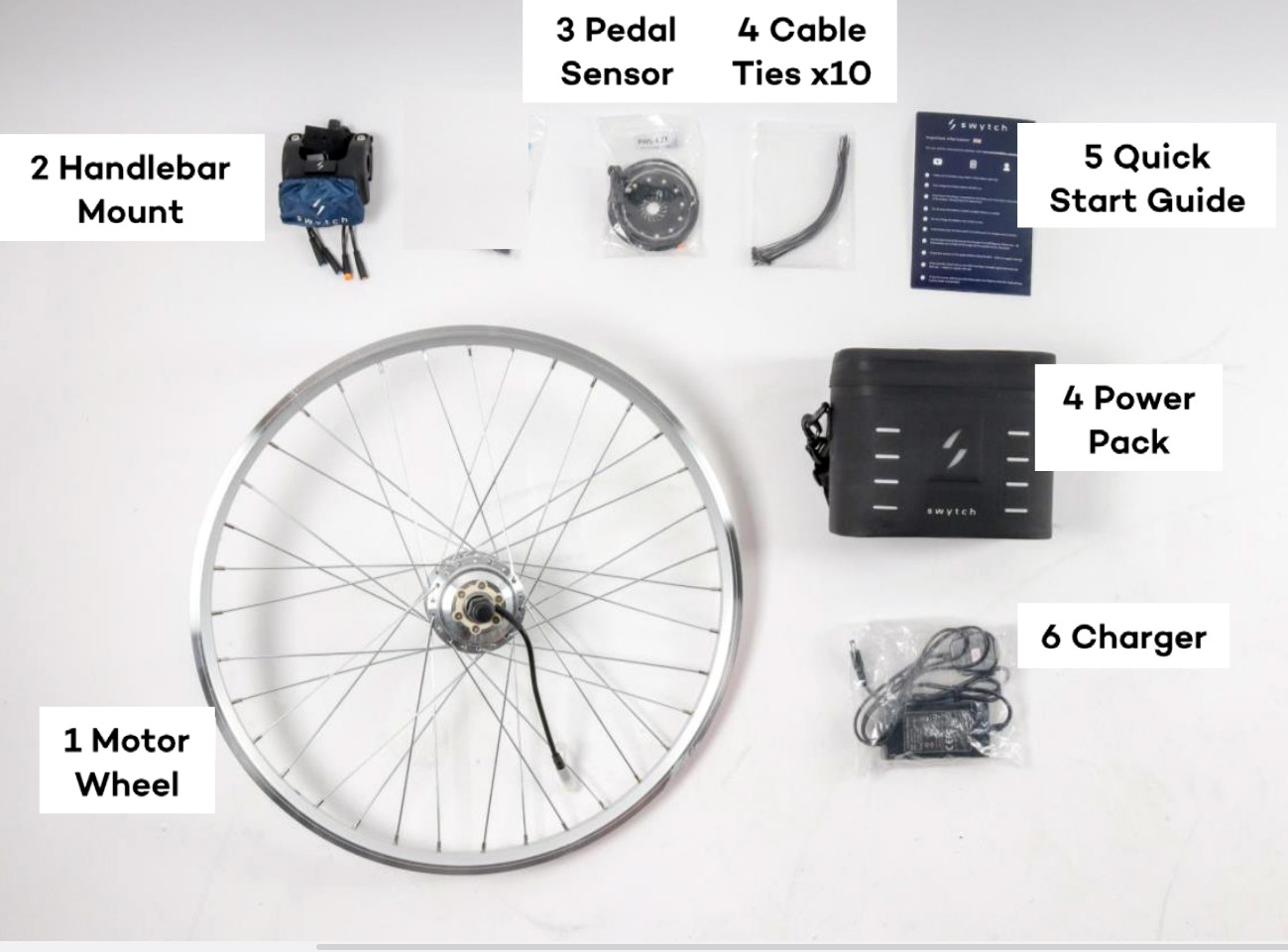
Swytch sell their kits via crowdfunding rounds, so I’d been on a waiting list for a while and got an early-bird price on my kit. It took quite a while to arrive, much longer than the expected time in mid-2020 because of the pandemic, finally being delivered some time in February last year. It came in a modestly-sized cardboard carton which would be an easy carry on the Brompton’s luggage rack, containing neatly packed a new front wheel with motor, as well as the battery and all sundry parts.
Fitting the kit shouldn’t stretch the capabilities of a Hackaday reader, with probably the trickiest part being the positioning of a Hall-effect sensor near the crank. The kit works by providing a motor assist when you pedal, so part of it is a set of magnets on a plastic disk with various attachments for different cranks and pedal sets. The Brompton front wheel is removed and its tyre and tube transferred to the Swytch one, which is then put on the bike. Once the magnet disk and Hall sensor are attached, the cables follow the existing ones and emerge at the handlebars where a sturdy bracket for the battery box is fitted. Continue reading “Converting Your Bike To Electric: Why You Should, And When You Shouldn’t”→
The biggest challenge facing humanity over the next century is how to do as much or more, with less environmental impact. Reducing our collective footprint on the planet is of course not any one person’s responsibility alone, and if it’s going to require a million clever solutions to create a sustainable future, then we know just the group of hackers to get to work.
This year’s 2022 Hackaday Prize challenges you to think of big or small ways to create greener energy sources, make recycling easier, hack old devices to save them from the landfill, or build out the networks that keep our local communities together and conscious of our group effort. If you’ve got a super solar harvester, a recycling robot, or even reverse engineering tools to help combat forced technological obsolescence, we want to see your hacks. Or if you’d like, you can simply save the world in the wildcard round.
As always, courtesy of our overlords at Supplyframe and the generous sponsorship of Digikey, we’ve got tons of prize money to give out to the best projects. The top ten projects in each of five challenge rounds will receive a $500 cash prize, and five winning projects will bag from $5,000 to $50,000 in the finals in November. But you shouldn’t wait — the first round, Planet-Friendly Power, starts right now!
Get your team together, start brainstorming an idea, post it up on Hackaday.io to enter in the Prize, and you’re on your way. Independent of the judging, we’ll be looking through the field and writing up awesome projects as we find them. This is your chance to be seen, to help create a better world, and maybe even to win big.
Challenge
Date
The Details
Planet-Friendly Power
Mar 29 – May 1
Your solution should lower the cost of clean energy, through energy harvesting and/or storage efficiency improvements.
Reuse, Recycle, Revamp
May 1 – June 12
Your project facilitates recycling of material that would otherwise end up in the waste stream.
Hack it Back
June 12th – July 24
Your project adds new capabilities to older electrical gear to keep it useful.
Climate Resilient Communities
July 24 – Sept 4
Design devices that help communities be more resilient to weather and climate disasters and/or collect data from their environments so that they may advocate for changes in local infrastructure.
Save the World Wildcard
Sept 4 – Oct 16th
This is where anything goes, your designs should stand apart from the other challenges but still create a more promising future for all.