The Factory Of The World – Hackaday Documentary On The Shenzhen Ecosystem

When it comes to manufacturing, no place in the world has the same kind of allure as the Pearl River Delta region of China. Within just an hour-long train ride, two vastly different cultures co-exist, each with its unique appeal that keeps attracting engineers, entrepreneurs, and hustlers alike. On the mainland side, cities like Shenzhen and Guangzhou bring the promise of cheap components, low-cost contract work, and the street cred of “having done the Shenzhen thing.” And on the island, the capitalist utopia called Hong Kong glows with all of its high finance and stories of lavish expat lifestyles.

As the “new” China evolves, it seems like it’s exactly the convergence of these two cultures that will bring the biggest change—and not just to the area but to the whole world. Still, understanding what exactly is going on and what the place is really all about remains a mystery to many. So, this June, we jumped on the bandwagon and headed east, trying to get our own feel for the whole thing.

Here’s what we came back with…

Continue reading “The Factory Of The World – Hackaday Documentary On The Shenzhen Ecosystem”

Dropping By The MIT Electronics Research Society

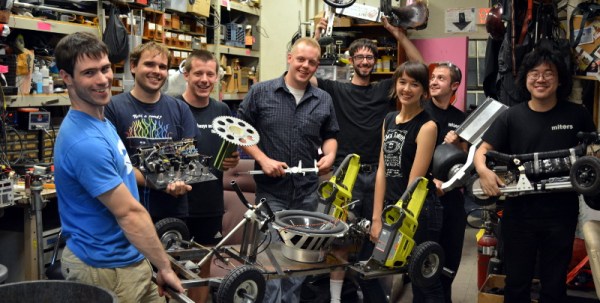
We’re in Boston this week and my first stop was at MITERS last night. This is the MIT Electronics Research Society, which started as a way to provide free access to computers for all students. Since those humble beginnings the organization has grown to include a slew of fabrication and test hardware, as well as a vibrant community that makes the group a great place to hang out.

Walking into the building you’re greeted with double doors strewn with interesting electronics and many examples of fabrication in the form of the word MITERS. The group, which is pushing 60-years of existence, feels immediately like a hackerspace where creativity and anarchy duke it out in a wild dance of experimentation. On this particular Wednesday evening we encountered a room of about 10 people working feverishly to fabricate electric racers for the PRS racing circuit in Detroit this Saturday.

Like a hackerspace, MITERS is completely member (read: student) run. There is a board that helps keep things on the rails. There is no membership fee; funding for the organization is sourced from Swapfest, a weekly flea market during the summer.

There is a strong slant toward machine shop at this hackerspace. In addition to a respectable Bridgeport CNC Mill, the machine tools and hand tools provide for almost all your fabrication needs.

What can be built in this space? How about a unibalancer? This is a single-wheeled, human-ridable vehicle that has a 7-mile cruise radius between charges. For me the most interesting feature is the deadman’s switch. You know those black rubber strips on public buses that you press for the next stop? This unibalancer has one that you need to stand on to make it go.

The hackers at MITERS excel when it comes to electric vehicles and this time of year that means the Power (Wheels) Racing Series. There are restrictions on size, and power output so the teams squeeze every bit that they can. For me, the most interesting build is based off of a pair of Ryobi electric chainsaws. The 40V batteries for these are themselves quite formidable but not used at all in the build. The team has reverse-engineered the driver circuits and written their own firmware for the STM8 microcontrollers on the boards. The chainsaws use chains to drive the two rear wheels. The entire system is monitored with XBEE-based wireless data which is displayed on a tablet.

This isn’t the only PRS build. The MITERS plan to take three different vehicles with them this weekend. The one they can’t bring is the huge electric shopping cart (with mandatory wheelie bar) which hangs from the ceiling of the space.

In addition to the formidable fabrication projects, there are a multitude of electronic projects to be seen. There is a musical tesla coil which is the best I’ve ever heard. It could easily be mistaken as a proper speaker. If you need more bass there’s a massive ceiling-mounted sub-woofer for that. And if you want a more formidable tesla coil, the parts are there.

Look hard enough and you’ll even find battle robots. This one had diamond plate that spins with a variety of nasty accoutrements intended for maximum damage of its foe. On the underside you’ll see a brushless motor used the opposite of how you might think. The shaft is attached to the locomotion frame of the bot. The underside of the spinning diamond plate has a ring of antistatic mat against which this brushless motor body spins.

Thanks to the MITERS for welcoming us in. It was a blast seeing all of the projects they’re working on!

Meetup at Artisan’s Asylum Tonight

If you’re in the Boston area, head on over to Artisan’s Asylum tonight starting at 6. They were gracious enough to open their doors for a Hackaday Meetup. Bring some hardware to show off if you can, if you can’t that’s fine as well. We’ll have a few lightning talks, some social time, and maybe an afterbar!

To wrap things up, we have covered a few projects from MITERS already, like this Power Wheels Racing build, and an electric go kart done the right way. Now that we’ve met them in person we’ll be on the lookout for a lot more awesome hacks from them.

[Thanks John for suggesting we stop by!]

[Federico Musto] Of Arduino SRL Discusses Arduino Legal Situation

Recently we had the opportunity to sit down and interview Arduino SRL’s CEO, [Federico Musto], over a nice dinner. His company is one half of the Arduino vs Arduino debacle which has pitted Arduino.cc against Arduino.org in a battle over the trademark on “Arduino”.

Given the tremendous amount of press coverage of [Massimo Banzi] and the Arduino LLC side of the story (Arduino.cc), we were very interested in hearing how the whole situation looks where [Frederico Musto] sit (Arduino.org). In the end, we came away with what we feel is a more balanced and complete picture of the situation, as well as interesting news about future products from the Arduino SRL camp. [Musto’s] take on the legal proceedings, both past and present, is nothing short of fascinating.

Continue reading “[Federico Musto] Of Arduino SRL Discusses Arduino Legal Situation”

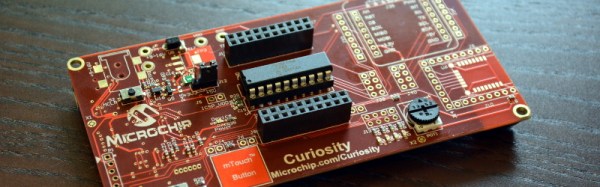
Review: Microchip Curiosity Is A Gorgeous New 8-bit Dev Board

Microchip has unveiled a new dev board called the Curiosity Development Board. I had my first look at this at Bay Area Maker Faire back in May but was asked not to publicize the hardware since it wasn’t officially released yet. Yesterday I got my hands on one of the first “pilot program” demo units and spent some time working with it.

I requested a sample board out of my own curiosity. As you may know, Microchip is one of the sponsors of the 2015 Hackaday Prize, but that partnership does not include this review. However, since we do have this relationship we asked if they would throw in a few extra boards that we could give away and they obliged. More about that at the end of the post.

Continue reading “Review: Microchip Curiosity Is A Gorgeous New 8-bit Dev Board”

What It Means To Be A Product

We’re not giving away a prize. We’re making it your priority to share hard-earned knowledge. On August 17th we’ll start testing the Best Products. Ten will be recognized as finalists, one will be awarded $100,000 but everyone will benefit.

We want to highlight a set of amazing products. These are well-built designs that deserve recognition for doing the extra 90% of work involved in designing for production. This has not traditionally been the fun or sexy part of product development, but that will change.

What does it mean to be a product? Engineering something to be manufactured and sold is a different ball game compared to going from a concept to a working prototype. This is often the downfall of the crowd funding campaign. You were prepared to hammer out 100 units with your friends in someone’s basement. Oops, you now have 1400 backers and have overshot the point at which your plans could work. If properly engineered, a product can be scaled without completely redesigning it.

This is where we are right now. The barriers for having a professionally fabbed PCB made are completely non-existant. But the barriers for making that small-run PCB proof-of-concept into a product are still formidable. We’re changing that and you’re the key to it all. It starts by sharing great examples of how these problems are being overcome. Start-ups should be leading the way, pollinating this information by talking about your experience, your ideas, and your vision.

Write about your successes, failures, and solutions. Show us what happened during the evolution of your product and secure the title of Best Product.

[Photo Credit: Hilmers Studios Technical Illustrations]


Submit your entry for Best Product before 8/17/15. Don’t forget to opt-in for best product by using the “Submit-to Best Product” option on the left sidebar of your project page. Qualifying entries which have sent in three working beta-test units by the entry deadline will be considered for the Best Product prizes. See the entries so far and drop into our live chat at 6:00 PDT Today.

“Drones” Endanger Airborne Wildfire Fighting

usdaThere is no denying that personal drones are in the public eye these days. Unfortunately they tend to receive more negative press than positive. This past weekend, there were news reports of a wildfire in California. Efforts to fight the fire were hampered when no less than five drones were spotted flying in the area. Some reports even stated that two of the drones followed the firefighting aircraft as they returned to local airports. This is the fourth time this month firefighting planes have been grounded due to unmanned aircraft in the area. It’s not a new problem either, I’ve subscribed to a google alert on the word “Drone” for over a year now, and it is rare for a week to go by without a hobby drone flying somewhere they shouldn’t.

The waters are muddied by the fact that mass media loves a good drone story. Any pilotless vehicle is now a drone, much to the chagrin of radio control enthusiasts who were flying before the Wright brothers. In this case there were two fields relatively close to the action – Victor Valley R/C Park, about 10 miles away, and the Cajun Pass slope flying field, which overlooks the section of I-15 that burned. There are claims on the various R/C forums and subreddits that it may have been members from either of those groups who were mistaken as drones in the flight path. Realistically though, Victor Valley is too far away. Furthermore, anyone at the Cajun pass flying site would have been fearing for their own safety. Access requires a drive through 3 miles of dirt road just to reach the site. Not a place you’d want to be trapped by a wildfire for sure. Who or whatever was flying that day is apparently lying low for the moment – but the problem persists.

Rules and Regulations

In the USA, the FAA rules are (finally) relatively clear for recreational drone operations. The layman version can be found on the knowbeforeyoufly.org website, which was put together by the Academy of Model Aeronautics (AMA), The Association for Unmanned Vehicle Systems International (AUVSI), and other groups in partnership with the FAA.

Continue reading ““Drones” Endanger Airborne Wildfire Fighting”

Childhood Tech Exposure Is Slowly Killing The Keyboard

I see the disturbing trend of moving away from keyboards as input devices — and I’m talking about a real, physical keyboard. This isn’t a matter of one decision that kills the keyboard, but an aggregate that is slowly changing the landscape. If you blink, you’ll miss it. We will not find ourselves in a world without keyboards, but in one where most of the available keyboards suck.

Rise of the Virtual Keyboard Generation

Is swipe-style keying the future of coding?

Tablets are great for screwing around, but when you want to get real work done in a reasonable amount of time, you grab a physical keyboard. In this scenario I don’t see the problem being those in the workforce going away from keyboards; it’s how the younger generations are learning to interact with technology that is troubling. The touchscreen is baby’s first computer. Families gather and the kids are handed their parent’s tablets while the grown-ups watch the game. More and more schools are outfitting classrooms with tablets, and for this I’m an advocate. Getting kids involved early in technology is imperative; knowledge evolves much more rapidly than printed textbooks. The tablet is a powerful tool in both of these areas. But most of the screen time kids get is with touchscreens and no physical keyboard.

How much time are K-12 kids spending in front of a physical keyboard? In the United States, if keyboard (typing) classes exist at all in a public school’s curriculum they’re usually only one-semester. Students who spend half of Elementary school using a tablet, and just one semester at a keyboard, are bound to prefer touchscreen-based entry over a physical keyboard.

Keyboard Erosion

We’ve already seen a strong push into touch-screens on laptops as the tablet market has grown. This is not necessarily a bad thing. Think of the computer mouse, it didn’t replace the keyboard, but augmented it and now is seen as a tool that itself is a necessity.

Continue reading “Childhood Tech Exposure Is Slowly Killing The Keyboard”