Art of 3D printer in the middle of printing a Hackaday Jolly Wrencher logo

3D Printering: Speed Is So Hot Right Now

Speed in 3D printing hasn’t been super important to everyone. Certainly, users value speed. But some value quality even more highly, and if gaining quality means giving up speed, then so be it. That’s more or less how things stood for a while, but all things change.

The landscape of filament-based 3D printing over the past year or so has made one thing clear: the market’s gotten a taste of speed, and what was once the domain of enthusiasts installing and configuring custom firmware is now a baseline people will increasingly expect. After all, who doesn’t want faster prints if one doesn’t have to sacrifice quality in the process?

Speed vs. Quality: No Longer a Tradeoff

Historically, any meaningful increase in printing speed risked compromising quality. Increasing print speed can introduce artifacts like ringing or ghosting, as well as other issues. Printing faster can also highlight mechanical limitations or shortcomings that may not have been a problem at lower speeds. These issues can’t all be resolved by tightening some screws or following a calibration process.

The usual way to get into higher speed printing has been to install something like Klipper, and put the necessary work into configuring and calibrating for best results. Not everyone who prints wishes to go this route. In 3D printing there are always those more interested in the end result than in pushing the limits of the machine itself. For those folks, the benefits of speedy printing have generally come at too high a cost.

That’s no longer the case. One can now buy a printer that effectively self-calibrates, offers noticeably increased printing speeds over any earlier style machines, and does it at a reasonable price.
Continue reading “3D Printering: Speed Is So Hot Right Now”

In Praise Of “Simple” Projects

When I start off on a “simple” project, experience shows that it’s got about a 10% chance of actually remaining simple. Sometimes it’s because Plan A never works out the way I think it will, due to either naivety or simply the random blockers that always get in the way and need surmounting. But a decent percentage of the time, it’s because something really cool happens along the way. Indeed, my favorite kind of “simple” projects are those that open up your eyes to a new world of possibilities or experiments that, taken together, are nothing like simple anymore.

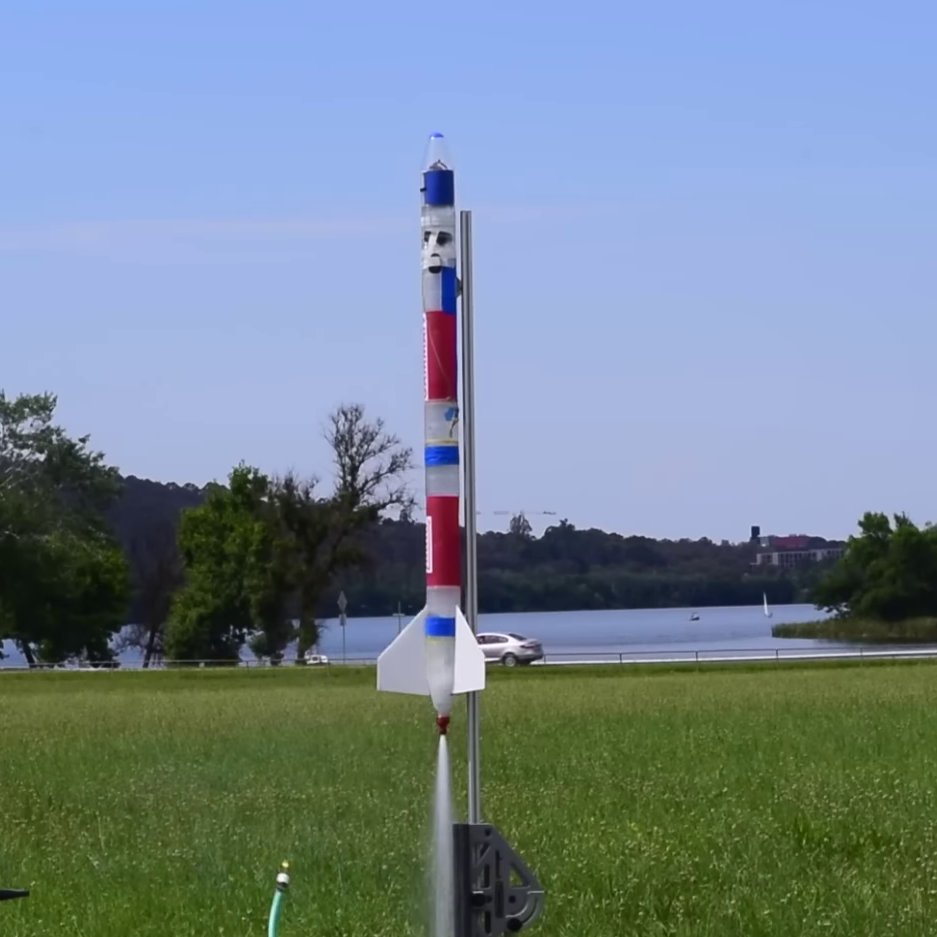
Al Williams and I were talking about water rockets on the podcast the other day, and I realized that this was a perfect example of an open-ended simple project. It sounds really easy: you put some water in a soda bottle, pressurize it a bit with air, and then let it go. Water gets pushed down, bottle flies up. Done?

Oh no! The first step into more sophistication is the aerodynamics. But honestly, if you make something vaguely rocket-shaped with fins, it’ll probably work. Then you probably need a parachute release mechanism. And then some data logging? An accelerometer and barometer? A small video camera? That gets you to the level of [ARRO]’s work that spawned our discussion.

But it wasn’t ten minutes into our discussion that Al had already suggested making the pressure vessel with carbon fiber and doctoring the water mix to make it denser. You’d not be surprised that these and other elaborations have been tried out. Or you could go multi-stage, or vector-thrust, or…

In short, water rockets are one of those “simple” projects. You can get one basically working in a weekend day, and then if you’re so inclined, you could spend an entire summer of weekends chasing down the finer points, building larger and larger tubes, and refining payloads. What’s your favorite “simple” project?

Could Moon Mining Spoil Its Untouched Grandeur And Science Value?

It’s 2024. NASA’s Artemis program is in full swing, and we’re hoping to get back to the surface of the Moon real soon. Astronauts haven’t walked on the beloved sky rock since 1972! A human landing was scheduled for 2025, which has now been pushed back to 2026, and we’re all getting a bit antsy about it. Last time we wanted to go, it only took 8 years!

Now, somehow, it’s harder, but NASA also has its sights set higher. It no longer wants to just toddle about the Moon for a bit to wave at the TV cameras. This time, there’s talk of establishing permanent bases on the Moon, and actually doing useful work, like mining. It’s a tantalizing thought, but what does this mean for the sanctity of one of the last pieces of real estate yet to be spoilt by humans? Researchers are already arguing that we need to move to protect this precious, unique environment.

Continue reading “Could Moon Mining Spoil Its Untouched Grandeur And Science Value?”

Human-Written Or Machine-Generated: Finding Intelligence In Language Models

What is the essential element which separates a text written by a human being from a text which has been generated by an algorithm, when said algorithm uses a massive database of human-written texts as its input? This would seem to be the fundamental struggle which society currently deals with, as the prospect of a future looms in which students can have essays auto-generated from large language models (LLMs) and authors can churn out books by the dozen without doing more than asking said algorithm to write it for them, using nothing more than a query containing the desired contents as the human inputs.

Due to the immense amount of human-generated text in such an LLM, in its output there’s a definite overlap between machine-generated text and the average prose by a human author. Statistical methods of detecting the former are also increasingly hamstrung by the human developers and other human workers behind these text-generating algorithms, creating just enough human-like randomness in the algorithm’s predictive vocabulary to convince the casual reader that it was written by a fellow human.

Perhaps the best way to detect machine-generated text may just be found in that one quality that these algorithms are often advertised with, yet which they in reality are completely devoid of: intelligence.

Continue reading “Human-Written Or Machine-Generated: Finding Intelligence In Language Models”

Could Solar-Powered Airships Offer Cleaner Travel?

The blimp, the airship, the dirigible. Whatever you call them, you probably don’t find yourself thinking about them too often. They were an easy way to get airborne, predating the invention of the airplane by decades. And yet, they suffered—they were too slow, too cumbersome, and often too dangerous to compete once conventional planes hit the scene.

And yet! Here you are reading about airships once more, because some people aren’t giving up on this most hilarious manner of air travel. Yes, it’s 2024, and airship projects continue apace even in the face of the overwhelming superiority of the airplane.

Continue reading “Could Solar-Powered Airships Offer Cleaner Travel?”

DB Cooper Case Could Close Soon Thanks To Particle Evidence

It’s one of the strangest unsolved cases, and even though the FBI closed their investigation back in 2016, this may be the year it cracks wide open. On November 24, 1971, Dan Cooper, who would become known as DB Cooper due to a mistake by the media, skyjacked a Boeing 727 — Northwest Orient Airlines Flight 305 — headed from Portland to Seattle.

During the flight, mild-mannered Cooper coolly notified a flight attendant sitting behind him via neatly-handwritten note that he had a bomb in his briefcase. His demands were a sum of $200,000 (about $1.5 M today) and four parachutes once they got to Seattle. Upon landing, Cooper released the passengers and demanded that the plane be refueled and pointed toward Mexico City with him and most of the original crew aboard. But around 30 minutes into the flight, Cooper opened the plane’s aft staircase and vanished, parachuting into the night sky.

In the investigation that followed, the FBI recovered Cooper’s clip-on tie, tie clip, and two of the four parachutes. While it’s unclear why Cooper would have left the tie behind, it has become the biggest source of evidence for identifying him. New evidence shows that a previously unidentified particle on the tie has been identified as “titanium smeared with stainless steel”.

Continue reading “DB Cooper Case Could Close Soon Thanks To Particle Evidence”

Switching Regulators For Dummies

We often use linear regulators in our designs. They are cheap and simple – you put the regulator chip itself on the board, add two capacitors, and get a voltage. Linear regulators are imperfect, of course – they can’t help but waste the voltage difference as heat, for a start, which straight up excludes them for high-current purposes, or significant voltage difference conversions, unless you have a hefty heatsink handy. They also can’t boost voltage, which means you can only go from high to low – a bit of a disappointment.

Of course, we haven’t been just throwing our hands up in the air if a linear regulator doesn’t fit our purpose. Switching regulators have none of these disadvantages, which is why your mobile phone alone has a few dozen of these. They are way more efficient and hi-tec, able to convert one voltage into another while losing hardly any power into heat. All that you need to do is switch an inductor at a somewhat high frequency!

However, for some, switching regulators might look a bit intimidating. They tend to have higher standards for board layout compared to linear regulators, and, they do need an inductor – sometimes, a few more components too. Inductors alone are somewhat intimidating components, with a fair few more parameters than we’d expect, and you might get confused when looking into adding a switching regulator to your circuit.



No more! In this article, I shall give you the switching regulator basics, remove any fog of war that might be clouding your vision, and show you just how easily you can get a good few amps at your favourite voltage whenever you need it. Continue reading “Switching Regulators For Dummies”