James West Began 40 Years At Bell Labs With World-Changing Microphone Tech

I’d be surprised if you weren’t sitting within fifty feet of one of James Edward Maceo West’s most well-known inventions — the electret microphone. Although MEMS microphones have seen a dramatic rise as smartphone technology progresses, electret microphones still sit atop the throne of low-cost and high-performance when it comes to capturing audio. What’s surprising about this world-changing invention is that the collaboration with co-inventor Gerhard Sessler began while James West was still at university, with the final version of the electret springing to life at Bell Labs just four years after his graduation.

A Hacker’s Upbringing

James’ approach to learning sounds very familiar: “If I had a screwdriver and a pair of pliers, anything that could be opened was in danger. I had this need to know what was inside.” He mentions a compulsive need to understand how things work, and an inability to move on until he has unlocked that knowledge. Born in 1931, an early brush with mains voltage started him on his journey.

Continue reading “James West Began 40 Years At Bell Labs With World-Changing Microphone Tech”
Minimal MQTT With Micropython

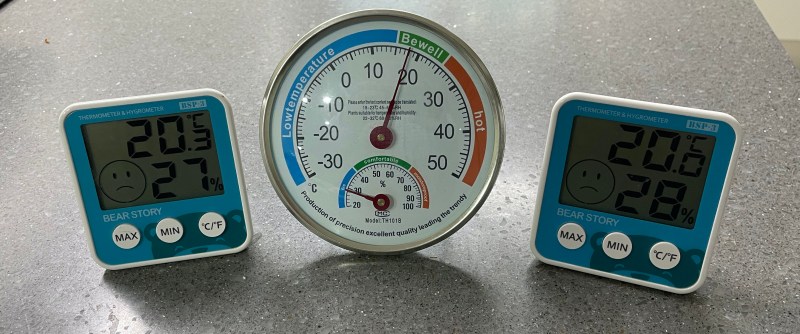
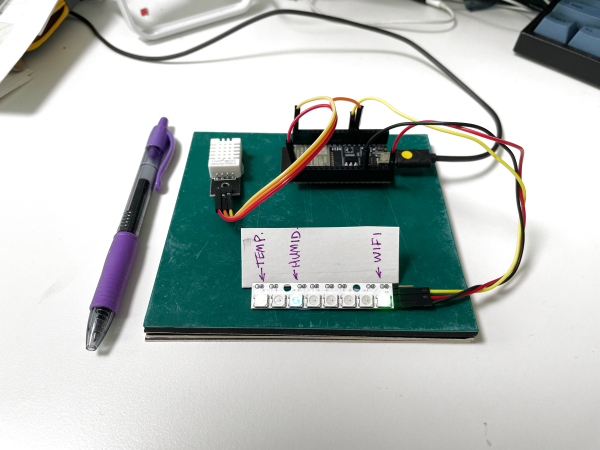
I have been meaning to play around with MQTT for some time now, and finally decided to take the plunge one evening last week. I had three cheap home temperature and humidity sensors, and was bothered that they often didn’t agree. Surprisingly, while the analog one had a calibration adjustment in the back, I have no idea how to calibrate the two digital ones. I took this as a sign that it was time to learn MQTT and be able to install my own, accurate sensors. Of course, I began by ordering the cheapest sensors I could find, but I can always upgrade later on.

Three Cheap Sensors

While we have written quite a bit about MQTT in Hackaday, I had to go all the way back to 2016 to find this introductory four-part series by Elliot Williams. Five years is a long time in the tech world, but I decided to give it a try anyway. Continue reading “Minimal MQTT With Micropython”

Trouble With The Texas Power Grid As Cold Weather Boosts Demand, Knocks Out Generators

It comes as something of a shock that residents of the Lone Star State are suffering from rolling power blackouts in the face of an unusually severe winter. First off, winter in Texas? Second, isn’t it the summer heat waves that cause the rolling blackouts in that region?

Were you to mention Texas to a European, they’d maybe think of cowboys, oil, the hit TV show Dallas, and if they were European Hackaday readers, probably the semiconductor giant Texas Instruments. The only state of the USA with a secession clause also turns out to to have their own power grid independent of neighboring states.

An accurate and contemporary portrait of a typical Texan, as understood by Europeans. Carol M. Highsmith, Public domain.

Surely America is a place of such resourcefulness that this would be impossible, we cry as we watch from afar the red squares proliferating across the outage map. It turns out that for once the independent streak that we’re told defines Texas may be its undoing. We’re used to our European countries being tied into the rest of the continental grid, but because the Texan grid stands alone it’s unable to sip power from its neighbours in times of need.

Let’s dive into the mechanics of maintaining an electricity grid, with the unfortunate Texans for the moment standing in as the test subject.


Continue reading “Trouble With The Texas Power Grid As Cold Weather Boosts Demand, Knocks Out Generators”

The Rotary-X Engine Is A Revolution In Thermodynamics

If you’re running an army, chances are good that you need a lot of portable power for everything from communications to weapons control systems. When it comes to your generators, every ounce counts. The smaller and lighter you can get them, the better.

Connecticut-based company LiquidPiston is developing a high-powered generator for the US Army that uses the company’s own rotary x-engine — a small, light, and powerful beast that sounds like a dream come true. It can run on gasoline, diesel, natural gas, kerosene, or jet fuel, and is scalable from 1 to 1,000 horsepower (PDF).

Co-founder and CEO Alex Schkolnik describes the design as a combination of the best parts of the Otto and Atkinson cycle engines, the Diesel, and the Wankel rotary while solving the big problems of the latter two. That sounds impressive, but it doesn’t mean much unless you understand how each of these engines work and what their various advantages and disadvantages are. So let’s take a look under the hood, shall we?

Continue reading “The Rotary-X Engine Is A Revolution In Thermodynamics”

Europa Decision Delivers Crushing Blow To NASA’s Space Launch System (SLS)

These days, NASA deciding to launch one of their future missions on a commercial rocket is hardly a surprise. After all, the agency is now willing to fly their astronauts on boosters and spacecraft built and operated by SpaceX. Increased competition has made getting to space cheaper and easier than ever before, so it’s only logical that NASA would reap the benefits of a market they helped create.

So the recent announcement that NASA’s Europa Clipper mission will officially fly on a commercial launch vehicle might seem like more of the same. But this isn’t just any mission. It’s a flagship interplanetary probe designed to study and map Jupiter’s moon Europa in unprecedented detail, and will serve as a pathfinder for a future mission that will actually touch down on the moon’s frigid surface. Due to the extreme distance from Earth and the intense radiation of the Jovian system, it’s considered one of the most ambitious missions NASA has ever attempted.

With no margin for error and a total cost of more than $4 billion, the fact that NASA trusts a commercially operated booster to carry this exceptionally valuable payload is significant in itself. But perhaps even more importantly, up until now, Europa Clipper was mandated by Congress to fly on NASA’s Space Launch System (SLS). This was at least partly due to the incredible power of the SLS, which would have put the Clipper on the fastest route towards Jupiter. But more pragmatically, it was also seen as a way to ensure that work on the Shuttle-derived super heavy-lift rocket would continue at a swift enough pace to be ready for the mission’s 2024 launch window.

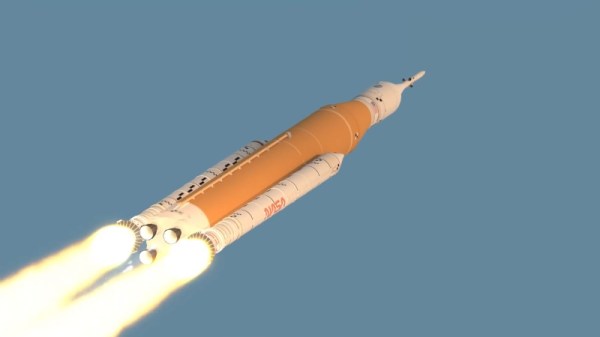
But with that deadline fast approaching, and engineers feeling the pressure to put the final touches on the spacecraft before it gets mated to the launch vehicle, NASA appealed to Congress for the flexibility to fly Europa Clipper on a commercial rocket. The agency’s official line is that they can’t spare an SLS launch for the Europa mission while simultaneously supporting the Artemis Moon program, but by allowing the Clipper to fly on another rocket in the 2021 Consolidated Appropriations Act, Congress effectively removed one of the only justifications that still existed for the troubled Space Launch System.

Continue reading “Europa Decision Delivers Crushing Blow To NASA’s Space Launch System (SLS)”

Linux Fu: Serial Untethered

Serial ports used to be everywhere. In a way, they still are since many things that appear to plug in as a USB device actually look like a serial port. The problem is that today, the world runs on the network. Sure, you can buy a terminal server that converts a serial port to an Ethernet port, but what fun is that? In this article, I’m going to show you how to stream serial ports over the network using some available Linux tools. It isn’t perfect, and it won’t work for every case, but when it works it works well.

Everything is a File, Until it Isn’t

At some point in the past, Unix — the progenitor of Linux — treated virtually everything as a file, and all files were created more or less equal. Programs didn’t care if a file was local, on the network, from a tape drive, or arriving over a named pipe.

But things started to change. Even though a serial port is just a file under Linux, it has some special attributes that let you set, for example, baud rates. Worse, some programs “know” too much about files and insist on certain naming conventions. So, in theory, you should be able to create a network socket, connect one end to a serial port and the other end to a program, and be done with it. In theory.

Continue reading “Linux Fu: Serial Untethered”

Tesla Recalls Cars With EMMC Failures, Calls Part A ‘Wear Item’

It’s a problem familiar to anyone who’s spent a decent amount of time playing with a Raspberry Pi – over time, the flash in the SD card reaches its write cycle limits, and causes a cavalcade of confusing errors before failing entirely. While flash storage is fast, compact, and mechanically reliable, it has always had a writeable lifespan much shorter than magnetic technologies.

Flash storage failures in the computer behind Tesla’s famous touch screen are causing headaches for drivers.

Of course, with proper wear levelling techniques and careful use, these issues can be mitigated successfully. The surprising thing is when a major automaker fails to implement such basic features, as was the case with several Tesla models. Due to the car’s Linux operating system logging excessively to its 8 GB eMMC storage, the flash modules have been wearing out. This leads to widespread failures in the car, typically putting it into limp mode and disabling many features controlled via the touchscreen.

With the issue affecting important subsystems such as the heater, defroster, and warning systems, the NHTSA wrote to the automaker in January requesting a recall. Tesla’s response acquiesced to this request with some consternation, downplaying the severity of the issue. Now they are claiming that the eMMC chip, ball-grid soldered to the motherboard, inaccessible without disassembling the dash, and not specifically mentioned in the owner’s manual, should be considered a “wear item”, and thus should not be subject to such scrutiny. Continue reading “Tesla Recalls Cars With EMMC Failures, Calls Part A ‘Wear Item’”