You Need More Weird

What do you do when you need to solve a problem creatively? Me, I go for a walk, preferably in the woods. It’s about as far away from the desk and computer as possible, and somehow getting outside of the box that is my office helps me to think outside of the metaphorical box as well. Maybe it’s the fresh air, maybe it’s the exercise. Or maybe, it’s putting my physical head in a different (head)space that helps me to think differently.

Psychologists are finding that being outside, being an outsider, or even just being exposed to the straight-up strange can help you think weirder, that is, more creatively. That artists, authors, and other hyper-creative folks are often a little bit odd is almost a cliche. Think of the artists who did their best work while under the influence of drugs, mental illness, or drastic dislocations.

The good news is that you might not have to go so far. Psychologists are able to measure increases in creative problem solving simply by exposing people to weirdness. And you don’t have to go on a magic-mushroom trip to get there either. In one study, this was playing in an upside-down VR world before answering a questionnaire, for instance. Ray Wilson meant it tongue-in-cheek when he suggested that building a silly synthesizer would help you think, but who’s laughing now that science is backing him up?

So if you find yourself, as I do, stuck inside the same four walls, make sure that you break out of the box from time to time. Expose your brain to weird, for your own creativity’s sake. Make some time for a completely wacky project. And of course, read more Hackaday! (We’ve got weird.)


This article is part of the Hackaday.com newsletter, delivered every seven days for each of the last 200+ weeks. It also includes our favorite articles from the last seven days that you can see on the web version of the newsletter.

Want this type of article to hit your inbox every Friday morning? You should sign up!

Core Devs Say A Fond But Firm Farewell To Python 2

Saying that it was finally time for the community to bid a “fond but firm farewell to Python 2”, core developer Benjamin Peterson marked the release of Python 2.7.18 on April 20th; officially ending support for the 2.x branch of the popular programming language. It was hardly a snap decision. Python 3.0 was released all the way back in December 2008, and it was never a secret that the newer branch was not only incompatible with the earlier version, but that it would eventually superseded it to become the standard.

But migrating the incredible amount of Python code in the wild over to the latest and greatest was easier said than done. Millions upon millions of lines of code used in everything from Linux distributions to virtually every major web service needed to be reviewed and migrated over to Python 3. In many cases the changes were relatively minor, but when code is being used in mission critical applications, even the smallest of changes are often avoided unless it’s absolutely necessary. The voluntary migration took far longer than expected, and the end-of-life (EOL) for Python 2 was pushed back by years to accommodate developers who hadn’t made the necessary changes yet.

Given the somewhat fluid nature of the Python 2 EOL date, it seems fitting that this last final release would come several months after the “official” January 2020 deadline. The intention was for it to coincide with PyCon 2020, but just like so many of the events planned for the first half of the year, the in-person conference had to be canceled in favor of a virtual one due to the COVID-19 epidemic. That might have stymied the celebration somewhat, but the release of Python 2.7.18 will still be looked on as a special moment for everyone involved.

Continue reading “Core Devs Say A Fond But Firm Farewell To Python 2”

This Week In Security: Nintendo Accounts, Pernicious Android Malware, And An IOS 0-day

A rash of Nintendo account compromises has made the news over the last week. Nintendo’s official response was that they were investigating, and recommended everyone enabled two factor authentication on their accounts.

[Dan Goodin] over at Ars Technica has a canny guess: The compromised accounts were each linked to an old Nintendo Network ID (NNID). This is essentially a legacy Nintendo account — one made in the Wii U and 3DS era. Since they’re linked, access via the NNID exposes the entire account. Resetting the primary account password doesn’t change the NNID credentials, but turning on two factor authentication does seem to close the loophole. There hasn’t yet been official confirmation that NNIDs are responsible, but it seems to fit the situation. It’s an interesting problem, where a legacy account can lead to further compromise.

Just Can’t Lose You: xHelper

xHelper, an Android malware, just won’t say goodbye. xHelper looks like a cleaner application, but once installed it begins rather stubbornly installing itself via the Triada trojan. The process begins with rooting the phone, and then remounting /system as writable. Binaries are installed and startup scripts are tampered with, and then the mount command itself is compromised, preventing a user from following the same steps to remove the malware. Additionally, if the device has previously been rooted, the superuser binary is removed. This combination of techniques means that the infection will survive a factory reset. The only way to remove xHelper is to flash a clean Android image, fully wiping /system in the process. Continue reading “This Week In Security: Nintendo Accounts, Pernicious Android Malware, And An IOS 0-day”

The Back And Forth Of Windshield Wipers And Patent Lawsuits

Who among us hasn’t dreamed of having some brainstorm idea, prototyping it, and then have some huge company put it into worldwide production? The problem is, that’s not really as easy as it sounds in most cases. Take the case of Robert Kearns. Never heard of him? You use the result of one of his patents pretty often; Kearns invented the intermittent windshield wiper.

If he had sold the patent to one of the big carmakers, this would be a short article. Not that he didn’t try. But it didn’t go very well and while, in the end, he prevailed, it was a very expensive victory.

Continue reading “The Back And Forth Of Windshield Wipers And Patent Lawsuits”

Printed It: Collet Drill Stop

You’d think that being quarantined in your home would be perfect for hackers and makers like us, as we all have a project or two that’s been sitting on the back burner because we didn’t have the time to tackle it. Unfortunately, some are finding that the problem now is actually getting the parts and tools needed to do the job. When there’s a bouncer and a line outside the Home Depot like it’s a nightclub on Saturday night, even the simplest of things can be difficult to source when making in the time of COVID.

Which is exactly the situation I found myself in recently when I needed to drill a bunch of holes to the same depth. The piece was too big to put in the drill press, and while I contemplated just wrapping the bit in some tape to serve as a makeshift stop, I wasn’t convinced it would be accurate or repeatable enough. It occurred to me that a set of drill stop collars would be easy enough to design and 3D print, but before I fired up OpenSCAD, I decided to see what was already available online.

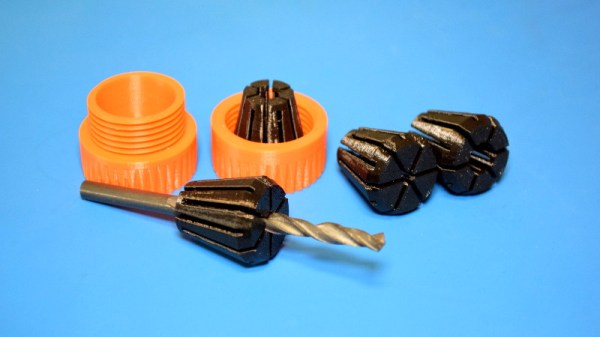
Which is how I found the “Collet Drill Stop” from Adam Harrison. Rather than the traditional ring and setscrew arrangement, his design uses a printable collet that will clamp down on the bit at an arbitrary position without tools. So not only could I avoid a trip to the store by printing this design out, it looked like it would potentially be an upgrade over what I would have bought.

Of course, it’s wise not to take anything for granted when dealing with 3D printing. The only way I could be sure that Adam’s design would work for me was to commit it to plastic and try it out.

Continue reading “Printed It: Collet Drill Stop”

Limiting Factor Submersible Is In A League Of Its Own

Space may be the final frontier, but there are still Earthly frontiers that a select few have visited — the deepest depths of the high seas. Victor Vescovo, a Texas businessman and former Naval officer, is one of those few. Last spring, Vescovo realized his dream of becoming the first person to scrape the bottoms of all five oceans.

Vescovo descended alone inĀ Limiting Factor, a $37 million two-seater submersible he commissioned from Triton, a private manufacturer who made this feat of engineering come to life. Vescovo and the crew discovered over 40 new species of aquatic lifeforms throughout the course of their Five Deeps expedition. But the attention-getting takeaway came when Vescovo visited the absolute lowest point on Earth. In the Challenger Deep portion of the Marianas Trench, seven miles below sea level, he saw a plastic bag drift by in the abyss.

One normal-sounding quirk sets this sub apart from others: it’s made to be reusable. You read that right, most super-deep divers never manage to dive over and over again.

Continue reading “Limiting Factor Submersible Is In A League Of Its Own”

Searching For Alien Life With The Sun As Gravitational Telescope

Astronomy is undoubtedly one of the most exciting subjects in physics. Especially the search for exoplanets has been a thriving field in the last decades. While the first exoplanet was only discovered in 1992, there are now 4,144 confirmed exoplanets (as of 2nd April 2020). Naturally, we Sci-Fi lovers are most interested in the 55 potentially habitable exoplanets. Unfortunately, taking an image of an Earth 2.0 with enough detail to identify potential features of life is impossible with conventional telescopes.

The solar gravitational lens mission, which has recently been selected for phase III funding by the NASA Innovative Advanced Concepts (NIAC) program, is aiming to change that by taking advantage of the Sun’s gravitational lensing effect. Continue reading “Searching For Alien Life With The Sun As Gravitational Telescope”