Eight Player GameCube Adapter Is Ready For Smash

With the release of Smash Ultimate fast approaching for the Nintendo Switch, [Patrick Hess] wanted to get ahead of the game and make sure his squad had the equipment they’d need. Namely, support for the GameCube controllers that serious Smash Bros players demand. But it wasn’t enough to have one or two of them hooked up, or even four. Not even six GameCube controllers could satiate his desire. No, he needed to have support for eight simultaneous GameCube controllers, and he wanted to look good doing it too.

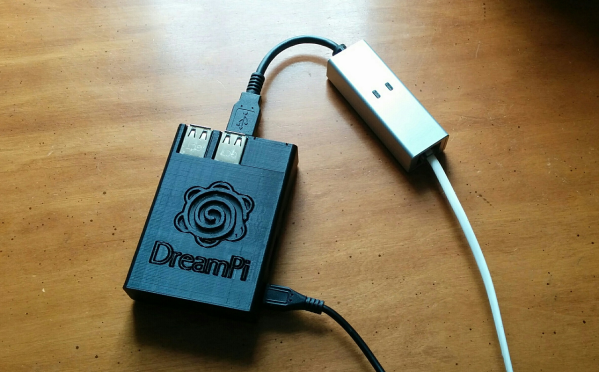
Enter his meticulously designed eight player GameCube to USB adapter. Made out of dual official Nintendo GameCube to USB adapters (intended for the Wii U) merged together in a 3D printed case, the final result looks like something that could earn the coveted Nintendo Seal of Approval. Or at least, something that might pop up on the import sites in the next month or two for a few bucks.

[Patrick] started the project by recreating the official adapter PCBs and their housings in 3D using a pair of calipers. After a couple of test prints to make sure he had all the dimensions right, he could then move on to designing his final enclosure knowing he had accurate data to model around.

In addition to the two adapter boards, there’s also a four port USB hub inside the device’s case. Each adapter has two USB leads, here shortened to fit inside the case, which connect up to the hub. The integrated hub allows connecting all eight GameCube controllers through only a single USB connection. All controllers worked as expected during intense testing on the Wii U’s version of Smash Bros, though at this point [Patrick] can only assume it will work when the Switch version is released.

If there’s a downside to this project, it’s that the design for the 3D printed case is so intricate that [Patrick] was only able to print it on a machine that supported water-soluble PVA supports. A somewhat tall order for the average hacker; it would be interesting to see if somebody could make a second pass on the enclosure that is geared more towards printability than aesthetics.

While the design of the GameCube controller remains somewhat controversial after all these years, there’s no denying it retains an impressive following. Whether turning them into USB devices, shrinking them to preposterously small dimensions, or just finding increasingly creative ways to use them on Nintendo’s latest console, hackers are definitely in love with the gonzo little controller that’s now pushing 20 years old.

Prototype Proves Wii Was Two Gamecubes Taped Together All Along

Say what you will about Nintendo’s little purple lunchbox, the GameCube, but it was home to many delightful experiences from Super Smash Bros. Melee to The Legend of Zelda: Twilight Princess. We now know it was also home to one of the very first Nintendo Wii remotes as well thanks to the recent listing from [Kuriaisu1122] on Yahoo Auctions.

The prototype Wii remote is a wired design and features a proprietary GameCube controller cable. Notable differences include the two buttons toward the bottom are labeled ‘B’ and ‘A’ respectively. This shows that Nintendo always intended to have players hold the remote sideways in order to play Virtual console games. The large white button next to the directional pad is unlabeled, and along the middle are the traditional ‘Start’ and ‘Select’ labels on either side of ‘Home’. However, these all would go through multiple revisions on the way to the final design. Interestingly there is an Ethernet jack at the base used to connect accessories. That connector would eventually become the often maligned “Nunchuk interface”, but what modder wouldn’t have loved it if that Ethernet port had carried on to the final design?

Continue reading “Prototype Proves Wii Was Two Gamecubes Taped Together All Along”

This RC Fortnite Rocket Is A Victory Royale

Minecraft is over and Red Dead Redemption II has barely even started yet. The biggest thing on the planet right now is Fortnite, and oh man, is it awesome. It’s the best game ever, and we wish every day was a Battle Royale. But what if Fortnite was real life? That’s exactly what [Giaco] and [David] did when they made an RC Fortnite Foam Rocket. It’s Fortnite, in the real world! If you don’t mind, we’re going to go T-pose in the corner.

The core of this build was done with the Maker Knife, first introduced as a Kickstarter by [Giaco] as an everyday carry utility knife that features ceramic blades. It’s impressive for a box cutter, but what’s even more impressive is that this fantastic tool can be used to make a real-life Fortnite rocket.

This rocket, like so many other RC planes we see these days, was constructed out of foam board, a technique that was popularized by the folks at Flite Test, and uses all the construction techniques you would usually see in a foam board model airplane. The hinges for the control surfaces are chamfered and reinforced with packing tape, servos are just hot glued to the body, and the control horns are just bits of cardboard.

What makes this really impressive is that this Fortnite rocket actually flies. [Giaco] took this plane out with [David] of rcexplorer fame, and even though this ‘plane’ didn’t really have any lifting surfaces, despite indiscernible center of gravity, and the fact that the paint weighed more than the plane itself, this thing can fly. Fairly well, too, until it gets stuck in a tree. There are prices to pay for producing content that’s this attractive to 12-year-olds, I guess.

Continue reading “This RC Fortnite Rocket Is A Victory Royale”

Slack On The SNES Via Satellite

We love seeing hardware and software from bygone eras getting a new lease on life through modern hacks, as longtime readers can surely attest to. Why leave this stuff to rot in a closet somewhere when it can be pushed into service today? Granted it might not always be the most efficient way to accomplish a task in the 21st century, but at least you’ll net some precious Internet Points for originality.

As a perfect example, take a look at this project which lets you read Slack messages through a Super Nintendo game. If your first thought was that such a thing would involve an unreasonable amount of effort and hoop jumping…then you would be correct. [Bertrand Fan] really had to think outside the box to make this one happen, and even admits a bit of imagination is required on the part of the end-user to use it. But it’s undeniably an original approach, so we hereby bestow the customary Internet Points unto him.

So how does this work, and where do the satellites come in? The key is in a fairly obscure Japanese SNES peripheral called the Satellaview, one of Nintendo’s early attempts at creating an online content delivery system for their consoles. Games designed with Satellaview support would be able to pull down new content from regular satellite broadcasts, not too bad for 1995. This means that if you have the hardware, and happen to own a satellite, you can push your own content into an unmodified SNES. No problem, right?

Alright, [Bertrand] didn’t really use a Satellaview modem plugged into an actual SNES. Plus we’re fairly sure he doesn’t have his own satellite network to broadcast Slack messages with anyway. But it turns out some SNES emulators have support for a virtual Satellaview modem, and there’s even software out there that will let you create new content “downloads” for the system’s included game: BS-X: The Story of The Town Whose Name Was Stolen. All he had to do was connect the dots.

[Bertrand] started by stripping the user interface out of SatellaWave, an open source tool for creating Satellaview content, so that it only need to be provided with an XML file of the content to be “downloaded” by the virtual satellite modem. Using the Slack API, he then came up with way to pull the last 10 messages from a server and push them into his modified version of SatellaWave. Each time somebody posts a new message his software kicks in to produce a new satellite download which automatically gets picked up by the SNES emulator and pops up in the game.

If this is still too practical for you, you can always go all in and run Slack on your Commodore 64.

Continue reading “Slack On The SNES Via Satellite”

That Time Atari Cracked The Nintendo Entertainment System

It was darkest hour for the video game industry following the holiday shopping season of 1982. The torrent of third party developed titles had flooded the home video game console market to the point of saturation. It incited a price war amongst retailers where new releases were dropped to 85% off MSRP after less than a month on the shelves. Mountains of warehouse inventory went unsold leaving a company like Atari choosing to dump the merchandise into the Chihuahuan desert rather than face the looming tax bill. As a result, the whole home video game industry receded seemingly overnight.

One company single-handedly revived video games to mainstream prominence. That company was Nintendo. They’re ostensibly seen as the “savior” of the video games industry, despite the fact that microcomputer games were still thriving (history tends to be written by the victors). Nevertheless their Nintendo Entertainment System (NES) was an innovative console featuring games with scrolling screens, arcade-like sprites. But the tactic they used to avoid repeating the 1983 collapse was to tightly control their market using the Nintendo Seal of Quality.

From the third party developer perspective, Nintendo’s Seal of Quality represented more than just another logo to throw on the box art. It represented what you could and couldn’t do with your business. Those third party licensing agreements dictated the types of games that could be made, the way the games were manufactured, the schedule on which the games shipped to retail, and even the number of games your company could make. From the customer side of things that seal stood for confidence in the product, and Nintendo would go to great lengths to ensure it did just that.

This is the story of how an Atari subsidiary company cracked the hardware security of the original Nintendo and started putting it into their unofficial cartridges.

Continue reading “That Time Atari Cracked The Nintendo Entertainment System”

Stock Looking PSP Hides A Raspberry Pi Zero

We don’t see that many PSP hacks around these parts, perhaps because the system never attained the same sort of generational following that Nintendo’s Game Boy line obtained during its heyday. Which is a shame, as it’s really a rather nice system with plenty of hacking potential. Its big size makes it a bit easier to graft new hardware into, the controls are great, and there’s no shortage of them on the second-hand market.

Hopefully, projects like this incredible “PiSP” from [Drygol] will inspire more hackers to take a second look at Sony’s valiant attempt at dethroning Nintendo as the portable king. With his usual attention to detail, he managed to replace the PSP’s original internals with a Pi Zero running RetroPie, while keeping the outside of the system looking almost perfectly stock. It wasn’t exactly a walk in the park, but we’d say the end definitely justifies the means.

The first half of the project was relatively painless. [Drygol] stripped out all the original internals and installed a new LCD which fit so well it looks like the thing was made for the PSP. He then added a USB Li-ion charger board (complete with “light pipe” made out of 3D printer filament), and an audio board to get sound out of the usually mute Pi Zero. He had some problems getting everything to fit inside of the case. The solution was using flat lithium batteries from an old Nokia cell phone to slim things down just enough to close up the PSP’s case with some magnets.

What ended up being the hardest part of the build was getting the original controls working. [Dyrgol] wanted to use the original ZIF connector on the PSP’s motherboard so he wouldn’t have to modify the stock ribbon cable. But it was one of those things that was easier said than done. Cutting out the section of PCB with the connector on it was no problem, but it took a steady hand and a USB microscope to solder all the wires to its traces. But the end result is definitely a nice touch and makes for a cleaner installation.

We’ve covered the exciting world of PSP homebrew, and even DIY batteries built to address the lack of original hardware, but it’s been fairly quiet for the last few years. Here’s hoping this isn’t the last we’ve seen of Sony’s slick handheld on these pages.

Continue reading “Stock Looking PSP Hides A Raspberry Pi Zero”

Playing Doom On Keysight Oscilloscope Via Windows CE

We all know the drill when buying a digital oscilloscope: buy the most hackable model. Some choose to void the warranty right away and access features for which the manufacturer has kindly provided all the hardware and software but has disabled through licensing. Few of us choose to tap into the underlying embedded OS, though, which seems a shame.

When [Jason Gin]’s scope started giving him hints about its true nature, he decided to find a way in. The result? An oscilloscope with a Windows desktop that plays Doom. The instrument is a Keysight DSOX1102G which [Jason] won during the company’s “Scope Month” giveaway. Relatively rare system crashes showed the familiar UI trappings of Windows CE.

Try as he might, [Jason] couldn’t get the scope to crash on cue — at least not until he tried leaving an external floppy drive plugged into the USB port on startup. But in order to use the desktop thus revealed, a keyboard and mouse were needed too. So he whipped up a custom USB switch cable, to rapidly toggle in the keyboard and mouse after the crash. This gave him the keys to the kingdom, but he still had a long way to go. We won’t spoil the story, but suffice it to say that it took [Jason] a year and a half, and he learned a lot along the way.

It was nice to hear that our review of the 1000X series scopes helped [Jason] accomplish this exploit. This hack’s great for bragging rights, as one way to prove you’ve owned a system is telling people it runs Doom!