A screenshot of pinball schematics

Get A Grip On Troubleshooting Your Vintage Pinball Machine

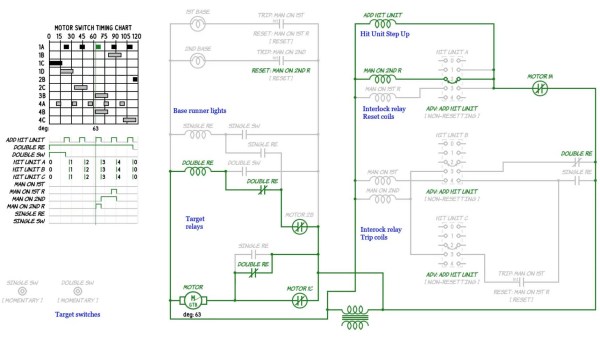
Restoring vintage technology can be a tricky business, especially without the appropriate schematics and documentation. To this end [Mark] has spent the past twelve months building a comprehensive schematic editor and circuit simulator library for electromechanical pinball machines.

Rather than explore each and every table in excruciating detail, the emSim software aims to examine how specific circuits work, and how they are used as part of the gaming experience. The aim of the project is to aid in the diagnosis and repair of vintage electromechanical pinball machines, the types that rely on a dizzying array of switches, gears, motors and coils in their operation, operating like clockwork underneath the play field. While these older pinball machines typically use alternating current, the game logic (for the most part) is still binary, and can be effectively described with Boolean operators.

Like any machine with moving parts, these systems will eventually wear down and require servicing, a task which may not be in the wheelhouse for your casual pinball enthusiast. [Mark]’s hope is that his circuit simulations will allow just about anyone to repair these classic tables, and keep them around for future generations to explore and enjoy.

If tinkering with pinball innards isn’t for you, then make sure to check out our coverage of this awesome virtual pinball table.

Low Cost Haptic VR Gloves Work With Hacked Steam Games

[Lucas VRTech] has made some significant progress with building force-feedback type haptic gloves for use with Steam VR games. The idea is pretty straightforward: the end of the finger is attached to a cable, which is pulled from inside a sprung-loaded spool; the kind used for hanging ID cards on.

The spool body can rotate, but a peg protruding from it engages with the arm of a co-located servo motor. This produces a programmable stop position. But it is a hard stop, and it is not possible with the current hardware to detect precisely when the stop is reached, nor is it possible to control the force it is pushing with. Such features are not difficult to achieve, its just a matter of a little more development with some custom mechatronics.

The current prototype has a focus on cost, which is great as an early development platform. By leveraging 3D printing and off-the-shelf parts that are easy to source; just a handful (chuckle!) of potentiometers, some servo motors and one from any number of ESP32 dev boards and you’re done. The real work is on the software side of things, as the games themselves need to be modified to play ball with the VR glove hardware. This has been achieved with a combination of a custom steam driver they call OpenGloves, and community developed per-game mods. A few titles are available to test right now, so this is definitely something some of us could build in a weekend and get involved with.

The hardware source for the glove mount and per-finger units can be found on the project GitHub, together with the ESP32 source for Arduino.

For some other haptic-related inspiration, here’s a force-feedback mouse, and for a more hand-off feedback, we have a wind-blaster project.

Continue reading “Low Cost Haptic VR Gloves Work With Hacked Steam Games”

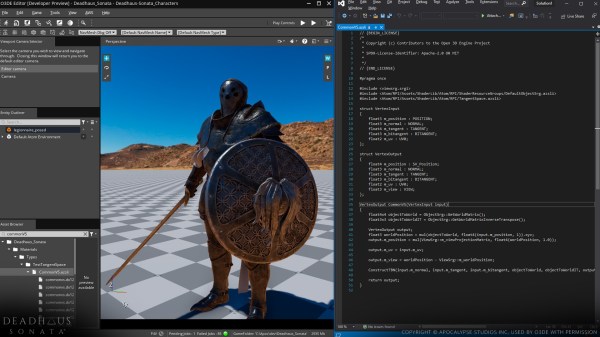
Open 3D Engine editor with Amazon Shader Language file and asset from the game Deadhaus Sonata open. (Credit: O3DE project)

Open 3D Engine: Amazon’s Old Clothes Or A Game Engine To Truly Get Excited About?

Recently Amazon announced that they would be open sourcing the 3D engine and related behind their Amazon Lumberyard game tooling effort. As Lumberyard is based on CryEngine 3.8  (~2015 vintage), this raises the question of whether this new open source engine – creatively named Open 3D Engine (O3DE) – is an open source version of a CryTek engine, and what this brings to those of us who like to tinker with 2D, 3D games and similar.

When reading through the marketing materials, one might be forgiven for thinking that O3DE is the best thing since sliced 3D bread, and is Amazon’s benevolent gift to the unwashed masses to free them from the chains imposed on them by proprietary engines like Unity and Unreal Engine. A closer look reveals however that O3DE is Lumberyard, but with many parts of Lumberyard replaced, including the renderer still in the process of being rewritten from the old CryEngine code.

What Makes a Good Game Engine?

My own game development attempts started with the Half Life engine and the Valve Hammer editor, as well as the Doom map editor. This meant that some expectations were set before encountering today’s game engines and their tools. The development experience with the Hammer editor in the late 1990s was pretty much WYSIWYG, and when I was just getting started with Unreal Engine 4 (UE4) a number of years back this was pretty much the same experience, making it relatively easy to hit the ground running. Continue reading “Open 3D Engine: Amazon’s Old Clothes Or A Game Engine To Truly Get Excited About?”

DE10-Lite Dev Board / Game Controller

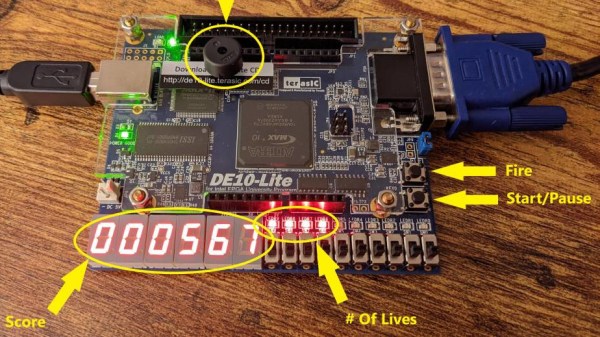
DE10-Lite-Ful FPGA Dev Board Hack Plays The 1981 Classic Defender

We’re not sure what the assignment was, but the results of [Garret Carter]’s homework for his Digital System Design class at Tennessee Tech couldn’t help but capture our attention. Below the break you can see what [Garrett] describes as a “simplified stylized version” of the 1981 arcade hit “Defender”.

With the goal of keeping the price low but keeping performance as high as possible, [Garrett] set forth to program the DE10-Lite FPGA development board in VHDL. The results are convincing, and while not perfect, came in under budget.

The DE10-Lite board gave [Garrett] the opportunity to get even more creative, using the dev board’s onboard switches, buttons, 7-segment LED’s and accelerometer to full effect. In this case, the dev board is not only the game, but also the controller and status display. A very neat hack indeed!

If you want to make your own, you can get the full project details at [Garrett]’s Github page. And [Garrett], we don’t know what marks your professor will give, but we give you an A+, would definitely play again.

While FPGA development boards aren’t necessarily inexpensive, our own Jenny List shows where you might be able to find a used but workable FPGA board for a fraction of the cost, If you know where to look.

Continue reading “DE10-Lite-Ful FPGA Dev Board Hack Plays The 1981 Classic Defender”

playing Super Hang-On with Paw Patroller

Playing Super Hang-On With Hacked Controller Gives Reason For Paws

There’s a thing that happens when you’re shopping at a second hand store. You know how it goes: You see an item that strikes your fancy, your mind immediately locks in, and the item just has to be yours. [Tom Tilley] experienced this when he saw a Paw Patrol kids toy at a local thrift store, and you can see the results of his holiday hacking sessions in the video below the break.

How did [Tom] put the Paw Patrol game to use? Looking like a motorcycle cockpit left him with few choices. Before long he’d flipped the game over over, pulled the innards, and hacked together what just might be the most perfect toy based interface we’ve seen lately.

Using a Raspberry Pi Pico controller and some careful surgery, [Tom] turned the Paw Patrol game into a controller for the 1987 Sega motorcycle race arcade game Super Hang-On. Watching [Tom] play is a blast, but just in case the whole thing is a losing prospect, it’s completely reversible as well!

Of course we were a little disappointed that Super Hang-On couldn’t make use of the paws button.

On the other end of the spectrum, here’s an actual car turned into a game controller. Got a hot controller hack to share? Be sure to let the Tip Line know!

Continue reading “Playing Super Hang-On With Hacked Controller Gives Reason For Paws”

Haptic Feedback “Rifle” Lets You Take Aim In VR

There was a time when virtual reality seemed like it would remain in the realm of science fiction at least for the foreseeable future. Then we were blessed with products like the Power Glove and Virtual Boy which seemed to make it more of a reality, if not a clunky and limited one. Now, though, virtual reality is taking more of a center stage as the technology for it improves and more and more games are released. We can see no greater proof of this than the fact that some gamers are building their own custom controllers to interact with the virtual world in more meaningful ways, like this game controller specifically built for first-person shooter games.

The controller is based on an airsoft gun but completely lacks the ability to fire a projectile, instead using the gun as a base for building the controller. In fact, the gun’s operation is effectively reversed in order to immerse the player into the game by using haptic feedback provided by pressurized air. The air is pumped in to what would be the front of the barrel and is discharged through the receiver when a trigger pull is detected in order to generate a recoil effect. The controller includes plenty of other features as well, including the ability to reload ammunition, change the firing mode, and track motion thanks to its pair of integrated Oculus controllers.

All of the parts for this controller are either 3D printed or readily available off-the-shelf, making this an ideal platform for customization and improvement. There’s also a demo game available from Unity which allows for a pretty easy setup for testing. While the controller looks like an excellent way to enjoy an FPS virtual reality experience, if you’re looking for a more general-purpose controller we are also starting to see a lot of development on that end as well.

Continue reading “Haptic Feedback “Rifle” Lets You Take Aim In VR”

Rat playing DOOM

Rats Learn To Play DOOM In This Automated VR Arena

When we run an article with “DOOM” in the title, it’s typically another example of getting the venerable game running on some minimalist platform. This DOOM-based VR rig for rats, though, is less about hacking DOOM, and more about hacking the rats.

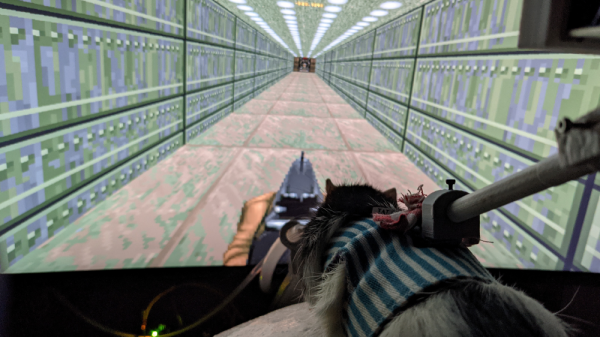
What started as a side project for [Viktor Tóth] has evolved into quite a complex apparatus. At the center of the rig is an omnidirectional treadmill comprised of a polystyrene ball about the size of a bowling ball. The ball is free to rotate, with sensors detecting rotation in two axes — it’s basically a big electromechanical mouse upside down. The rat rides at the top of the ball, wearing a harness to keep it from slipping off. A large curved monitor sits right in front of the rat to display the virtual environment, which is a custom DOOM map.

With the VR rig built, [Viktor] worked on automating the training. A treat dispenser provides the proper motivation, while powered drive wheels engage with the ball to nudge the rat if it gets stuck in the virtual world. [Viktor] says he has trained three rats — [Romero], [Carmack], and [Tom] — to walk down a straight hallway using this automated method. As for the meat of the game — shooting monsters — [Viktor] has that covered too, with a sensor that detects when a rat rears up on its hind legs to register a shot.

Total training time to get the rats to the point seen in the video was about six weeks, and [Viktor] reports the whole thing cost him about $2000. That’s a lot of time and money, but the results are pretty interesting. If you’re more interested in minimalist DOOM builds, we understand — check out DOOM on a lightbulb, or a thermostat, or even a GPS.

Continue reading “Rats Learn To Play DOOM In This Automated VR Arena”