Hackaday Links Column Banner

Hackaday Links: September 2, 2018

It’s (was, is?) the end of August, and that means the entire dreadlocked population of San Francisco is out in the middle of the Nevada Desert for a week. Yes, it’s Burning Man, and as always we have a host of builds that make you ask, ‘how did they do that, and how did they get that here’.

For the last few years, the greatest logistical feat of art cars is the 747. Yes, it’s the fuselage of a 747, turned into an art car. The top deck is a convertible. The biggest question surrounding this 747 is how do you transport this thing? You can’t fly it in (well, you could, once), it’s not going to fit on a train, and it’s extraordinarily long. Now we have an answer: they did it on a truck. The 747 was stationed in the Mojave, and from there it’s a relatively quick shot up Nevada to Black Rock City. Several power lines had to be raised, and you’re still looking at an enormous logistical endeavour.

I’m saying it now. Sphere, the 1998 movie with Dustin Hoffman. There’s a 25 meter diameter mirror ball that looks like the sphere in Sphere. It’s inflatable, so that takes care of the obvious questions, but we’re still asking how this thing looks in person, how massive wind storms are going to affect what is basically a gigantic sale sail, and what the reflections of the sun will actually do. I suppose being convex, you’re not going to get the accidental architectural parabolic mirror effect that melts cars, but one can always hope.

Want a neat story on the features of Burning Man that doesn’t get a lot of press? IEEE Spectrum did a feature on Black Rock City airport. For one week a year, it is the third busiest airport in Nevada, behind McCarren and Reno. It’s also a towered, yet uncontrolled airport. This makes no logical sense, but it’s something that can happen with FAA regs.

[alicestewwwart] has left us with a quandary. She’s creating highly artistic circuits out of ICs, discrete parts, and wire. These circuits are functional, but we don’t know what to call them. They’re not quite deadbug, because SMD parts don’t have legs, and ‘deadbug’ gets its name from upside down DIPs that looks like dead centipedes. It’s not Manhattan style, although this might be closer to Manhattan than deadbug. So what is it? Leave your answer in the comments.

Retrotechtacular: The Iron Giants That Built The Jet Age

In the closing months of World War II, the Axis and the Allies were throwing everything they had at each other. The tide was turning to the Allies’ favor, but the Germans were showing a surprising resilience, at least in terms of replacing downed fighter and bomber aircraft. When the Allies examined the wreckage of these planes, they discovered the disturbing truth: the planes contained large pieces forged from single billets of metal, which suggested a manufacturing capability none of the Allies possessed and which allowed the Germans to quickly and cheaply make better and faster planes.

When the war was over, the Allies went looking for the tools the Germans had used to make their planes, and found massive closed-die forging presses that could squeeze parts out of aluminum and magnesium alloys in a single step. The Soviets carted off a 30,000 ton machine, while the Americans went home with a shipload of smaller presses and the knowledge that the Russians had an edge over them. Thus began the Heavy Press Program, an ultimately successful attempt by the US military to close a huge gap in strategic manufacturing capabilities that [Machine Thinking] details in the excellent video below.

One doesn’t instantly equate monstrous machines such as the Mesta 50,000-ton press, over nine stories tall with half of it buried underground and attached directly to bedrock, with airplane manufacture. But without it and similar machines that came from the program, planes from the B-52 to the Boeing 747 would have been impossible to build. And this isn’t dead technology by any means; sold to Alcoa in 1982 after having been operated by them for decades, the “Fifty” recently got a $100 makeover after cracks appeared in some castings, and the press and its retro-brethren are still squeezing out parts for fighters as recent as the F-35.

Continue reading “Retrotechtacular: The Iron Giants That Built The Jet Age”

GSM Phone Network At EMF Camp Built On Raspberry Pi And LimeSDR

The Electromagnetic Field 2018 hacker camp in the UK will have its own GSM phone network, and as we have already covered its badge will be a fully-functional GSM phone. This is as far as we are aware a first in the world of badges, and though it may not be a first in hacker camp connectivity it is still no mean achievement at the base station side. To find out more we talked to two of the people behind the network, on the radio side Lime Microsystems‘ [Andrew Back], and on the network side Nexmo‘s developer advocate, [Sam Machin].

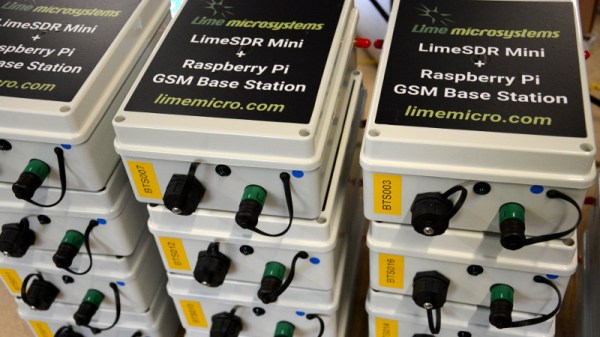
There are sixteen base stations spread around the site, of which each one is a Raspberry Pi 3 B+ with a LimeSDR Mini. Development of the system was undertaken prior to the release of the Raspberry Pi Foundation’s PoE board, so they take a separate 24V supply which powers the Pi through a DC-to-DC converter. This arrangement allows for a significant voltage drop should any long cable runs be required.

On the software side the base stations all run the Osmocom (Open Source Mobile Communications) cellular base station infrastructure package. It was a fine decision between the all-in-one Osmocom NITB package and the fully modular Osmocom, going for the former for its reliability. It was commented that this would not necessarily be the case at a future event but that it made sense in the present. It appears on the network as a SIP phone system, meaning that it can easily integrate with the existing DECT network. Let’s take a look at how the network operates from the user side, and the licencing loophole that makes everything possible.

Continue reading “GSM Phone Network At EMF Camp Built On Raspberry Pi And LimeSDR”

All The Badges Of DEF CON 26 (vol 3)

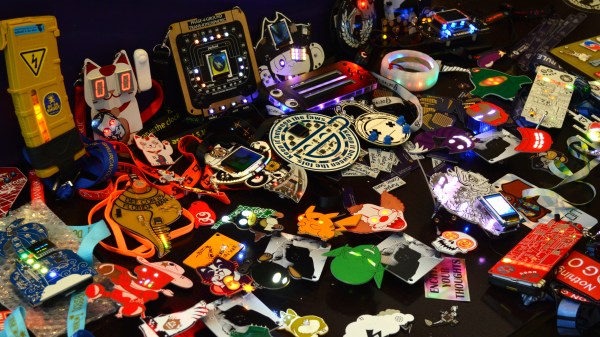
I tried my best to see every badge and speak with every badge maker at DEF CON 26. One thing’s for sure, seeing them all was absolutely impossible this year, but I came close. Check out the great badges shown off in volume 1 and in volume 2 of this series. The game is afoot, and if you are headed to a hacker conference there’s never been a better time to build your own hardware badge — whether you build 5 or 500!

All right, let’s look at the badges!

Continue reading “All The Badges Of DEF CON 26 (vol 3)”

Martian Dust Storm May Spell Doom For Rover

Everyone knows that space is an incredibly inhospitable place, but the surface of Mars isn’t a whole lot better. It’s a dim, cold, and dry world, with a wisp of an atmosphere that provides less than 1% of Earth’s barometric pressure. As the planet’s core no longer provides it with a magnetosphere, cosmic rays and intense solar flares bathe the surface in radiation. Human life on the surface without adequate environmental shielding is impossible, and as NASA’s fleet of rovers can attest, robotic visitors to the planet aren’t completely immune to the planet’s challenges.

Opportunity Mission Patch

As a planet-wide dust storm finally begins to settle, NASA is desperately trying to find out if the Red Planet has claimed yet another victim. The agency hasn’t heard from the Opportunity rover, which landed on Mars in 2004, since before the storm started on June 10th; and with each passing day the chances of reestablishing contact are diminished. While they haven’t completely given up hope, there’s no question this is the greatest threat the go-kart sized rover has faced in the nearly 15 years it has spent on the surface.

Opportunity was designed with several autonomous fail-safe systems that should have activated during the storm, protecting the rover as much as possible. But even with these systems in place, its twin Spirit succumbed to similar conditions in 2010. Will Opportunity make it through this latest challenge? Or has this global weather event brought the long-running mission to a dramatic close?

Continue reading “Martian Dust Storm May Spell Doom For Rover”

Let The Musical Instrument Challenge Begin!

Today is the start of the Musical Instrument Challenge. This newest part of the 2018 Hackaday Prize asks you to go far beyond what we’re used to seeing from modern musical instrumentation. Twenty entries will be awarded $1,000 each and go on to compete in the final round of the Hackaday Prize.

Imagine music without the electric guitar amp, violin, two turntables and a microphone, the electric drum pad, or in the absence of autotune. Maybe that last one made you groan, but autotune is a clever use of audio manipulation and when used to augment the music (rather than just to correct off-key voices) it shows its value as a new tool for creativity.

Musicians have always been hackers. The story of Brian May’s handmade guitar — the Red Special — is one of not being able to buy it, so he built it. Unlocking emotion in the listener has always meant finding new and different ways to use sound. This is a natural motivator to re-imagine and invent new ways of doing that. That first hand-built guitar got him in the door, but iterative improvements to the tremolo bar, the pickups, and even just the mechanical engineering of the neck made it a new instrument that you’ve heard in every Queen performance since.

So what’s next? What does a brand new instrument, interface, tool, or trick look like? That’s what we want to see from this Hackaday Prize challenge. From instrument makers to the people who write software for sampling, synthesizing, sequencing, and manipulating sound, we’re looking for things that let others make music. These creations are the tools of the trade that help more people unlock their musical creativity. Show off your work by sharing all the details of your design, and demonstrate the music you can make with it.

You have until October 8th to put your entry up on Hackaday.io. The top twenty entries will each get $1,000 and go on to the finals where cash prizes of $50,000, $20,000, $15,000, $10,000, and $5,000 await.

FOSSCON 2018: Hacking The Indego Bike Sharing API

It’s often said that necessity of the mother of invention, but as a large portion of the projects we cover here at Hackaday can attest, curiosity has to at least be its step-mother. Not every project starts with a need, sometimes it’s just about understanding how something works. That desire we’ve all felt from time to time, when we’ve looked at some obscure piece of hardware or technology and decided that the world would be a slightly better place if we cracked it open and looked at what spilled out.

That’s precisely the feeling Eric O’Callaghan had when he looked out the window of his Philadelphia apartment a few years back and saw something unusual. Seemingly overnight, they had built an automated Indego bike sharing station right across the street. Seeing the row of light blue bicycles sitting in their electronic docks, he wondered how the system worked, and what kind of data they might be collecting. He didn’t need to rent a bike, he hadn’t even ridden one in years, but he suddenly had a strong urge to go across the street and learn as much as he could about this system.

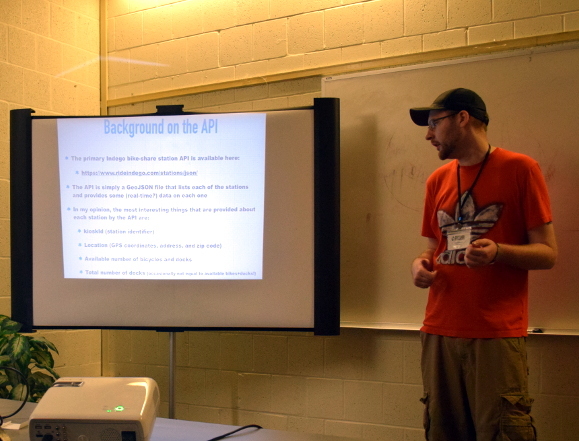
He recently presented those findings during FOSSCON 2018 at the International House in Philadelphia, in the hopes that others might be interested in getting involved. Currently Eric is one of the only people who’s investigating the public data Indego offers, and as his personal MySQL database has now surpassed 15 million rows of data, he’s hoping to get some developers with big data experience into the fray. His approach to making this data useful is an interesting one which I’ll dive into after the break.

Continue reading “FOSSCON 2018: Hacking The Indego Bike Sharing API”